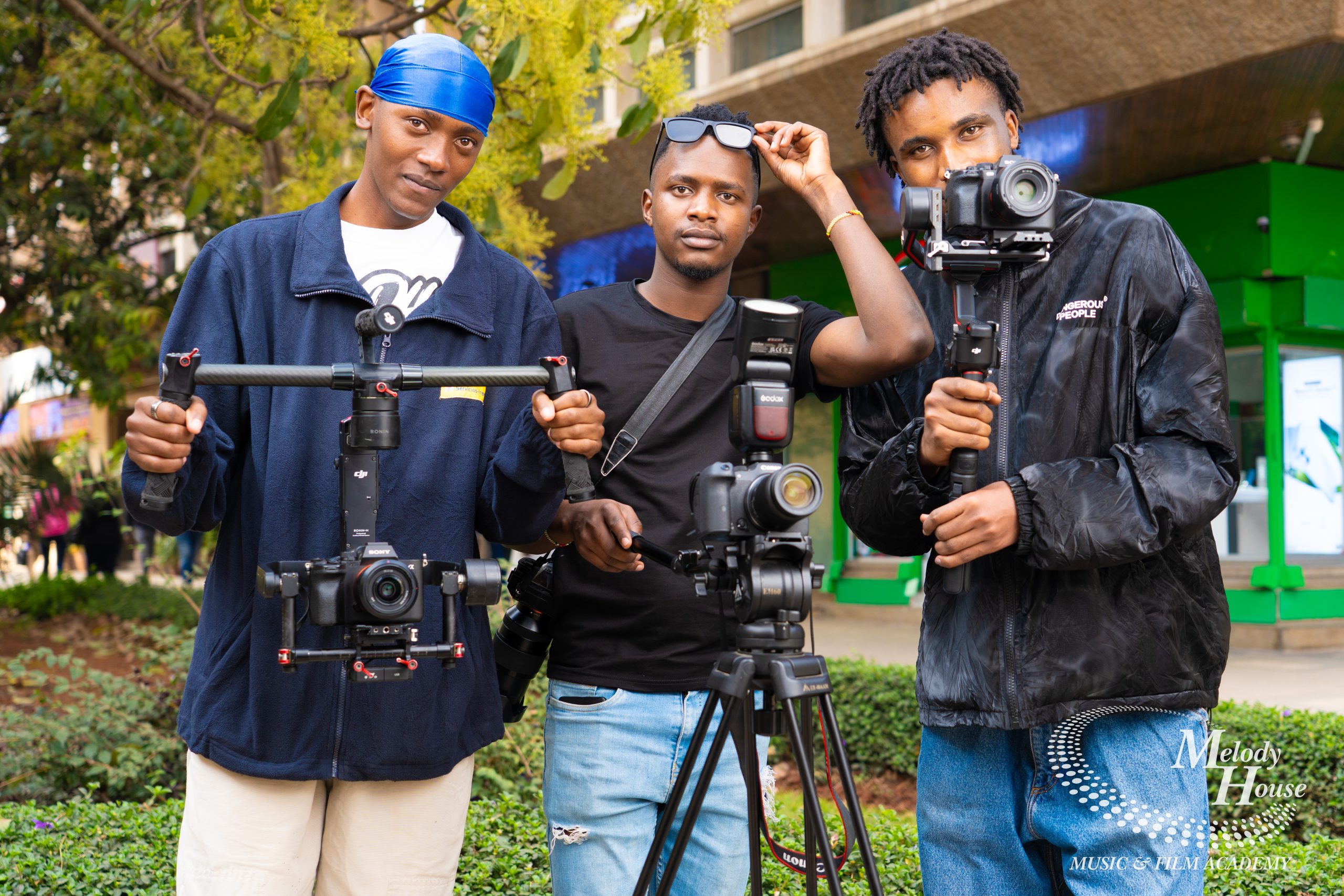
Hands-on practical training with professional cinema cameras and motorized 3-axis electronic gimbals in Nairobi.
Advanced Certificate in Videography
Are you ready to transcend basic camera operations and step into the role of a visionary director of photography, technical director, or post-production mastermind? The Advanced Certificate in Videography at the Music and Film Academy is an elite, high-tier masterclass engineered specifically to transition experienced camera operators, filmmakers, and media professionals into elite industry leaders. Operating from our state-of-the-art media labs at Information House, Nairobi CBD, this curriculum moves completely past the basic mechanics of capturing images, focusing heavily on the “Art of Cinematic Storytelling.”
Entering today’s premium commercial, corporate, and NGO media markets requires a refined command over specialized technical systems rather than automated compromises. Earning an Advanced Certificate in Videography establishes your professional authority, proving your ability to handle complex multi-camera live broadcast arrays, low-key dramatic lighting designs, and advanced node-based color pipelines. Training occurs under an uncompromising professional framework, utilizing high-end cinema camera systems, motorized stabilizers, and industry-standard post-production software to ensure you are fully prepared to spearhead high-value contracts across East Africa and beyond.
In the commercial film and television sectors, premium clients pay for visual intentionality, predictability, and a highly polished look. A great filmmaker doesn’t just record a scene; they actively sculpt the mood using motivated camera physics and complex light-shaping tools.
Choosing this intensive masterclass track collapses your development curve by plunging you into specialized workflows that cannot be picked up through trial and error. If you are still mastering manual exposure engineering, basic audio signal flows, or elementary timeline structures, we highly recommend reviewing our foundational training tracks first. You can easily compare our entry-level classes, multi-disciplinary short workshops, and professional trajectories by visiting our main category directory for videography courses in kenya.
📊 Program Overview & Fee Structure
This professional masterclass balances advanced aesthetic theories with rigorous practical studio hours, optimizing you for the demands of modern live broadcast and cinematic sets.
Parameter
Specification
Course Duration
2–3 Months (Intensive Professional Masterclass)
Tuition Fees
KES 39,000 (Total Course Tuition)
Registration Fees
KES 2,000 (One-time institutional fee)
Study Mode & Timing
Part-Time with Highly Flexible Timing Structures
Core Systems & Software
Cinema Camera Arrays, Motorized Gimbals, ATEM Switchers, DaVinci Resolve Studio
Campus Location
Information House, Nairobi CBD, Kenya
💡 Explore Your Training Options: Not sure if your current portfolio matches the technical pacing of our advanced track? You can browse our entry-level certificates, basic video editing options, and creative media tracks on our main videography courses in Kenya hub page.
📋 Course Eligibility & Technical Prerequisites
To maintain the high-octane pacing of this professional track, all applicants must satisfy the following baseline entry pathways prior to enrollment:
Technical Prerequisite Pathways (Must meet at least ONE):
Academic Advancement Route: Successful completion and formal graduation from our basic media program.
Prior Experience Route: Verifiable field experience working as a camera operator or video editor. Applicants selecting this route must submit a digital portfolio or showreel of at least 3 distinct video projects demonstrating a flawless command over manual exposure physics, clean audio acquisition, and non-linear editing workspaces.
Intermediate Digital Literacy & Software Access: A firm, foundational understanding of standard editing timelines and workspace interfaces is mandatory. The advanced track does not cover basic tool selection and immediately begins with advanced workflows, including node-based color grading and timecode jam synchronization.
Technical Intake Interview: All prospective candidates must sit for a practical consultation with the faculty of the School of Visual Arts. This review evaluates the applicant’s entry portfolio or showreel to ensure their technical foundation matches the curriculum.
🗺️ Detailed Advanced Curriculum Structure
Module 6: Motivated Camera Movement & Advanced Optics Systems
Hands-on practical training with professional cinema cameras and motorized 3-axis electronic gimbals in Nairobi.
This module transitions students from static framing into the complex world of kinetic visual energy, exploring how moving the camera affects the psychological state of an audience.
The Physics of Kinetic Emotion: Implementing deliberate camera movements to enhance the visual narrative. You will execute purposeful push-ins to emphasize character realizations, slow tracking pull-backs to underscore isolation, and controlled pan-and-tilt movements to reveal key narrative details.
Motorized Stabilization Masterclass: Configuring, balancing, and calibrating high-payload, motorized 3-axis electronic gimbals. Students master fluid “ninja-walk” tracking techniques, manage multi-axis motorized sliders, and program automated motion paths for complex commercial tracking.
Parallax Motion Dynamics: Exploiting dynamic tracking movements to move foreground elements against deep background spaces, creating a clear sense of three-dimensional depth, visual separation, and cinematic scale inside the lens frame.
Module 7: Cinematic Lighting, Log Formats & Color Correction Panels
Students step past basic 3-point illumination to explore the dramatic rules of contrast ratios and master high-end node-based digital color pipelines.
Chiaroscuro & Low-Key Lighting Architecture: Constructing high-contrast dramatic lighting ratios. Students use flag modifiers, c-stands, nets, and cutters to shape crisp lines, control dramatic spill light, and sculpt shapes inside moody commercial or cinematic environments.
Practical Lighting Integration: Repurposing on-set ambient fixtures (such as local neon elements, practical lamps, and architectural LEDs) as primary key sources, reinforcing them with hidden professional studio fixtures to maintain a completely natural look.
LOG/RAW Gamma Curve Grading: Maximizing dynamic range and shadow detail by shooting flat color profiles (such as S-Log3, V-Log, and REDCODE RAW). Utilizing advanced Expose to the Right (ETTR) data tracking to capture pristine sensor readouts without clipping highlight channels.
Targeted Node-Based Digital Grading: Navigating the color page of DaVinci Resolve Studio. Students deploy power windows, qualifiers, HSL curves, and 3D LUT conversions to isolate and manipulate specific color palettes, ensuring broadcast-compliant skin tones and commercial product color accuracy.
Module 8: Continuity Architecture & Russian Montage Theory
This section dissects the grammar of editing, exploring how structural juxtaposition and spatial rules construct a coherent visual universe.
Axis of Action Guidelines: Executing, maintaining, and strategically breaking the iconic 180-Degree Rule to deliberately construct spatial continuity or trigger intense emotional disorientation and psychological tension within a narrative scene.
The Kuleshov Effect Engine: Structuring sequence arrangements based on classic Russian montage theory to generate secondary cognitive meaning and deep psychological subtext inside the viewer’s mind through the juxtaposition of separate frames.
Continuity Management Protocols: Tracking visual continuity metrics across multiple takes. Students learn professional script tracking, screen direction rules, wardrobe placement monitoring, prop positioning, and maintaining lighting consistency across multi-day shoots.
Module 9: Drone Cinematography & Aerial Media Operations
Students take to the sky, combining technical flight mechanics with strict regulatory compliance to capture sweeping, professional aerial assets.
Aviation Framework Compliance: Navigating the legal parameters established by the Kenya Civil Aviation Authority (KCAA) for unmanned aerial vehicles (UAVs). Students study Remote Pilot License (RPL) restrictions, air traffic communication protocols, weight classifications, and strict No-Fly zone logistics.
Aerial Motion Execution: Advanced field mastery over coordinated multi-axis flight maneuvers, including complex circular orbits, bird’s-eye tracking vectors, low-altitude reveal flights, and dynamic drone parallax moves.
Operational Emergency Systems: Building strict pre-flight checklist disciplines, monitoring real-time battery voltage safety limits, and managing radio frequency signal interference mitigation protocols to protect expensive production hardware.
Module 10: Multi-Camera Broadcast & Live Production Switching
This module tackles the rapid world of live event streaming, multi-cam broadcast environments, and real-time signal engineering.
Hardware Switcher Arrays: Executing real-time live mixing, multi-source signal routing, chroma-keying, and upstream/downstream key configurations utilizing Blackmagic ATEM hardware switchers and professional vMix software engines.
Timecode Jam Synchronization: Deploying master hardware Timecode Generators to embed identical, frame-accurate timecode metadata across all independent camera sensors and audio recorders for rapid multi-cam timeline alignment in post-production.
Live Color Alignment: Calibrating and balancing multiple camera lenses simultaneously. Embedding custom Look-Up Tables (LUTs) in-camera to achieve uniform white balance and matching contrast profiles across different camera sensors in live broadcast setups.
Module 11: Production Management, Script Logistics & Business Law
Great imagery means nothing without ironclad organization and bulletproof legal structures to monetize your creative intellectual property.
Pre-Visualization Systems: Constructing professional director shot lists, overhead blocking maps, and detailed storyboards. Students learn to build bulletproof shooting schedules, production talent call sheets, and gear check-lists.
Commercial Asset Protections: Formulating legally binding talent releases, location permits, and music synchronization licenses. Registering creative intellectual property assets under the strict guidelines of the Kenya Copyright Board (KECOBO) to protect long-term digital royalty streams.
Talent Direction Shorthand: Developing professional communication protocols to guide actors, corporate clients, and non-professional talent to evoke genuine, unforced on-camera performances under tight scheduling pressures.
The final structural module explores the sonic environment of cinema, treating spatial sound and post-production audio mastering as critical components of the viewing experience.
Atmospheric Texturing: Layering sub-audible ambient fields, custom room tones, and environmental acoustics to establish a realistic sonic “sense of place” across different scenes.
Foley Artistry Production: Recording custom physical audio layers (such as footsteps, fabric textures, and object handling) within an acoustic studio environment to build physical realism.
Loudness Maximization Metrics: Mixing and mastering final stereo and multi-track audio stems to hit strict global streaming and television broadcast compliance limits (EBU R128 and ATSC A/85 LUFS standards).
💼 Career Paths & Industry Opportunities
Graduating with an Advanced Certificate in Videography positions you at the highest tier of the regional media sector, unlocking immediate access to high-value roles across television, commercial advertising, corporate media, and international documentary production:
1. Director of Photography (DP / Cinematographer)
The Role: Commanding the entire visual identity of a film, commercial campaign, or high-end music video. You will design lighting architectures, select camera packages, determine camera movement mechanics, and manage the technical camera and grip crew on set.
Primary Industries: Film production companies, premium commercial advertising agencies, and corporate media houses.
2. Professional Colorist (DaVinci Resolve Specialist)
The Role: Serving as a specialized post-production visual engineer. Using your advanced knowledge of LOG/RAW gamma curves and node-based grading, you will correct exposure discrepancies, execute localized color selections, and craft unique creative visual styles for premium brands and cinema releases.
Primary Industries: High-end post-production houses, boutique media agencies, and international remote freelancing networks.
3. Multi-Camera Broadcast Technical Director
The Role: Directing complex, live broadcast operations, such as high-profile political debates, multi-camera live sports, major corporate conferences, or international music festivals. You will configure hardware switchers, align multi-lens white balance profiles, and manage live streaming signal arrays.
Primary Industries: Television broadcast networks, live streaming production agencies, and large corporate public relations departments.
4. Drone Cinematographer & Aerial Specialist
The Role: Executing high-difficulty, multi-axis coordinated aerial tracking shots for real estate conglomerates, tourism boards, and cinematic film productions while working strictly within national aviation laws.
Primary Industries: Commercial real estate marketing, documentary production houses, and environmental research groups.
5. Senior Video Editor & Post-Production Specialist
The Role: Leading the creative assembly of long-form and short-form video projects. You will manage complex proxy ingestion pipelines, execute advanced continuity structures, manage timecode jam alignments, and master multi-track immersive audio designs for commercial delivery.
Primary Industries: Creative media agencies, documentary production houses, and independent digital entertainment networks.
🎓 The Capstone Graduation Film: The Master Portfolio Short
To qualify for your Advanced Certificate in Videography, every candidate must independently produce, execute, and defend a high-production-value short film, premium music video, or commercial documentary before an academic review board and visiting industry guests.
Pre-Production Phase: Formulation of a production-ready shooting script, a complete visual storyboard layout, comprehensive overhead lighting maps, and equipment scheduling sheets.
On-Set Execution: Directing and managing a live physical film set, serving as the primary Director of Photography (DP) under a strict 1-to-1 crew framework.
Post-Production Phase: Managing fine cuts, multi-track audio sound design, node-based color grading, and technical submission to the academic evaluation board for formal review.
❓ Frequently Asked Questions
What exact software and camera platforms will I master during this advanced track?
This course provides immersive training with professional cinema camera systems and advanced production gear. For post-production, we focus heavily on the advanced architecture of DaVinci Resolve Studio for color grading, audio layout, and multi-cam sync timelines.
What is the difference between this course and the basic certificate?
The basic track focuses purely on the fundamentals of manual camera operations, exposure parameters, and basic video editing loops. The Advanced Certificate in Videography steps completely past basic tool handling to master cinematic lighting design, motorized stabilizers, timecode workflows, drone operations, live multi-camera broadcast setups, and complex color grading paths.
Do I receive assistance with building a commercial showreel?
Yes. Your entire training is geared toward asset generation. Your final capstone project—the professional graduation short film—serves as a high-production-value anchor piece for your professional commercial showreel, ready to pitch to premium corporate and agency clients.