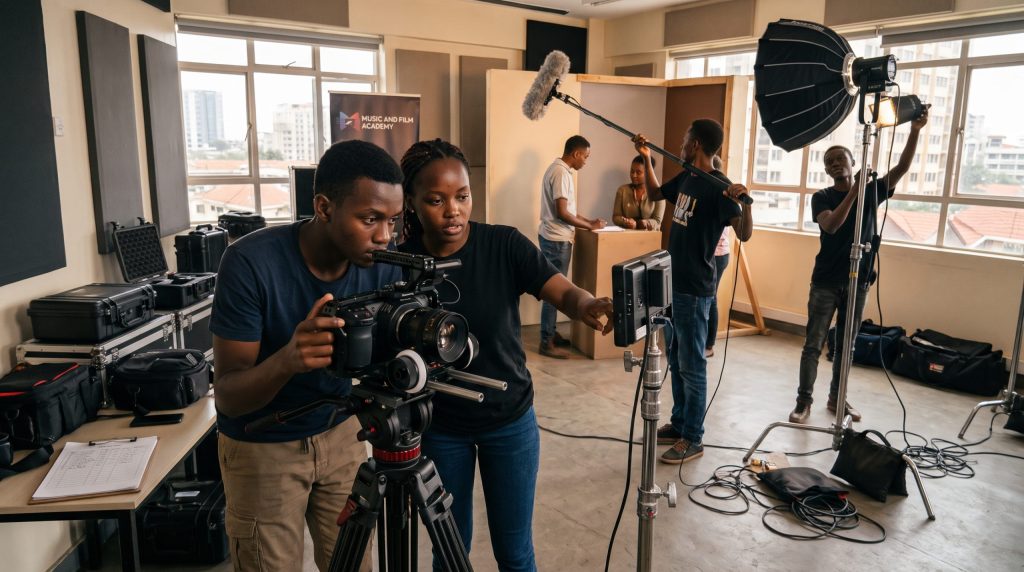
Hands-on studio lighting and camera practice at the Music and Film Academy, Nairobi.
Film Production Courses in Kenya | Best Film School in Nairobi
The best film production courses in Kenya are offered at Music and Film Academy in Nairobi CBD, led by the TVETA-licensed Diploma in Film Production (KES 39,000 per term across 8 terms / 2 years, requiring a KCSE Mean Grade of C- [Minus] or prior film certificate, plus a one-time KES 2,000 registration fee). This flagship program delivers advanced mastery in digital cinema camera operation (Blackmagic Design, Sony FX series), anamorphic and prime glass optics, DaVinci Resolve Studio color grading, 3-axis gimbal and dolly motion tracking, and guaranteed media house internships. For students seeking technical foundation pathways, the Academy provides the 1-year Certificate in Film Production (KES 39,000 per term or KES 13,000/Mo across 4 terms, requiring a KCSE Mean Grade of D [Plain]) with production agency attachment support. For candidates requiring shorter, accelerated tracks, the Academy offers a 3-month Videography Short Course (KES 39,000 total or KES 13,000/Mo, Open Enrollment / No minimum KCSE grade required) targeting camera operators, social media creators, and event videographers. Operating as one of the premier film schools in Nairobi and across Kenya, all practical training takes place under a strict 1:1 student-to-camera ratio at Information House on Hakati Road.
1. Comprehensive Film Production Comparison Matrix (2026 Rates)
Evaluating film schools in Nairobi and Kenya requires analyzing physical cinema camera access, post-production render infrastructure, official accreditation, entry grades, and real-world placement guarantees. Music and Film Academy maintains transparent payment schedules formatted as total or per-term tuition alongside flexible monthly installments:
Feature / Detail
Diploma in Film Production
Certificate in Film Production
Videography Short Course (Shorter Option)
Official Course Title
Diploma in Film Production
Certificate in Film Production
Videography Short Course
Duration & Terms
8 Terms (2 Years)
4 Terms (1 Year)
1 Term (3 Months)
Registration Fee
KES 2,000 One-Time Fee
KES 2,000 One-Time Fee
KES 2,000 One-Time Fee
Tuition & Payment Terms
KES 39,000 per Term (KES 13,000/Mo)
KES 39,000 per Term (KES 13,000/Mo)
KES 39,000 Total (KES 13,000/Mo)
Accreditation & Awarding Body
TVETA Licensed | Pearson BTEC Certified
TVETA Licensed Only
TVETA Licensed Only
Academic Entry Requirement
KCSE Grade C- (Minus) or prior Film Cert
KCSE Grade D (Plain)
Open Enrollment (No Minimum Grade)
Target Industry Roles
Director of Photography (DoP), Film Director, Colorist, Showrunner
Camera Operator, Assistant Editor, Gaffer, Location Sound Tech
Event Videographer, Camera Assistant (2nd AC), Content Creator
Camera Systems & Optics
Full Cinema Packages (Blackmagic 6K/G2, Anamorphic & Prime Glass)
4K Cinema Rigs (Sony FX3/FX6, Blackmagic 6K)
Mirrorless & Digital Video Rig Baselines
Lighting & Grip Infrastructure
HMIs, High-Output LED Panels, Dollies, Jib Arms, Color Meters
Heavy C-Stands, Softboxes, Modifiers, Motorized Gimbals
COB Spotlights, 3-Point Continuous LED Arrays
Location Audio Hardware
Dual-System Boom Recorders, Wireless RF Systems & Foley Setup
Multi-Track Field Recorders & Directional Shotguns
Field Microphones & Wireless Lavalier Transmitters
Editing & Color Software
DaVinci Resolve Studio (Color Grading) & After Effects VFX
Adobe Premiere Pro & After Effects (Motion Graphics)
Adobe Premiere Pro (Non-Linear Cuts)
Internship & Placement
Guaranteed Term 8 Media House & TV Network Internship
Commercial Studio Attachment Placement
Production Agency Attachment Support
2. 6 Core Criteria for Choosing the Best Film School in Kenya & Nairobi (Why MFA Leads)
To avoid theoretical lecture halls and crowded group observe-only sessions, ensure your chosen film production course meets these six non-negotiable operational standards:
A. Guaranteed 1:1 Student-to-Camera Ratio
No student masters frame geometry, manual focus pulling, or dynamic lighting setup by watching someone else operate a camera. We guarantee direct, solo handling of dedicated cinema camera packages during every set call and practical shooting lab.
B. Dual-Pipeline Mastery (On-Set Cinema & Post-Production Color Science)
The modern film industry demands technical agility across both production and post-production. Our curriculum builds complete proficiency in operating digital cinema cameras on set (Blackmagic Design 6K, Sony FX series) and executing professional non-linear cuts, motion graphics, and node-based color grading in Adobe Premiere Pro, After Effects, and DaVinci Resolve Studio.
C. Advanced Location Audio & Spatial Sound Architecture
Visuals account for only half of the cinematic experience. Our film school integrates hands-on location sound engineering—training you on directional shotgun boom operation, multi-channel field recorders, wireless lavalier RF management, dialogue cleanup, and atmospheric Foley layering.
D. Cinematic Lighting & Heavy Grip Engineering
Moving beyond simple video recording requires manipulating light and physical camera movement. Students engineer high-impact 3-point lighting setups, handle high-power LED COB spotlights, calculate light falloff using the Inverse Square Law, and master smooth camera tracking using electronic 3-axis gimbals, fluid heads, and tracking dollies.
E. Industrial Attachment & Media House Internship Support
Graduating with a technical film qualification is only meaningful if it leads to employment. We provide direct commercial production agency attachment placement for short course and certificate students, alongside guaranteed Term 8 internships with leading TV networks and media houses for diploma graduates.
F. TVETA Licensing, Pearson BTEC & Nairobi CBD Campus Location
Choosing a TVETA-licensed institution guarantees that your credentials conform to national technical education standards, while Pearson BTEC offers global accreditation accepted in over 70 countries. Situated on the 5th Floor of Information House on Hakati Road in Nairobi CBD, our campus offers immediate access to major broadcast networks, commercial production houses, and creative hubs.
Hands-on film production training: Students operating digital cinema camera rigs, boom microphones, and studio lighting setups at Music and Film Academy in Nairobi CBD.
3. Dedicated Camera Locker & Studio Hardware Inventory
Our Nairobi CBD campus houses industry-standard production hardware, fully available to students under our 1:1 equipment policy without extra rental charges:
Cinematic Optics: Cine Prime Lenses (S35 & Full Frame), Anamorphic Glass, Cinema Zooms, Variable ND Filters, and Follow Focus Units.
Studio & Location Lighting: High-Output COB LED Spotlights (Aputure/Godox), Continuous LED Soft Panels, RGB Color Accent Tubes, Fresnel Lenses, Softboxes, and Diffusion Grids.
Field Audio Recorders & Mics: Multi-Track Field Recorders (Zoom/Tascam), Directional Shotgun Boom Microphones, Wireless Lavalier Systems, Windshields (Blimps/Deadcats), and Field Headphones.
Post-Production Render Suites: High-Performance Render Terminals running licensed Adobe Creative Cloud (Premiere Pro, After Effects, Photoshop) and DaVinci Resolve Studio color grading consoles.
4. Detailed Breakdown of Film Program Tracks
Diploma in Film Production & Cinematic Arts (2 Years / 8 Terms)
Accreditation: TVETA Licensed & Pearson BTEC International Certified (KCSE Mean Grade C- or prior Film Certificate).
Target Roles: Director of Photography (DoP), Film & TV Director, Senior Colorist, VFX Compositor, Executive Line Producer, Showrunner.
Core Skills Mastered:
Year 1 (Terms 1–4): Complete technical mastery across camera, lighting, audio, and non-linear editing pipelines.
Term 5 (Advanced Cinematography & Grip): RAW recording formats (Blackmagic RAW, ProRes RAW), Inverse Square Law light calculations, HMI fixtures, tracking dollies, jib arms, and DCI-P3 color space calibration.
Term 7 (DaVinci Resolve Masterclass & VFX): XML timeline conforming, secondary color isolation (qualifiers and tracking windows), green screen keying, rotoscoping, camera tracking, and surround sound design.
Term 8 (Thesis Short Film & Media House Internship): Directing and producing a 10-to-15 minute narrative thesis film, line producing, and completing a guaranteed 6-week media house or TV network internship.
Investment:KES 39,000 per term (payable in KES 13,000 monthly installments) + KES 2,000 registration fee. Includes guaranteed Term 8 media house internships.
Certificate in Film Production (1 Year / 4 Terms)
Accreditation:TVETA Licensed Only (KCSE Mean Grade D Plain Required).
Target Roles: Commercial Camera Operator, Corporate Videographer, Gaffer, Location Sound Recordist, Non-Linear Video Editor.
Term 2 (Camera, Optics & Lighting): Full-frame vs Super 35 sensors, Log color profiles, prime vs zoom lenses, COB LED fixtures, optical diffusion, and 3-axis motorized gimbal balancing.
Term 3 (Field Audio & Assembly Editing): Multi-track field audio recorders, directional shotgun boom rigging, proxy editing workflows, multi-camera sync clips, and motion graphics in After Effects.
Term 4 (Color Grading & Capstone Short): Reading video scopes, LUT implementation in DaVinci Resolve, dialogue noise gating, and shooting a 60-second commercial or music video capstone project.
Investment:KES 39,000 per term (payable in KES 13,000 monthly installments) + KES 2,000 registration fee. Includes commercial studio attachment support.
Videography Short Course (Shorter 3-Month Option) — 3 Months / 1 Term
Accreditation:TVETA Licensed Only (No Minimum KCSE Grade Required / Open Enrollment).
Target Roles: Event Videographer, Social Media Content Creator, Junior Camera Assistant (2nd AC), Corporate Video Editor.
Core Skills Mastered: Camera anatomy, exposure triangle in motion (shutter angle 180-degree rule, cinema ISO, T-stops vs f-stops), framing geometry (rule of thirds, leading lines, 180-degree line continuity), 3-point LED lighting, wireless lavalier miking, and non-linear video editing in Adobe Premiere Pro.
Investment:KES 39,000 total tuition (payable in KES 13,000 monthly installments) + KES 2,000 registration fee. Includes agency attachment support.
5. Graduate Career Opportunities & Expected Earnings in Kenya (2026)
Graduating with practical cinema camera mastery and post-production expertise opens direct, high-value revenue streams across East Africa’s broadcast networks, streaming platforms, advertising agencies, and commercial film sectors:
Director of Photography (DoP) / Cinematographer:KES 30,000 – KES 100,000+ per shoot day (Operating digital cinema packages, managing lighting crews, and designing visual aesthetics for TV commercials, brand films, and features).
Film & TV Director / Showrunner:KES 80,000 – KES 250,000+ per project / TV season (Leading creative vision, actor blocking, script execution, and set management for broadcast series and streaming originals).
Senior Video Editor & Colorist:KES 50,000 – KES 180,000 per project / monthly retainer (Executing multi-cam edits, DaVinci Resolve color grading, LUT creation, and final master exports for commercial broadcast).
Commercial Videographer & Corporate Filmmaker:KES 40,000 – KES 120,000 per brand video (End-to-end production of corporate documentaries, product launches, and brand stories for corporate clients).
Location Sound Recordist & Boom Operator:KES 20,000 – KES 60,000 per shoot day (Capturing multi-channel location dialogue, managing wireless lavaliers, and handling field audio gear on active film sets).
Camera Assistant (1st/2nd AC) & Gaffer / Key Grip:KES 15,000 – KES 45,000 per shoot day (Focus pulling, camera rigging, data wrangling, C-stand mounting, and lighting execution).
6. Choosing the Right Track by Career Goal
Selecting the ideal training path depends on your career objectives, timeline, and current qualifications:
For Feature Directors, DoPs, Senior Colorists & Showrunners: Choose the Pearson BTEC Diploma in Film Production (2 Years / 8 Terms @ KES 39,000/term / KES 13,000/Mo) for international qualification, RAW cinema packages, DaVinci Resolve color science, thesis film production, and guaranteed Term 8 media house internships (KCSE Grade C- / Prior Film Cert Required).
For Commercial Videographers, Gaffers & Corporate Video Leads: Choose the Certificate in Film Production (1 Year / 4 Terms @ KES 39,000/term / KES 13,000/Mo) for comprehensive training across screenwriting, multi-point lighting, field audio, motion graphics, and color grading (KCSE Grade D Plain Required).
For Shorter 3-Month Entry, Videographers & Content Creators: Choose the 3-Month Videography Short Course (KES 39,000 total / KES 13,000/Mo) to master camera exposure, framing, 3-point lighting, and Premiere Pro editing in an accelerated timeframe (No Minimum KCSE Grade Required).
7. Compare Out-of-Class Value: Music and Film Academy vs. Alternatives
Beyond the syllabus, evaluate the operational facilities and equipment access provided by prospective institutions:
Feature & Facility
Music and Film Academy (Nairobi CBD)
Standard Film Schools in Kenya / Competitors
Student-to-Gear Ratio
Guaranteed 1:1 direct camera access during all practical labs
Group learning (6–10 students sharing 1 camera)
Camera Hardware Rigs
Digital Cinema Packages (Blackmagic 6K, Sony FX series)
Entry-level consumer DSLRs or mobile phones
Post-Production Terminals
High-Performance editing suites with DaVinci Resolve & Premiere
Shared, low-spec computer labs with basic software
Industry Accreditation
International Pearson BTEC & TVETA Licensed
Unaccredited or internal-only certificates
Industry Attachment
Dedicated agency attachment & guaranteed Term 8 internships
No formal placement assistance; student-dependent searches
Campus Location
Nairobi CBD (Information House, Hakati Road)
Out-of-town locations far from major media networks
8. Flexible Class Shifts & 2026 Intake Schedule
To accommodate working media professionals, corporate staff, and full-time students, practical film labs at our Nairobi CBD campus operate on a flexible 3-days-per-week schedule, allowing students to select their preferred shift and class days:
Weekday Shifts (Choose 3 Days per Week):
Morning Shift: 8:30 AM – 11:30 AM
Afternoon Shift: 2:00 PM – 5:00 PM
Evening Shift: 5:30 PM – 7:30 PM
Saturday Block Sessions (Weekend Option):
First Block: 10:30 AM – 12:30 PM
Second Block: 12:30 PM – 2:30 PM
2026 Intake Schedule: Continuous monthly intakes for both the 3-Month Videography Short Course and the TVETA Certificate in Film Production; major January, May, and September intakes for the Pearson BTEC Diploma track.
9. Frequently Asked Questions (FAQ)
How much do film production courses cost in Kenya?
At Music and Film Academy in Nairobi CBD, the 3-month Videography Short Course costs KES 39,000 total tuition (payable in KES 13,000/Mo installments). The 1-year Certificate in Film Production is KES 39,000 per term (KES 13,000/Mo across 4 terms), and the 2-year Diploma in Film Production is KES 39,000 per term (KES 13,000/Mo across 8 terms). A standard one-time KES 2,000 registration fee applies upon initial admission.
What are the KCSE requirements to study film production in Kenya?
Academic entry requirements vary by program level:
3-Month Videography Short Course:Open Enrollment / No Minimum KCSE Grade Required.
Certificate in Film Production (1 Year / 4 Terms):KCSE Mean Grade D (Plain).
Diploma in Film Production (2 Years / 8 Terms):KCSE Mean Grade C- (Minus) or a prior visual arts certificate.
How many years is a film production course in Kenya?
Course duration depends on the award level:
3-Month Videography Short Course: 1 Term (12 Weeks) focused on fast-track camera work and editing.
Certificate in Film Production: 1 Year (4 Terms) covering full pre-production, lighting, field audio, and non-linear editing.
Diploma in Film Production: 2 Years (8 Terms) covering advanced narrative directing, DaVinci Resolve color science, thesis short films, and guaranteed Term 8 media house internships.
Is film production a marketable course in Kenya?
Yes. The East African creative economy is experiencing rapid demand across streaming networks (Netflix, Showmax), TV broadcasters, corporate brand filmmaking, and digital advertising agencies. Film graduates secure high-paying roles as Directors of Photography (KES 30,000–100,000+ per day), Commercial Video Editors & Colorists (KES 50,000–180,000 per month), Location Sound Recordists (KES 20,000–60,000 per day), and Corporate Video Leads.
Where can I study film production in Nairobi CBD?
You can study TVETA and Pearson BTEC accredited film production courses at Music and Film Academy, located on the 5th Floor, Room 516, Information House, Hakati Road, Nairobi CBD (Opposite Co-operative Bank / formerly Hakati Rd). All practical labs operate under a strict 1:1 student-to-camera ratio with direct access to Blackmagic Design 6K and Sony FX cinema packages.
Which course is best for filmmaking vs. videography?
If you want to produce fast-paced commercial videos, event coverage, social media reels, and corporate promo content in a shorter timeframe, choose the 3-Month Videography Short Course (KES 39,000 total). If you want to direct long-form feature films, write screenplays, manage multi-point lighting setups, and engineer DaVinci Resolve color grading, choose the 1-Year Certificate or 2-Year Diploma in Film Production (KES 39,000 per term).
10. How to Apply & Enroll Today
Securing your spot under our strict 1:1 camera access policy requires reserving your practical workstation early:
Select Your Program Track: Choose between the 3-Month Videography Short Course (Open Entry), TVETA Certificate (KCSE Grade D Plain), or Pearson BTEC Diploma (KCSE Grade C- Minus or prior film cert).
Submit Your Application Documents: Visit our campus or apply online at www.musicandfilmacademy.ac.ke/apply with a copy of your National ID/Passport, KCSE result slip (where applicable), and two passport-size photos.
Pay Registration Fee & Confirm Shift: Pay the non-refundable KES 2,000 application/registration fee via M-PESA or Direct Bank Deposit alongside your first monthly installment of KES 13,000 to secure your preferred lab shift.
Official Payment Details
M-PESA Paybill (Mobile Money)
Business Number: 529914
Account Number: 428550
Direct Bank Deposit / Cheque / Electronic Funds Transfer (EFT)
Bank Name: Kingdom Bank
Account Name: Music And Film Academy
Account Number: 2042105890002
Branch: Tom Mboya
Branch Code: 204
Bank Code: 051
SWIFT Code: CIFIKENA (for international transfers & regional remittances)
Campus Location & Direct Contacts
Physical Address: 5th Floor, Room 516, Information House, Hakati Rd, Nairobi CBD, Kenya.
Explore complementary professional tracks at Music And Film Academy.
Photography Courses: Capture the world through a professional lens. Master lighting, composition, and high-end digital retouching to build a stunning visual portfolio. Explore Photography →
Videography Courses: Move beyond the still image. Learn cinematic camera techniques, gimbal operations, and storytelling for the modern digital era. Explore Videography →
Graphic Design Courses: Communicate visually with impact. Learn the principles of branding, typography, and industry-standard software to complement your media production skills. Explore Graphic Design →
Cross-Disciplinary Discount: Enrolling in more than one track? Ask our admissions team about our multi-course bundle for 2026.