Phone:
+254 719 428 550
Physical address:
Information House, Hakati Road,
Nairobi, Kenya.

Phone:
+254 719 428 550
Physical address:
Information House, Hakati Road,
Nairobi, Kenya.
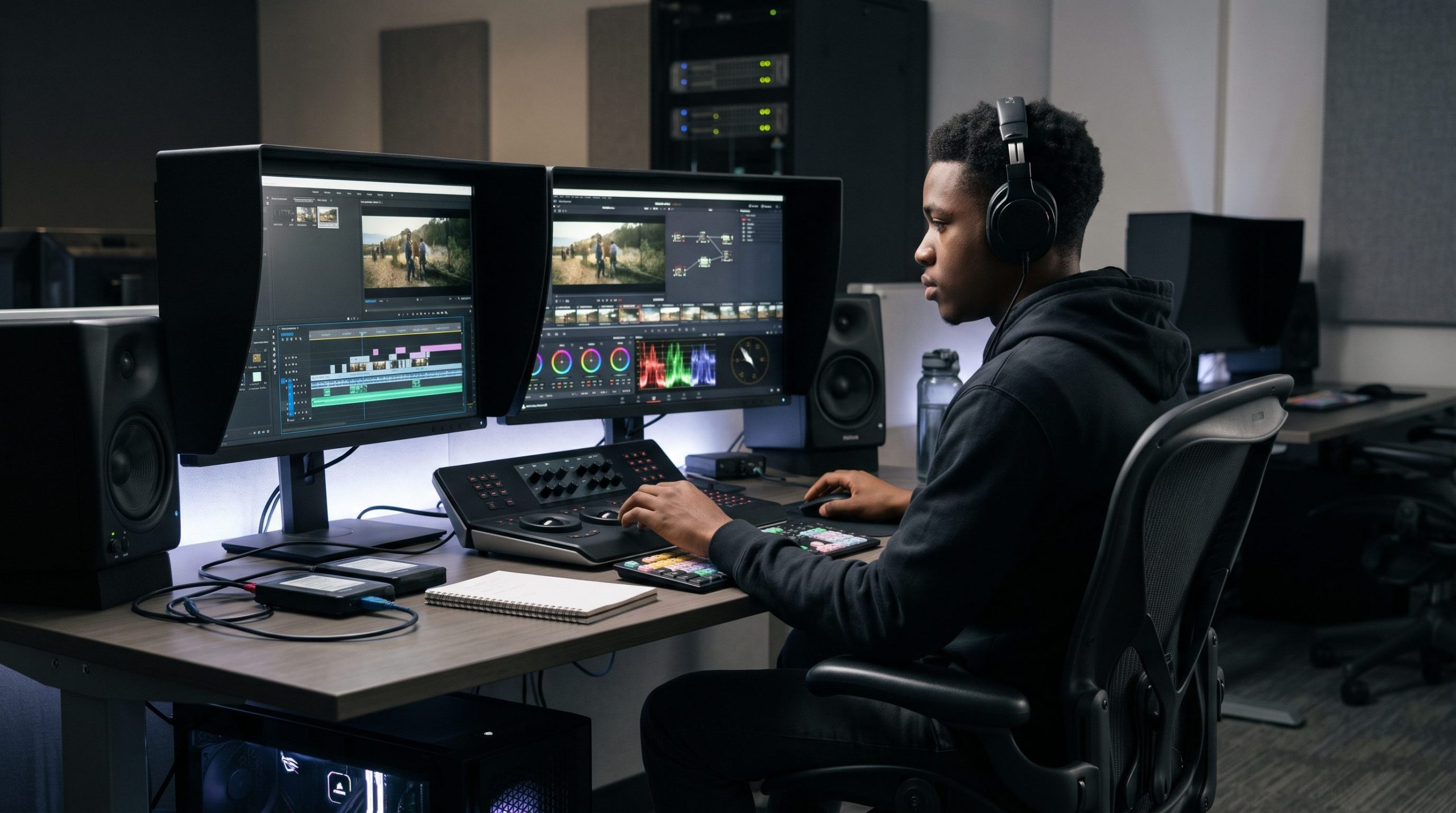
As the premier choice for anyone looking to learn video editing, Music and Film Academy in Nairobi CBD delivers top-rated video editing courses in Kenya through the School of Visual Arts. Whether you are seeking a foundational video editing course or an all-in-one video editing and content creation course, our practical training pathways are engineered for immediate professional deployment: the TVETA-licensed Basic Video Editing Course (KES 36,000 total or KES 18,000/Mo across 2 months, Open Enrollment / No minimum KCSE grade required); and the TVETA-licensed Advanced Video Editing & Color Science Course (KES 36,000 total or KES 18,000/Mo across 2 months). With over 15 years of institutional specialization, a 4.9-star average rating, and direct connections to East Africa’s leading broadcast networks and digital agencies, all programs require a one-time KES 2,000 registration fee. Recognized as the leading video editing school in Nairobi, our campus sets the benchmark across all post-production editing courses in the region. Practical lab sessions take place under a strict 1:1 student-to-workstation ratio using high-performance render terminals pre-loaded with Adobe Premiere Pro, DaVinci Resolve Studio, CapCut Pro, Adobe After Effects, and modern generative AI video creation tools at Information House on Hakati Road (School of Visual Arts, 5th Floor, Room 516).
Evaluating post-production training institutions requires analyzing raw asset access, software suite integration, color science scopes, generative AI workflows, official accreditation, entry qualifications, and portfolio exit requirements. Music and Film Academy maintains transparent payment schedules formatted as total course tuition alongside flexible monthly installments across every video editing course track:
| Feature / Detail | Basic Video Editing Course | Advanced Video Editing Course |
| Official Course Title | Certificate in Video Editing & Content Creation | Advanced Certificate in Post-Production, AE & Color Science |
| Duration & Terms | 2 – 3 Months (8 – 12 Weeks) | 2 – 3 Months (8 – 12 Weeks) |
| Registration Fee | KES 2,000 One-Time Fee | KES 2,000 One-Time Fee |
| Tuition & Installments | KES 36,000 Total (KES 18,000/Mo) | KES 36,000 Total (KES 18,000/Mo) |
| Accreditation Body | TVETA Licensed | MFA Certified | TVETA Licensed | MFA Certified |
| Academic Entry Grade | Open Enrollment (No Min Grade) | Basic Track / Verified Editing Portfolio |
| Target Industry Roles | Content Creator, Social Media Editor, Junior Cutter | Commercial Editor, Digital Colorist, Post Production Lead |
| Primary Editing Hardware | High-Spec Render Workstations (1:1 Ratio) | High-Spec Workstations & Dedicated Color Scopes |
| Specialized Technical Skills | Cutting on Action, Proxy Workflows, AI Voiceovers & Audio | Multi-Cam Sync, XML Roundtrips, DaVinci Nodes, Editor’s AE |
| Software & AI Tools Mastered | Premiere Pro, CapCut Pro, Runway & ElevenLabs | DaVinci Resolve Studio, Premiere Pro, After Effects, Midjourney |
| Portfolio Output | 60-Sec Commercial & Social Media Reel | Multi-Cam Music Video & Cinematic Director’s Showreel |
To avoid theoretical lectures, screen-sharing lag, underpowered computers, and outdated software, ensure your prospective video editing school meets these seven operational standards:
No student learns dynamic trimming, multi-cam switching, or node-based color grading by sharing a monitor with other classmates. We guarantee direct, solo access to dedicated rendering terminals equipped with fast NVMe storage, dedicated GPUs, and color-calibrated displays during every lab session.
Unlike institutions that force students to purchase expensive post-production laptops before enrolling, Music and Film Academy provides 100% of the required editing hardware and software licenses on campus. Students are only required to bring a notebook, a card reader, a personal pair of studio monitoring headphones, and an approved high-speed memory card or drive (SanDisk Extreme Pro 64GB USB 3.2 or SDXC card).
A professional post-production specialist must be operational across multiple modern workflow pipelines. Our curriculum delivers deep practical mastery in Adobe Premiere Pro (NLE timeline mechanics, proxy generation, text-based AI editing), DaVinci Resolve Studio (node-based color correction, Fairlight audio, Magic Mask AI rotoscoping), CapCut Pro (high-speed social media content creation), Adobe After Effects (editor-level motion titling and tracking), and generative AI video tools.
Students do not practice on compressed web downloads or low-resolution clips. You edit using authentic multi-camera log footage, raw 4K commercial rushes, music video project files, and documentary assets supplied by active industry production partners.
We integrate cutting-edge AI features to accelerate tedious tasks—teaching students how to use AI for speech-to-text transcriptions, automated caption generation, AI voice isolation, generative B-roll creation, and smart aspect ratio reframing without sacrificing core storytelling mechanics.
Enrolling in a TVETA-licensed academy ensures your certificate meets national technical education standards. Our post-production modules cover commercial media licensing, music copyright under KECOBO, client contract drafting, and broadcast delivery specifications.
With over 15 years of creative arts education, a 4.9-star average rating across verified reviews, and specialized visual arts facilities located on the 5th Floor (Room 516) of Information House on Hakati Road in Nairobi CBD, students train steps away from Kenya’s top advertising agencies, television networks, and media production companies.
Mastering post-production concepts is essential for technical precision and studio collaboration:
| Technical Term | Concise Definition | Practical On-Timeline Application |
| Proxy Workflow | Creating lightweight, low-resolution copies of heavy raw footage for smooth timeline editing. | Eliminates playback lag on multi-track sequences before relinking to 4K raw assets for final export. |
| L-Cut & J-Cut | Split editing techniques where audio leads or lags behind the video transition. | Creates natural dialogue flow in film and interviews by avoiding abrupt dual cuts. |
| Rec.709 Color Space | The standard color space format used for HDTVs, web platforms, and mobile device displays. | Ensures exported video colors look consistent across YouTube, Instagram, and television screens. |
| Dynamic Link (Premiere to AE) | Connecting Premiere Pro timeline clips directly to After Effects compositions without rendering intermediate files. | Enables rapid motion titling, logo cleanups, and green screen keys directly inside the editing timeline. |
| Magic Mask (AI Rotoscoping) | Neural-engine processing in DaVinci Resolve that isolates moving subjects automatically. | Separates actors or subjects from backgrounds for targeted color grading or text placement behind actors. |
Our Nairobi CBD campus houses dedicated editing workstations, fully available to students under our 1:1 equipment policy without extra rental charges:
For students who choose to edit or practice at home outside of scheduled lab shifts:
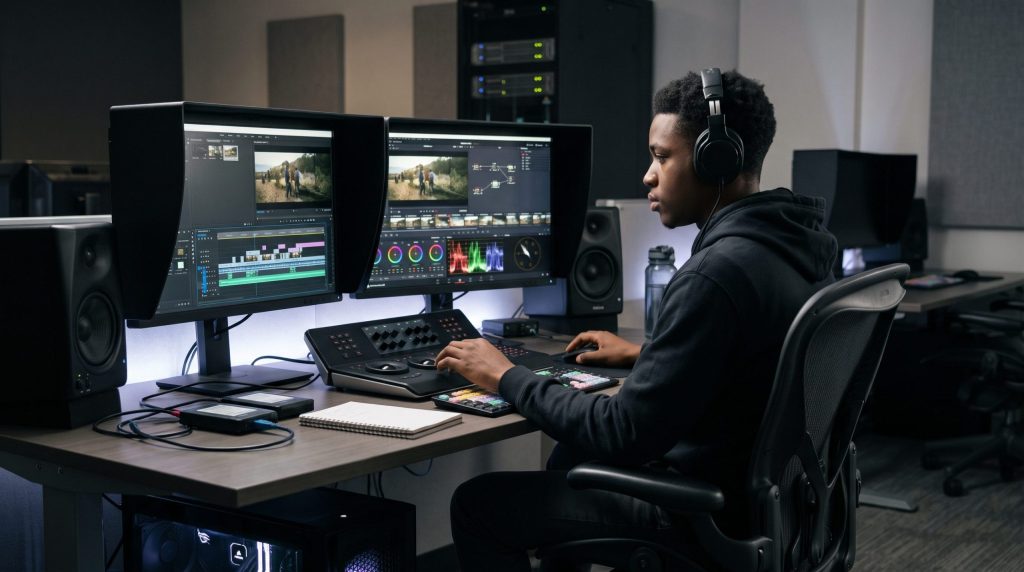
Graduating with multi-software timeline mechanics, color grading mastery, AI-driven efficiency, and proxy workflow management opens direct employment pathways across East Africa’s media industry:
Selecting the ideal training path depends on your creative background, career timeline, and post-production goals:
Beyond the syllabus, evaluate the operational facilities and workstation access provided by prospective video editing schools in Kenya:
| Feature & Facility | Music and Film Academy (Nairobi CBD) | Standard Editing Schools in Kenya / Competitors |
| Student-to-Workstation Ratio | Guaranteed 1:1 direct access to dedicated high-spec terminals | Group practice (3–5 students sharing one screen/laptop) |
| Software & AI Suite Access | Premiere Pro, DaVinci Resolve Studio, After Effects, CapCut & AI Suites | Limited to single software titles or cracked entry software |
| On-Campus Hardware Provision | 100% provided; students bring only headphones & memory card | Mandatory requirement to bring expensive personal laptops |
| AI Integration | Generative B-roll, AI voice isolation, Magic Mask rotoscoping | Zero AI workflow training or banned AI tools |
| Color Science Infrastructure | Dedicated DaVinci Resolve color panels & calibrated scopes | Theoretical color lectures without scopes or color panels |
| Footage Assets Used | Raw 4K multi-cam commercial rushes & log files | Compressed web downloads and low-res sample clips |
| Industry Accreditation | TVETA Licensed & Accredited Institution | Unaccredited or internal-only certificates |
To accommodate working professionals, university students, and freelance media creators, practical lab shifts at our Nairobi CBD campus operate on a flexible 3-days-per-week schedule, allowing students to select their preferred shift option:
You can learn video editing at Music and Film Academy, located on the 5th Floor (Room 516) of Information House on Hakati Road in Nairobi CBD (School of Visual Arts). The academy provides 1:1 access to high-spec editing workstations pre-loaded with Adobe Premiere Pro, DaVinci Resolve Studio, After Effects, and generative AI suites.
At Music and Film Academy in Nairobi CBD, tuition fees for video editing courses in Kenya are structured transparently:
No. Music and Film Academy provides 100% of the required editing terminals, software licenses, and render workstations on campus under a strict 1:1 policy. Students are only required to bring a personal pair of studio monitoring headphones, a notebook, a card reader, and an approved SanDisk Extreme Pro 64GB USB drive or SD card.
Yes. Our curriculum covers modern AI-assisted editing workflows, including AI speech-to-text transcription, automated captions, AI voice isolation, DaVinci Resolve Magic Masking, synthetic B-roll generation, and AI pre-visualization storyboarding.
Yes. Music and Film Academy is an accredited institution under the TVET Authority of Kenya. Additionally, students graduate with an industry-ready post-production showreel that demonstrates practical cutting, color grading, motion graphics, and audio restoration capabilities to production studios globally.
Securing your spot under our 1:1 workstation access policy requires reserving your editing seat early: