Photography and Videography Courses in Kenya: #1 School in Nairobi 2026
Music And Film Academy offers two flagship dual-discipline certificates in Nairobi: the Basic Certificate in Photography and Videography (2–3 Months) and the Advanced Certificate in Commercial Photography & Videography (2–3 Months). Situated at Information House on Hakati Road (Nairobi CBD), the academy provides a 1:1 student-to-gear policy across pre-production, manual camera physics, continuous LED and studio flash lighting, multi-track audio capture, live streaming, drone operation, and post-production software including Adobe Lightroom Classic, Premiere Pro, Photoshop, and DaVinci Resolve Studio.
While dedicated standalone courses exist for photography and videography individually, these combined programs are built specifically for creators, agency staff, and freelancers who need complete visual mastery across both still and moving images.
Multi-track field recorders, Boom poles, RF scanning
Specialized Equipment
3-Axis Motorized Gimbals
Aerial Drones (KCAA rules), Multi-cam Switchers
Post-Production Software
Adobe Lightroom Classic & Adobe Premiere Pro
DaVinci Resolve Studio & Adobe Photoshop
Campus Location
Information House, Hakati Rd, Nairobi CBD
Why Choose a Dual Photography and Videography Course?
Choosing a combined dual-discipline program solves key commercial and production challenges:
Eliminates Keyword & Skill Fragmentation: Modern media clients rarely hire separate shooters for stills and video. A dual program equips you to bid on full-suite media briefs.
Single Pre-Production Workflow: Learn how to plan shot lists, conduct site location recce, write scripts, and build call sheets that serve both photo assets and video clips simultaneously.
Unified Exposure Physics: Master how shutter speed operates for crisp still photos versus how shutter angle (180-degree rule) controls motion blur in 24fps/25fps video.
Versatile Post-Production Pipeline: Seamlessly move from developing RAW images in Lightroom Classic to assembling 4K video timelines in Premiere Pro and color grading flat LOG footage in DaVinci Resolve.
Ideal Candidate: Absolute beginners, social media managers, marketing officers, and self-taught content creators looking to master manual camera mechanics, field lighting, and editing suites.
Comprehensive Unit Breakdown
Unit 1: Pre-Production & Visual Planning
Scripting & Mood Boards: Translating client briefs into visual storyboards, shot lists, and shoot schedules.
Location Scouting & Recce: Assessing natural light orientation, ambient acoustic interference, power availability, and space constraints.
Gear Prep Protocols: Sensor inspection, lens cleaning, formatting SD cards, battery maintenance, and field gear checklists.
Unit 2: Camera Physics & Manual Exposure Controls
The Exposure Triangle: Balancing Aperture (f-stop scale, light transmission, depth-of-field control), Shutter Speed vs. Shutter Angle (motion blur control, light flicker elimination, 180-degree shutter rule for cinema), and ISO thresholds.
Frame Rates & Motion Standards: 24fps cinema standard, 25fps PAL broadcast, 30fps web standards, and high-frame-rate speed ramping (60fps / 120fps slow motion).
Sensors & Focal Lengths: Full Frame vs. Super 35 / APS-C crop factors; optical focal lengths (24mm wide, 35mm environmental, 50mm natural, 85mm portrait).
Monitoring Tools: Manual focus techniques, focus peaking, zebra stripes for highlight protection, false color, and live histogram balancing.
Unit 3: Visual Grammar, Composition & Camera Movement
Compositional Framing: Rule of Thirds, Leading Lines, Golden Ratio, Symmetry, Headroom, and Look/Lead Room.
Shot Scale Classification: Extreme Wide (EWS), Wide (WS), Medium (MS), Close-Up (CU), Extreme Close-Up (ECU), and Over-the-Shoulder (OTS) angles.
Posing & Still Timing: Anatomy posing for portraiture, natural light direction, and capturing decisive moments.
Movement Mechanics: Pan, tilt, tracking, pedestal moves, and hands-on balancing/calibration of 3-axis motorized gimbals.
Unit 4: Fundamental Field Lighting & Audio Capture
3-Point Lighting Architecture: Key Light placement, Fill Light ratios, and Hair/Backlight isolation.
Light Modifiers & Flashes: Diffusers, 5-in-1 reflectors, bounced flash techniques, and Speedlight operation (TTL automation vs. Manual power control).
Continuous LED Operations: Kelvin color temperature control (2700K Warm Tungsten to 6500K Daylight), CRI/TLCI accuracy ratings, and battery power setups.
Field Audio Mechanics: Shotgun mic polar patterns, wireless lavalier placement, gain staging, signal-to-noise ratio optimization, and live input monitoring.
Unit 5: Foundation Post-Production Workflow
Data Management & Offloading: Ingesting files, folder hierarchy standardization, proxy file generation, and 3-2-1 backup strategies.
Photo Processing in Adobe Lightroom Classic: RAW file development, white balance/exposure correction, color grading basics, profile corrections, and batch exporting.
Video Editing in Adobe Premiere Pro: Project setup, timeline assembly, rough cuts, J-cuts and L-cuts, basic transitions, title design, audio leveling, and H.264 rendering.
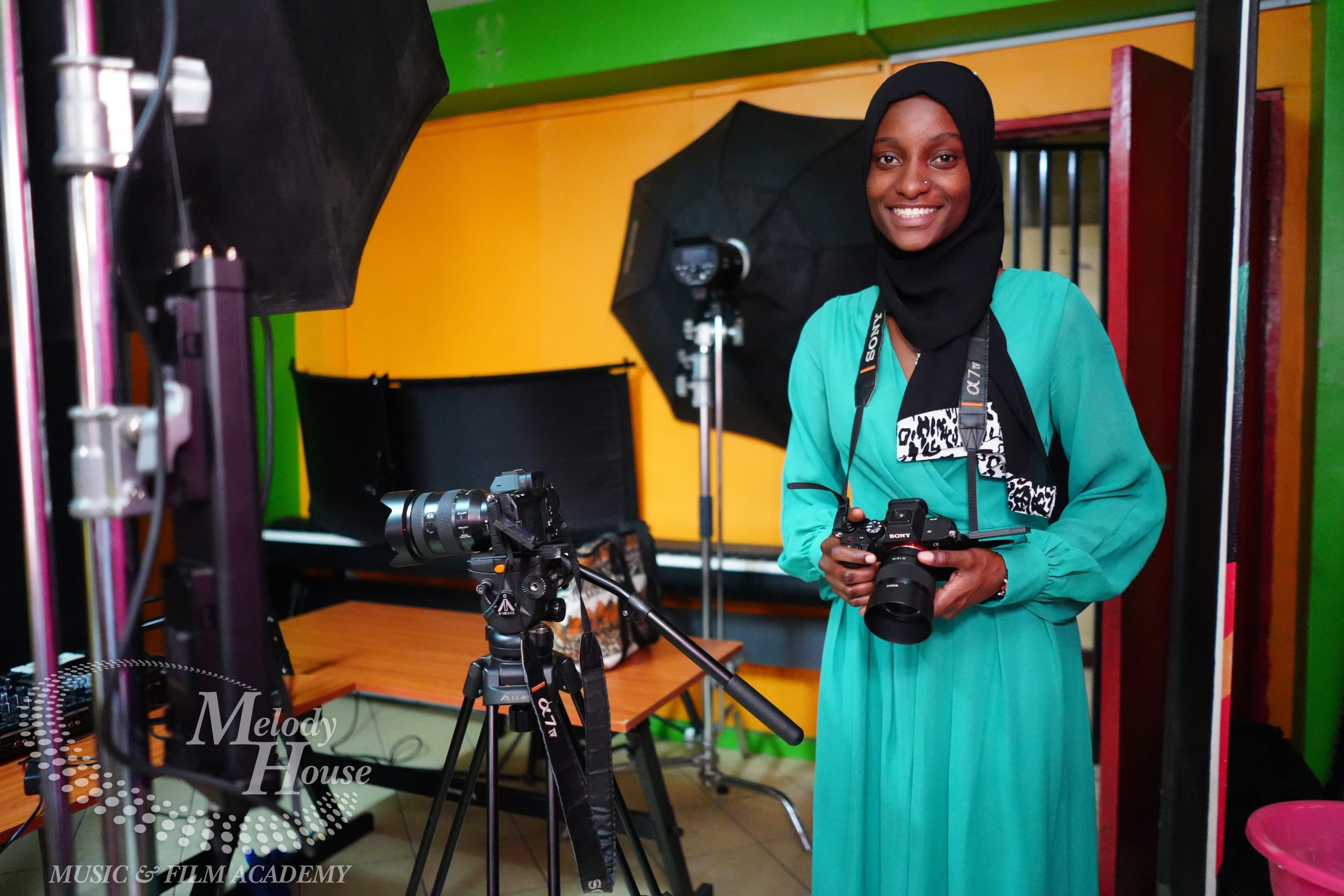
Hands-on practical camera operation and studio lighting session at Music And Film Academy, offering leading photography and videography courses in Kenya.
Tuition: KES 51,000 or in installments @ 17,000 Per Month for 3 Months
Certification: Advanced Certificate in Commercial Photography & Videography
Primary Gear & Software: Cinema Camera Systems (Sony FX, Blackmagic, Canon C-series), Multi-Light Studio Strobes, Wireless Video Transmitters, ATEM Mini Switchers, Aerial Drones, Multi-Track Field Recorders, Adobe Photoshop, DaVinci Resolve Studio
Ideal Candidate: Working media operators, directors of photography, agency creatives, and experienced shooters seeking high-budget corporate gigs, broadcast-grade production, live streaming skills, and advanced color grading.
Comprehensive Unit Breakdown
Unit 1: Commercial Pre-Production & On-Set Directing
Storyboarding & Floor Plans: Translating commercial briefs into scene storyboards, overhead lighting schematics, and camera movement blueprints.
Script Breakdown & Call Sheets: Extracting props, crew roles, talent notes, equipment manifests, and producing professional daily call sheets.
Commercial Studio Aesthetics: Controlling reflections on glass and metallic products, high-key/low-key fashion portraiture, gel color balance, and specular highlight shaping.
Cinema Set Lighting: Keying high-output LED fixtures, creating window spill, haze management, and lighting multi-person commercial interviews.
Unit 4: Multi-Cam Live Streaming & Location Audio Engineering
Multi-Camera Switcher Setup: Hardware switchers (Blackmagic ATEM Mini/ISO series), HDMI/SDI routing, tally light setups, and matching sensor color signatures.
Live Broadcast Protocols: Configuring RTMP/RTSP keys, vMix/OBS Studio routing, bitrate stability, multi-channel live audio, and real-time lower-third graphics.
Advanced Field Audio: Multi-track field recorders (Zoom/Tascam), boom pole techniques, wardrobe lavalier concealment, RF frequency scanning, and monitoring.
Unit 5: High-End Color Grading & Advanced Photo Retouching
DaVinci Resolve Studio Color Grading: Node tree structure, Color Space Transforms (CST), primary wheel balancing, secondary qualifier isolation, skin-tone vector scope alignment, tracking windows, and custom LUT creation.
Photoshop Retouching: 16-bit Frequency Separation (separating texture from tone), micro Dodge and Burn, background extension, compositing, and luminance masking.
Mastering & Multi-Format Delivery: Exporting for television broadcast standards, cinema projection (DCP basics), web streaming formats, and CMYK print prep.
Unit 6: Commercial Business & Rate Card Structuring
Media Law & Legal Compliance: Talent release forms, location usage releases, copyright ownership, IP assignment, and commercial licensing.
Portfolio Assembly & Positioning: Creating agency-ready websites, optimizing video showreels, structuring client deliverables, and setting up monthly retainers.
Why Choose Music And Film Academy’s School of Visual Arts in Kenya?
┌──────────────────────────────────────┐
│ MUSIC AND FILM ACADEMY ADVANTAGE │
└──────────────────┬───────────────────┘
│
┌──────────────────┬───────────────┴───────────────┬──────────────────┐
▼ ▼ ▼ ▼
1:1 Gear Ratio TVETA Accredited CBD Campus Hub Collaborative Labs
Guaranteed zero Nationally recognized 5th Floor, Info House Direct access to audio,
sharing policy diplomas & certificates Central Nairobi CBD music & performance tracks
TVETA Accredited Institution: Operating as a recognized technical institute delivering accredited certifications that align with national vocational qualifications.
Guaranteed 1:1 Student-to-Gear Ratio: Strict zero-sharing policy during practical labs ensures every student operates their own camera body, light kit, or editing workstation.
Dedicated Nairobi CBD Campus: Situated on the 5th Floor of Information House (Hakati Road, Nairobi CBD) featuring shooting bays and editing suites.
Collaborative Campus Ecosystem: Visual arts students direct, shoot, and grade live artist sessions, studio recordings, and brand videos alongside our sound engineering and music production departments.
Active Industry Practitioners as Instructors: Mentorship by practicing commercial photographers, directors of photography, and post-production colorists working in the East African market.
Admission Requirements & Career Pathways
Entry Requirements
Basic Certificate Program: Minimum KCSE Grade D (Plain) or equivalent secondary qualification. No prior camera or editing experience required.
Advanced Certificate Program: Completion of the Basic Certificate in Photography and Videography OR a verified portfolio demonstrating manual exposure controls and basic non-linear editing software proficiency.
Graduate Career Opportunities
Commercial Photographer: Corporate headshots, fashion editorials, real estate listings, and consumer product campaigns.
Director of Photography (DoP) / Cinematographer: Lighting and framing TV commercials, narrative films, and music videos.
Corporate Media Specialist: Documentary production, executive brand communications, and promotional web media.
Multi-Cam Live Stream Operator: Managing corporate conferences, cultural events, and live church broadcasts.
Post-Production Editor & Colorist: NLE timeline assembly, high-end Photoshop retouching, and DaVinci Resolve color grading.
KCAA-Compliant Drone Specialist: Commercial aerial video, real estate tours, and aerial mapping projects.
Frequently Asked Questions (FAQ)
Q1: Which course is best for photography and videography? The best course depends on your career goals, but a dual-discipline certificate program covering both still photography and motion videography offers the highest market value. For beginners, a Basic Certificate in Photography & Videography built around manual camera physics, 3-point lighting, and Adobe Lightroom/Premiere Pro provides a solid technical foundation. Working professionals benefit most from an Advanced Certificate covering cinema camera rigs, aerial drones, studio strobes, and DaVinci Resolve color grading.
Q2: How much does it cost to study photography in Kenya? The cost of studying photography and videography in Kenya ranges from Ksh 15,000 to Ksh 35,000 per month depending on the institution, facility quality, and gear access. At Music And Film Academy, our 2–3 month certificate programs include full access to camera rigs, lighting kits, and editing suites under a guaranteed 1:1 gear policy with flexible installment options.
Q3: How much do photographers earn in Kenya? Entry-level photographers and videographers in Kenya typically earn between Ksh 30,000 and Ksh 70,000 per month, while mid-level freelance creators charge Ksh 25,000 to Ksh 80,000 per event or commercial project. Established commercial directors of photography and agency studio owners capturing corporate briefs, live streams, and high-end weddings command Ksh 150,000 to Ksh 500,000+ per campaign.
Q4: Where can I learn videography and photography in Nairobi? You can learn photography and videography at TVETA-accredited media institutions located in Nairobi CBD, such as Music And Film Academy situated at Information House on Hakati Road (5th Floor). Look for training centers that guarantee 1:1 gear ratios, practical studio bays, dedicated editing labs, and hands-on production experience.
Q5: What are the entry requirements for photography and videography courses in Kenya? To enroll in a Basic Certificate in Photography and Videography, the standard requirement is a KCSE Grade D (Plain) or equivalent secondary qualification, with no prior technical experience needed. Admission into the Advanced Certificate requires either a Basic Certificate or a verified portfolio demonstrating manual camera exposure control and fundamental editing proficiency.
Enrollment Details
Campus Location: 5th Floor, Room 516, Information House, Hakati Road, Nairobi CBD, Kenya