Best Music Production School in Nairobi Kenya | 2026 Professional Courses

The best music production courses in Kenya are offered at Music and Film Academy in Nairobi CBD, structured across four specialized pathways to match your career scope: the flagship TVETA-licensed & Pearson BTEC Diploma in Music Production (KES 45,000 per term across 6–8 terms / 18–24 months, requiring a KCSE Mean Grade of C- [Minus] or prior audio cert, plus a one-time KES 2,000 registration fee); the TVETA-licensed & Pearson BTEC Certificate in Music Production (KES 45,000 per term across 4 terms / 12 months, requiring a KCSE Mean Grade of D [Plain]); the 6-month Music Production Foundation Course (KES 45,000 per term across 2 terms / 6 months); and the accelerated 3-month Music Production Short Course (KES 45,000 total or KES 15,000/Mo, Open Enrollment / No minimum KCSE grade required). With over 15 years of institutional specialization, a 4.9-star average rating, and hundreds of successful graduates across East Africa, both the 1-Year Certificate and 2-Year Diploma pathways combine in-studio or online beatmaking, vocal engineering, and mixing with specialized Live Sound Engineering units (FOH mixing, digital console architecture, stage box routing, and venue PA tuning). Operating as one of the premier music production schools in Nairobi, all practical training takes place under a strict 1:1 student-to-workstation ratio at Information House on Hakati Road (2nd Floor, Room S2).

Table of Contents

1. Comprehensive 4-Way Music Production Comparison Matrix (2026 Rates)

Evaluating music production schools in Nairobi and Kenya requires analyzing dedicated DAW workstation access, acoustic vocal booth facilities, live sound reinforcement integration, official accreditation, entry grades, and real-world placement guarantees. Music and Film Academy maintains transparent payment schedules formatted as total or per-term tuition alongside flexible monthly installments:

Feature / Detail3-Month Short Course (Single Focus)6-Month Foundation Course (Complete Studio)1-Year Certificate (Studio + Live Sound)2-Year Diploma (Masterclass & Scoring)
Official Course TitleMusic Production Short CourseMusic Production FoundationCertificate in Music ProductionDiploma in Music Production
Duration & Terms1 Term (3 Months / 12 Weeks)2 Terms (6 Months / 24 Weeks)4 Terms (1 Year / 48 Weeks)6–8 Terms (18–24 Months / 72–96 Weeks)
Registration FeeKES 2,000 One-Time FeeKES 2,000 One-Time FeeKES 2,000 One-Time FeeKES 2,000 One-Time Fee
Tuition & InstallmentsKES 45,000 Total (KES 15,000/Mo)KES 45,000 / Term (KES 15,000/Mo)KES 45,000 / Term (KES 15,000/Mo)KES 45,000 / Term (KES 15,000/Mo)
Accreditation BodyTVETA Licensed OnlyTVETA Licensed OnlyTVETA Licensed | Pearson BTECTVETA Licensed | Pearson BTEC
Academic Entry GradeOpen Enrollment (No Min. Grade)Open Entry / KCSE DKCSE Grade D (Plain)KCSE Grade C- (Minus) or Prior Cert
Target Industry RolesSingle-Skill Beatmaker OR Mix TechFull Studio Producer & Vocal EngineerStudio Producer & Live Sound EngineerExecutive Producer, Film Scorer & Audio Director
DAWs MasteredFL Studio 24 OR Ableton 12FL Studio 24 & Ableton Live 12FL Studio 24, Logic Pro 11 & AbletonFL Studio, Logic Pro, Ableton, Pro Tools & Cubase
Live Sound UnitsNot Included (Studio Focus)Not Included (Studio Focus)Included (FOH Mixing, Stage Patching, PA Tuning)Included (Dante IP Networks, Line Arrays, Live Recording)
Genre SpecializationOption A (Beatmaking) OR Option B (Mixing)Afrobeats, Gengetone & TrapAfrobeats, Amapiano, Gospel & DancehallMulti-Genre, Cinematic Film Scoring & Spatial Audio
Music Biz & RightsBasic DAW Export & Digital UploadsCopyright & Online Beat Store SalesMCSK, KAMP, PRISK & ISRC MetadataSync Licensing, Film Contracts & Global Royalties
Placement SupportStudio Attachment & Portfolio ReviewStudio Attachment & Track ReviewsCommercial Studio Attachment PlacementGuaranteed Term 6/8 Media House Internship

2. 6 Core Criteria for Choosing the Best Music Production School in Kenya & Nairobi (Why MFA Leads)

To avoid theoretical lecture halls and crowded group observe-only setups, ensure your chosen music production course meets these six non-negotiable operational standards:

A. Guaranteed 1:1 Student-to-Workstation Ratio

No student learns beatmaking, vocal tuning, or dynamic mixing by watching an instructor click a mouse on a projector screen. We guarantee direct, solo access to your own dedicated production workstation—equipped with licensed DAWs, audio interfaces, MIDI controllers, and studio headphones—during every single class.

B. Dual Capability: Studio Recording & Live Sound Engineering

Modern sound engineers cannot survive restricted to a laptop. Our 1-Year Certificate and 2-Year Diploma pathways bridge the gap between recording studios and concert stages, embedding complete units in digital live mixing consoles (Yamaha, Allen & Heath, Behringer Wing/Midas), wireless RF scanning, stage box patching, and line array PA calibration.

C. Native Mastery of the “Nairobi Sound” & Modern African Genres

Generic Western production courses ignore the local market. Our curriculum is engineered specifically for Kenyan and East African creators, mastering the rhythmic DNA of Afrobeats, Gengetone, Amapiano Log Drums, Urban Gospel, Nairobi Drill, and Benga/Zilizopendwa sampling.

D. Multi-DAW Industry Fluency

Professional producers do not restrict themselves to a single piece of software. You gain hands-on operational mastery across industry-standard Digital Audio Workstations—including FL Studio 24, Apple Logic Pro 11, Ableton Live 12, Avid Pro Tools, and Steinberg Cubase—allowing you to collaborate seamlessly with any studio worldwide.

E. Flexible In-Studio & Fully Online Distance Learning Infrastructure

We eliminate geographical barriers with hybrid delivery options. Online students participate in live, interactive screen-sharing sessions in FL Studio, Logic Pro, and Ableton via Google Meet/Zoom, downloading identical project stems, receiving 1-on-1 mentor assignment reviews, and accessing equal certification credentials.

F. TVETA Licensing, Pearson BTEC & Nairobi CBD Campus Location

Choosing a TVETA-licensed school ensures your certificate is legally recognized by government bodies and higher education institutions in Kenya. Pearson BTEC accreditation across our Certificate and Diploma tracks adds an internationally recognized British credential accepted in over 70 countries. Located on the 2nd Floor (Room S2) of Information House on Hakati Road in Nairobi CBD, our campus sits at the nerve center of East Africa’s creative industry.
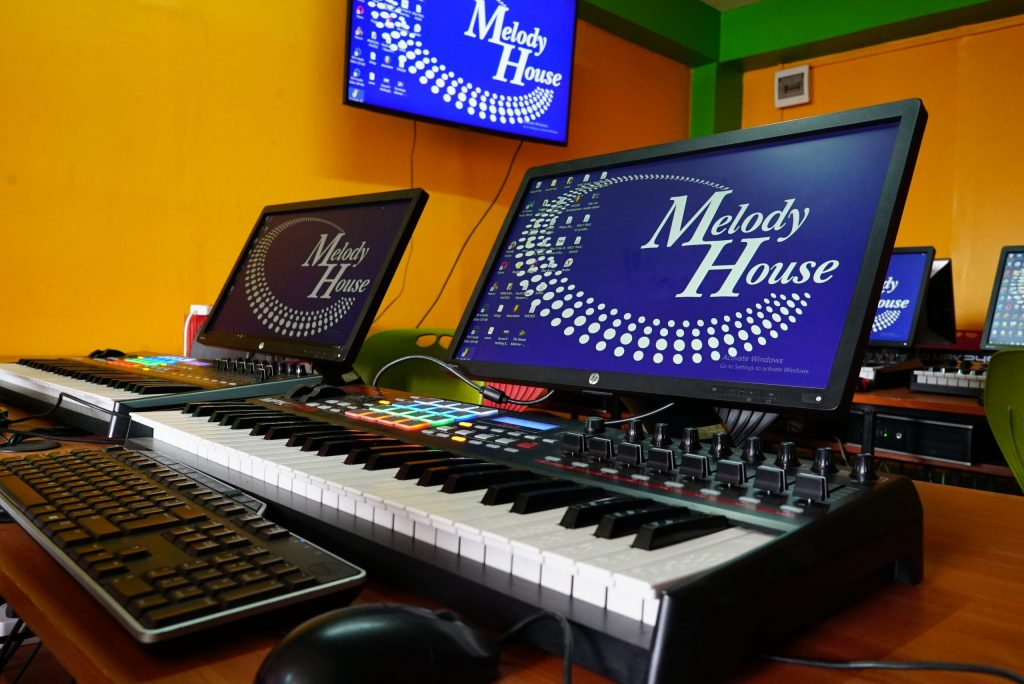
A row of professional workstations for **music production courses** at **Music And Film Academy**. Each station features an Akai MPK249 MIDI keyboard controller with colorful backlit pads, a high-resolution HP monitor displaying the Melody House logo, and a dedicated computer setup. The vibrant yellow and orange studio environment showcases the modern, hands-on learning lab where students master beat-making, sound design, and digital audio workstation (DAW) techniques.

3. Dedicated Studio & Software Inventory

Our Nairobi CBD studio operates as a commercial-grade production facility, fully accessible to students under our 1:1 hardware policy:

  • Digital Audio Workstations (DAWs): FL Studio 24 Producer Edition, Apple Logic Pro 11, Ableton Live 12 Suite, Avid Pro Tools, Steinberg Cubase.
  • Studio Hardware Controllers: Akai Professional MIDI Keyboards, Novation Launchpads, Tactile Fader Surfaces, and Drum Pads.
  • Audio Interfaces & Conversion: Focusrite Scarlett & Clarett Systems, Steinberg UR Interfaces, High-Fidelity 24-bit/96kHz A/D & D/A Converters.
  • Microphones & Vocal Booth: Shure SM58 / SM57 Dynamics, Audio-Technica AT2020 / AT4040 Large-Diaphragm Condensers, Acoustically Treated Vocal Isolation Booth with Pop Filters & Reflection Shields.
  • Live Sound Reinforcement Hardware: Digital Mixing Consoles (Behringer Wing, Midas, Yamaha), Digital Stage Boxes, Directional Shotgun & Wireless RF Systems, Active PA Speaker Arrays.
  • Monitoring & Acoustics: Yamaha HS Series Active Studio Reference Monitors, AKG / Audio-Technica Professional Studio Monitoring Headphones.
  • Virtual Instruments & Processing: Serum, Massive, Kontakt Sample Libraries, FabFilter Total Bundle, Waves Horizon, iZotope Ozone Mastering Suite, Auto-Tune Pro, and Melodyne.

4. Technical Audio & Sound Engineering Jargon Glossary

Mastering key industry concepts is essential for technical precision and commercial communication:

Technical TermConcise DefinitionPractical Studio & Live Application
TransientThe ultra-fast, high-energy peak at the start of a waveform.Preserving transients ensures kick drums and snare strikes cut cleanly through dense mixes.
SibilanceHarsh, high-frequency energy (5kHz–8kHz) produced by “S” and “T” vocal sounds.Controlled surgically using frequency-conscious De-essers during vocal processing.
Comb FilteringPhase cancellation causing hollow or thin sound when identical signals combine out of phase.Prevented using the 3:1 mic placement rule and checking phase correlation switches.
THD (Total Harmonic Distortion)Gentle, musical saturation added by analog-modeled transformers and tubes.Introduced using tape emulations to add warmth, body, and cohesion to digital signals.
LUFS (Loudness Units Full Scale)The international integrated volume measurement standard for streaming audio.Targeted at -14 LUFS for Spotify/Apple Music and -6 LUFS for club/DJ tracks.

5. Detailed Breakdown of the 4 Music Production Pathways

Option 1: 3-Month Short Course (Specialized Single Focus)

  • Duration: 1 Term (3 Months / 12 Weeks) | Investment: KES 45,000 Total (KES 15,000/Mo) + KES 2,000 registration fee.
  • Accreditation: TVETA Licensed Only (Open Enrollment / No Minimum KCSE Grade Required).
  • Ideal For: Independent beatmakers, DJs, and self-taught creators needing to solve a specific technical bottleneck.
  • Curriculum Breakdown (Choose 1 Specialized Track):
    • Option A (Beat-Making & Arrangement): Focuses on drum programming, bassline architecture (Amapiano log drums, Afrobeats grids, Gengetone syncopation), virtual instrument routing, diatonic chord theory, and structural hooks.
    • Option B (Mixing & Mastering): Focuses strictly on post-production—gain staging at -18 dBFS, frequency cleanup with dynamic parametric EQ, vocal pitch correction (Auto-Tune/Melodyne), bus compression, and mastering for streaming algorithms.

Option 2: 6-Month Foundation Course (Complete Studio Production)

  • Duration: 2 Terms (6 Months / 24 Weeks) | Investment: KES 45,000 per Term (KES 15,000/Mo across 2 terms) + KES 2,000 registration fee.
  • Accreditation: TVETA Licensed Only (Open Entry / KCSE Grade D Plain).
  • Ideal For: Aspiring producers who want to take a track from initial chord progression to a final commercial master without needing live event sound units.
  • Curriculum Breakdown:
    • Term 1 (Beat-Making & Sound Design): Advanced beat production across Afrobeats, Gengetone, Trap, and Amapiano; subtractive synthesis (designing custom leads and 808s); digital signal path; and acoustic wave physics.
    • Term 2 (Vocal Engineering & Commercial Mixing): Vocal tracking techniques, dynamic range compression (Threshold, Ratio, Attack, Release), temporal reverb/delay spatial design, advanced sampling, and commercial loudness mastering.

Option 3: 1-Year Certificate in Music Production (Studio Production + Live Sound)

  • Duration: 4 Terms (1 Year / 4 Weeks) | Investment: KES 45,000 per Term (KES 15,000/Mo across 4 terms) + KES 2,000 registration fee.
  • Accreditation: TVETA Licensed & Pearson BTEC International Certified (KCSE Mean Grade D Plain Required).
  • Ideal For: Audio technicians and commercial producers who want to manage both studio recording sessions and live venue/church audio setups.
  • Curriculum Breakdown:
    • Terms 1 & 2 (Advanced Studio Production): Deep-dive beatmaking, multi-DAW workflows (FL Studio, Logic Pro, Ableton Live), vocal tuning, parallel compression, and heritage fusion beat design.
    • Term 3 (Live Sound Reinforcement Units): Front-of-House (FOH) and monitor wedge mixing on digital consoles (Yamaha / Allen & Heath / Behringer Wing); stage box patching; wireless RF spectrum scanning; and PA system tuning to prevent feedback during live gigs and church services.
    • Term 4 (Music Business, Metadata & Capstone): MCSK, KAMP, PRISK registration; embedding ISRC/ISWC metadata codes for digital royalty collection; beat store monetization; and producing a 3-track portfolio.

Option 4: 2-Year Diploma in Music Production (Masterclass, Scoring & Advanced Live Systems)

  • Duration: 6–8 Terms (18–24 Months / 72–96 Weeks) | Investment: KES 45,000 per Term (KES 15,000/Mo across terms) + KES 2,000 registration fee.
  • Accreditation: TVETA Licensed & Pearson BTEC International Certified (KCSE Mean Grade C- or prior Audio Certificate).
  • Ideal For: Executive producers, film scorers, sound designers, and commercial studio directors seeking top-tier international credentials and comprehensive technical authority.
  • Curriculum Breakdown:
    • Year 1 (Terms 1–4): Complete technical mastery across multi-genre beatmaking, acoustic recording physics, advanced mixing, and baseline live sound setups.
    • Term 5 (Mastering Science & Immersive Spatial Audio): LUFS streaming calibration (-14 LUFS Spotify vs -6 LUFS club masters), True Peak limiting, dithering, and 3D Dolby Atmos spatial audio mixing (7.1.4 object-based environments).
    • Term 6 (Film Scoring, Audio Post-Production & Sound Design): Composing custom background scores for film/TV, sync licensing, ADR (Automated Dialogue Replacement), Foley sound creation, and sound design for media.
    • Term 7 (Advanced Live Sound Systems & Dante IP Networking): Networked audio protocols (Audinate Dante Level 1 & 2), managed IP switches, line array rigging calibration, and multi-track live concert recording.
    • Term 8 (Executive Producer Thesis & Media House Internship): Tracking, mixing, mastering, and releasing a 5-track commercial EP with PR rollout strategy, alongside a guaranteed 6-week media house or commercial recording studio internship.

6. Graduate Career Opportunities & Expected Earnings in Kenya (2026)

Graduating with practical beatmaking, sound engineering, live audio, and music business skills opens multi-stream revenue channels across East Africa’s music, broadcast, advertising, and digital entertainment sectors:

  • Commercial Music Producer / Beatmaker: KES 20,000 – KES 150,000+ per track (Custom beat creation, artist production fees, and digital beat store leases/exclusive sales). Discover actionable steps in our Beginner’s Guide to Starting a Beat Making Career in Nairobi.
  • Recording & Mix Engineer: KES 15,000 – KES 50,000 per song mix (Multitrack vocal tuning, instrument balancing, analog/digital processing, and final mix delivery).
  • Live Sound & FOH Venue Engineer: KES 15,000 – KES 50,000 per gig / event (Managing digital mixing desks, stage boxes, IEMs, and PA line arrays for live concerts, corporate launches, and churches).
  • Corporate Jingles & Sonic Branding Specialist: KES 50,000 – KES 300,000+ per campaign (Composing audio signatures, brand anthems, and radio/TV commercial soundtracks for corporate clients).
  • Film & Game Sound Designer / Composer: KES 60,000 – KES 250,000 per score (Foley recording, audio-to-picture synchronization, atmospheric pads, and cinematic soundtrack creation).

7. Choosing the Right Pathway by Career Goal

Selecting the ideal training path depends on your artistic goals, career timeline, and current qualifications:

  • For Single-Skill Specialization (Beatmaking OR Mixing): Choose the 3-Month Short Course (KES 45,000 total / KES 15,000/Mo) to rapidly eliminate a specific bottleneck in beat production or mix engineering (Open Enrollment / No KCSE Required).
  • For Full-Stack Studio Producers (Beatmaking AND Mixing): Choose the 6-Month Foundation Course (KES 45,000/term / KES 15,000/Mo) to build complete studio independence from chord progressions to final masters.
  • For Dual Studio & Venue Sound Engineers: Choose the 1-Year Certificate in Music Production (KES 45,000/term / KES 15,000/Mo) for Pearson BTEC international accreditation, studio production alongside Live Sound Reinforcement (FOH mixing, stage patching, PA tuning) (KCSE Grade D Required).
  • For Executive Producers, Film Composers & Studio Directors: Choose the Pearson BTEC Diploma in Music Production (18–24 Months @ KES 45,000/term / KES 15,000/Mo) for international accreditation, Dolby Atmos spatial audio, film scoring, advanced Dante live audio systems, and guaranteed Term 6/8 media house internships (KCSE Grade C- Required).

8. Compare Out-of-Class Value: Music and Film Academy vs. Alternatives

A student actively engages in music production courses at Music And Film Academy, working on a professional digital audio workstation (DAW). The student is using an Akai MPK249 MIDI keyboard to arrange colorful audio tracks and patterns on a large computer monitor. The modern classroom setup features multiple workstations, highlighting the academy’s commitment to providing students with hands-on technical training in beat-making and sound engineering.

Beyond the syllabus, evaluate the operational facilities and equipment access provided by prospective music schools:

Feature & FacilityMusic and Film Academy (Nairobi CBD)Standard Music Schools in Kenya / Competitors
Workstation-to-Student RatioGuaranteed 1:1 dedicated DAW workstation access in all classesGroup observation (4–8 students crowding around 1 computer)
Genre FocusNative Afrobeats, Gengetone, Amapiano, Gospel & Nairobi SoundGeneric Western pop/classical theory with zero local focus
Live Sound ReinforcementDigital consoles (Yamaha/Allen & Heath/Behringer Wing) & PA tuning unitsComputer-only software focus with zero venue stage gear access
Vocal Recording StudioAcoustically treated vocal booth with commercial condenser micsUntreated room recordings with high background noise
Multi-DAW TrainingFL Studio, Logic Pro, Ableton Live, Pro Tools & CubaseSingle DAW restriction (often cracked software baselines)
Learning Delivery ModesFlexible In-Studio Labs or Fully Interactive Online Distance LearningOn-campus physical attendance only with no online alternative
Music Business IntegrationDirect setup for MCSK, KAMP, PRISK, ISRC & Beat StoresZero financial or legal guidance; purely technical focus
Industry AccreditationInternational Pearson BTEC & TVETA LicensedUnaccredited or non-formal internal certificates

9. Flexible Class Shifts & 2026 Intake Schedule

To accommodate working producers, active studio technicians, church musicians, and full-time students, practical labs at our Nairobi CBD campus operate on a flexible 3-days-per-week schedule, allowing students to select their preferred shift and class days:

  • Weekday Shift Options:
    • Morning Shift: 9:00 AM – 11:00 AM (Monday to Friday)
    • Midday Shift: 11:30 AM – 1:30 PM (Monday to Friday)
    • Afternoon Shift: 2:30 PM – 4:30 PM (Monday to Friday)
    • Evening Shift (Post-Work): 6:00 PM – 8:00 PM (Monday to Friday)
    • Saturday Intensive: 10:30 AM – 12:30 PM or 12:30 PM – 2:30 PM
    • Sunday: Closed.
  • Saturday Block Sessions (Weekend Option):
    • First Block: 10:30 AM – 12:30 PM
    • Second Block: 12:30 PM – 2:30 PM
  • 2026 Intake Schedule: Continuous monthly intakes for the 3-Month Short Course and 6-Month Foundation; major January, May, and September intakes for the Pearson BTEC Certificate and Diploma tracks.

10. Frequently Asked Questions (FAQ)

How much do music production courses cost in Kenya?

At Music and Film Academy in Nairobi CBD, the 3-month Music Production Short Course costs KES 45,000 total tuition (payable in KES 15,000/Mo installments). The 6-month Foundation Course is KES 45,000 per term (KES 15,000/Mo across 2 terms), the 1-year Certificate in Music Production is KES 45,000 per term (KES 15,000/Mo across 4 terms), and the Diploma in Music Production is KES 45,000 per term (KES 15,000/Mo across 6–8 terms). A standard one-time KES 2,000 registration fee applies upon initial admission.

What are the KCSE requirements to study music production in Kenya?

Academic entry requirements vary by program level:

  • 3-Month Short Course & 6-Month Foundation: Open Enrollment / No Minimum KCSE Grade Required. Ideal for beginners and active beatmakers.
  • Certificate in Music Production (1 Year / 4 Terms): KCSE Mean Grade D (Plain).
  • Diploma in Music Production (18–24 Months / 6–8 Terms): KCSE Mean Grade C- (Minus) or a prior music/audio certificate.

Do the Certificate and Diploma courses include Live Sound Engineering?

Yes. Both the 1-Year Certificate and 2-Year Diploma pathways feature dedicated modules in Live Sound Reinforcement. Students learn Front-of-House (FOH) and monitor mixing on digital mixing consoles (Yamaha, Allen & Heath, Behringer Wing/Midas), digital stage box patching, wireless RF frequency management, venue PA tuning, and live concert recording.

Are online music production courses in Kenya effective?

Yes. Music and Film Academy’s online music production courses maintain identical standards as in-studio training through live screen-sharing in FL Studio, Logic Pro, and Ableton, downloadable project stems, 1-on-1 mentor feedback, and identical TVETA / BTEC certification.

Do I need prior music or instrument experience to join?

No. Our short courses, foundation, and certificate programs start from baseline acoustic physics, signal flow, and basic keyboard layout. We teach you diatonic chord theory, beat quantization, and scale selection from scratch on physical MIDI controllers.

Which software will I learn in the music production course?

Students receive hands-on training across major industry-standard DAWs—including FL Studio 24, Apple Logic Pro 11, Ableton Live 12, Avid Pro Tools, and Steinberg Cubase. You can focus on your preferred primary DAW while gaining complete operational familiarity with all platforms.

Where can I study music production in Nairobi CBD?

You can study TVETA and Pearson BTEC accredited music production courses at Music and Film Academy, located on the 2nd Floor, Room S2, Information House, Hakati Road, Nairobi CBD (School of Music Technology). All practical sessions run under a strict 1:1 student-to-workstation ratio.

Does Music and Film Academy assist graduates with internships?

Yes. Music and Film Academy provides commercial studio attachment placement support and portfolio reviews for short course and certificate students, alongside guaranteed Term 6/8 internships with leading media houses, TV networks, or commercial recording studios for Diploma in Music Production students.

11. How to Apply & Enroll Today

Securing your spot under our strict 1:1 workstation access policy requires reserving your practical studio space early:

  1. Select Your Program Track: Choose between the 3-Month Short Course (Open Entry), 6-Month Foundation, TVETA Certificate (KCSE Grade D Plain), or Pearson BTEC Diploma (KCSE Grade C- Minus or prior audio cert).
  2. Submit Your Application Documents: Visit our campus or apply online at www.musicandfilmacademy.ac.ke/apply with a copy of your National ID/Passport, KCSE result slip (where applicable), and two passport-size photos.
  3. Pay Registration Fee & Confirm Shift: Pay the non-refundable KES 2,000 application/registration fee via M-PESA or Direct Bank Deposit alongside your first monthly installment of KES 15,000 to secure your preferred lab shift.

Official Payment Details

M-PESA Paybill (Mobile Money)

  • Business Number: 529914
  • Account Number: 428550

Direct Bank Deposit / Cheque / Electronic Funds Transfer (EFT)

  • Bank Name: Kingdom Bank
  • Account Name: Music & Film Academy (or Music And Film Academy)
  • Account Number: 2042105890002
  • Branch Name: Moi Avenue / Tom Mboya
  • Branch Code: 204
  • Bank Code: 051
  • SWIFT Code: CIFIKENA (for international transfers & regional remittances)

Campus Location & Direct Contacts

  • Physical Address: School of Music Technology, 2nd Floor, Room S2, Information House, Hakati Rd, Nairobi CBD, Kenya.
  • Phone & WhatsApp: +254 707 490 055 | +254 719 428 550
  • Email: admissions@musicandfilmacademy.ac.ke | info@musicandfilmacademy.ac.ke
  • Official Website: www.musicandfilmacademy.ac.ke

Verified Student Reviews & Alumni Ratings

HAVE A QUESTION ABOUT ENROLLMENT?

Expand Your Skillset

Explore complementary professional tracks at Music And Film Academy to elevate your music production career.

  • Sound Engineering Course
    Master the technical foundation that powers great productions. Learn signal flow, live sound reinforcement, mixing consoles, audio physics, and studio recording techniques to take your mixes and masters to professional level. Explore Sound Engineering →
  • DJ & Deejaying Courses
    Develop performance skills, live mixing creativity, and crowd energy reading. These skills inspire fresh ideas for composition, arrangement, and sound design in the studio—perfect for producers who want to bridge the booth and the stage. Explore DJ Courses →