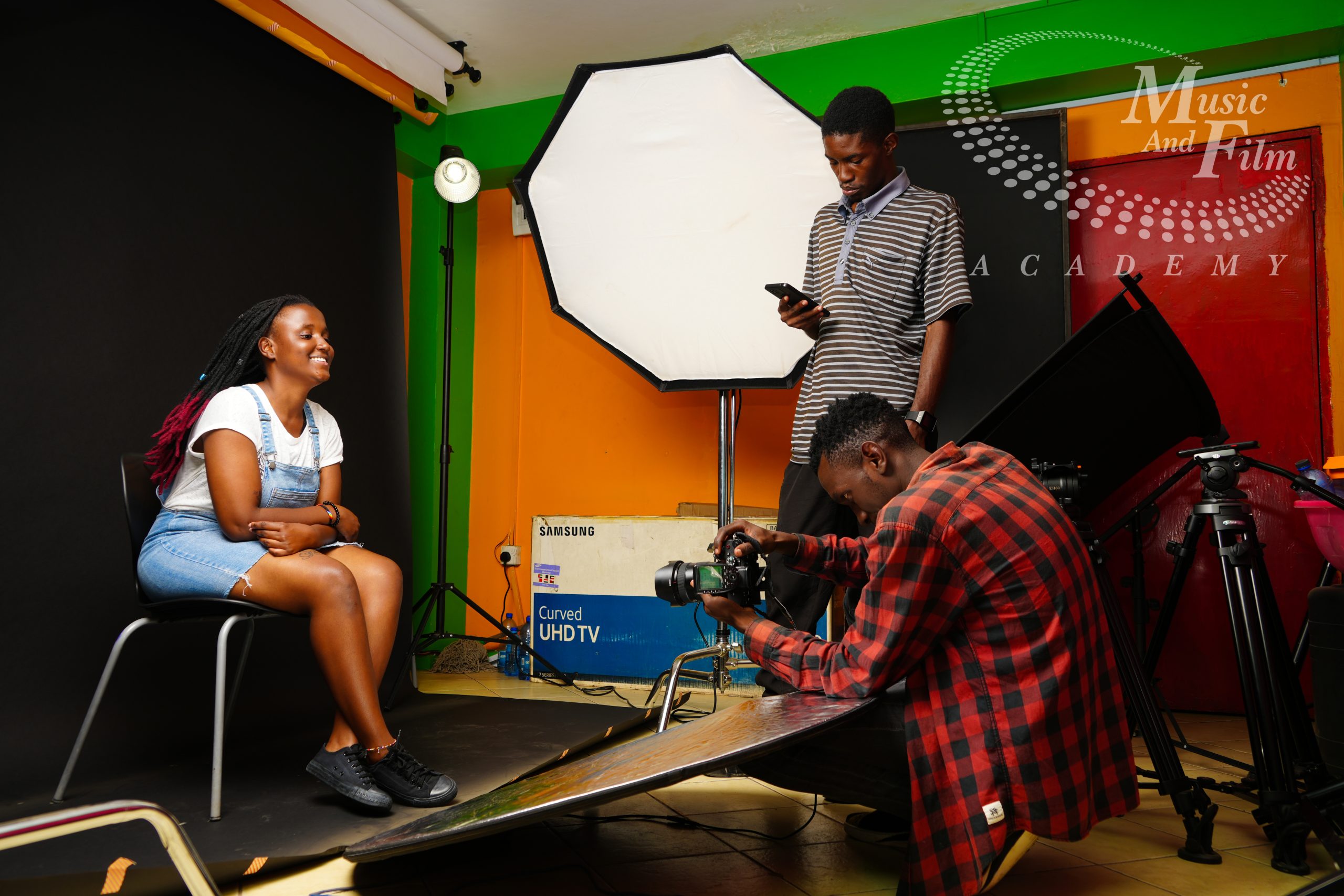
Hands-on studio lighting and camera practice at the Music and Film Academy, Nairobi.
Best Film Production Courses in Kenya | School of Visual Arts
Welcome to the ultimate launchpad for cinematic storytellers, directors, editors, sound designers, and directors of photography. The School of Visual Arts at the Music and Film Academy provides the most practical, deeply immersive, and industry-aligned film production courses in Nairobi, Kenya. Our comprehensively structured programs are specifically engineered for high-school leavers, working media professionals seeking to formalize their craft, and independent content creators who want to transition from casual shooting to professional-grade cinema and broadcast television.
With strategic intakes throughout the year (January, May, and September), our TVETA-mapped, portfolio-driven film production school curriculum guarantees that you spend your time on live sets, operating industry-standard camera packages, rather than sitting in endless theoretical lecture halls. Located at Information House in the heart of the Nairobi CBD, our campus offers immediate exposure to the raw creative energy of the capital, serving as a vibrant, living canvas for our media students.
Why Choose Film Production Courses at Music And Film Academy?
The East African creative economy is expanding at an unprecedented rate. With major streaming entities actively commissioning Kenyan originals and regional advertising agencies demanding world-class commercial execution, the need for highly skilled, specialized technical crew members is at an all-time high. However, knowing how to turn on a digital camera is only a tiny fraction of the battle. Understanding psychological visual grammar, audio architecture, intricate crew coordination, and asset management is what makes you truly hirable.
Here is why our academy stands out as the top destination for film production courses in Kenya:
Guaranteed 1:1 Student-to-Gear Access: We completely eliminate the passive “observer” model of learning. When you are on our sets, you operate your own dedicated equipment. Our gear lockers feature professional Blackmagic Design Cinema Cameras, Sony FX systems, advanced grip gear, and high-end field audio setups.
Active Industry Practitioners as Mentors: Our instructors do not just teach from outdated textbooks; they are active directors, cinematographers, and senior editors who shoot high-profile commercial features, documentaries, and corporate brand films across East Africa. You learn real-world troubleshooting, local industry protocols, and modern client management.
Comprehensive Portfolio-First Methodology: You will never graduate with just a certificate or diploma on paper. Every single student departs our film production school with a fully polished, professional director’s showreel, a short film credit, and a technical portfolio designed to stand out to international agencies.
High-Performance Dedicated Editing Suites: Train on powerhouse rendering terminals fully equipped with the Adobe Creative Cloud Suite (Premiere Pro, After Effects) and DaVinci Resolve Studio for professional-tier color grading and conforming workflows.
Strategic Location in the Creative Hub: Being based in the Nairobi CBD means our students are steps away from major production houses, media networks, and casting agencies, creating unparalleled networking opportunities throughout their study.
Robust TVETA & Global Alignment: Our training modules are structured to meet both local regulatory frameworks and international technical standards, ensuring your qualifications carry weight both locally and globally.
Program Pathways
To cater to different career timelines and professional depths, the School of Visual Arts offers two distinct, high-impact pathways in film production courses:
The One-Year Certificate in Film Production & Digital Media
The Two-Year Diploma in Cinematic Arts & Narrative Filmmaking
1. Certificate in Film Production
Duration: 4 Terms (1 Year)
Intakes: January / May / September
Ideal For: High school leavers, active content creators, and corporate communications professionals requiring an intensive, fast-paced technical foundation across all core departments of filmmaking.
The One-Year Certificate provides an accelerated, highly focused pathway into the technical execution of modern motion pictures. This course bypasses theoretical filler to ensure that you master the baseline mechanics of professional camera operation, location audio capture, three-point lighting setups, and fast-turnaround non-linear post-production editing.
Detailed Film Production Certificate Course Curriculum Breakdown
Term 1: Camera Architecture, Optics, and Exposure Physics
The Anatomy of a Cinema Camera: Master the structural differences between mirrorless hybrids and true digital cinema packages. Learn sensor formats (Full Frame vs. Super 35), global versus rolling shutters, and dynamic range latitudes.
The Exposure Triangle in Motion: Deep dive into the physical interaction between shutter angles (mastering the 180-degree rule), cinema ISO calibrations, and lens apertures (T-stops vs. f-stops).
Optical Science & Lens Selection: Learn focal length physics, depth of field compression, and choosing between spherical and anamorphic glass to evoke specific psychological emotions in an audience.
Visual Literacy & Composition Geometry: Practical execution of framing rules (rule of thirds, leading lines, quadrant composition) and managing strict screen direction (the 180-degree line).
Term 2: Lighting Foundations and Location Audio Architecture
The Physics of Light & Color: Exploring the Kelvin color temperature scale, CRI (Color Rendering Index), and handling mixed lighting environments (Daylight vs. Tungsten).
Three-Point Lighting Mechanics: Constructing Key, Fill, and Backlight relationships using hard and soft modifiers to define facial structure, depth, and narrative mood.
Acoustic Wave Distribution & Microphones: Introduction to microphone polar patterns (Shotgun, Hypercardioid, Omnidirectional) and choosing the right capsule for field dialog.
Field Audio Capture & Gain Staging: Operating external multi-track recorders, setting preamp gain staging, eliminating signal floor noise, and handling wireless lavalier frequencies in congested RF environments.
Term 3: The Non-Linear Editing Pipeline (Adobe Premiere Pro)
Post-Production Asset Management: Ingesting footage, creating lightweight proxies for heavy 4K/60p timelines, and structuring non-destructive project bins and scratch disks.
The Art of the Cut: Practical training in continuity editing, J-cuts, L-cuts, smash cuts, and pacing mechanisms for fast-paced commercial media versus documentary narratives.
Audio Post-Processing Basics: Noise reduction, leveling dialog tracks, utilizing compression, and embedding spatial sound effects using standard digital audio workstations.
Deliverable Architecture & Codecs: Compressing video assets without losing structural color fidelity; understanding H.264, ProRes, and modern container profiles for YouTube, TikTok, and broadcast TV.
Term 4: Capstone Commercial Project & Career Launch
Short-Form Content Production: Planning, scripting, and executing a high-impact 60-second commercial or music video under real deadline constraints.
Set Protocol & Crew Integration: Understanding the standard call sheet, safety procedures for grip setups, and the operational hierarchy of a commercial film set.
Freelance Business Architecture: Constructing a digital profile (Behance, Vimeo, YouTube), drafting professional production contracts, and setting up daily/hourly rate billing systems for the Kenyan corporate landscape.
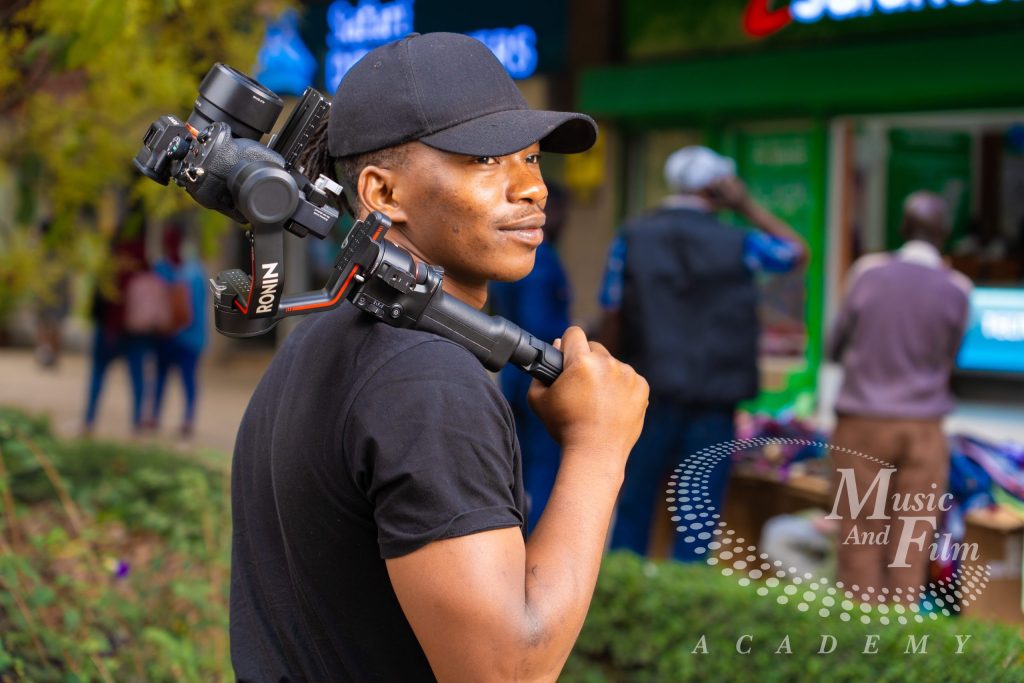
Mastering cinematic camera movement using motorized 3-axis gimbals at the Music and Film Academy.
2. Diploma in Film Production
Duration: 8 Terms (2 Years)
Intakes: January / May / September
Ideal For: Aspiring film directors, screenwriters, cinematographers, and senior editors seeking deep artistic mastery, long-form project management skills, and international creative standards.
The Two-Year Diploma is our flagship program. It takes the technical foundation established in the first year and expands into advanced narrative mastery, psychological direction, complex lighting engineering, and high-end post-production color grading. This program trains you to be a creative decision-maker, a filmmaker capable of leading teams on large-budget productions.
Detailed Film Production Diploma Course Curriculum Breakdown
Year 1: Technical Mastery & Short Forms (Terms 1 to 4)
Note: Diploma students complete the comprehensive technical foundation outlines of the Certificate program during their first year, developing an ironclad grasp of cameras, lighting, sound, and basic editing mechanics.
Year 2, Term 5: Advanced Cinematography & Grip Infrastructure
Advanced Camera Packages: Operating multi-camera setups, configuring RAW recording formats (ProRes RAW, Blackmagic RAW, REDCODE), and understanding log color profiles.
Cinematic Grip Movement Engineering: Mastering fluid heads, heavy-duty tracking dollies, jib arms, and electronic 3-axis gimbal calibration for complex tracking shots.
The Inverse Square Law & Large-Scale Lighting: Calculating light falloff across expansive interior/exterior spaces, using heavy distribution panels, and operating high-power HMI and LED fixtures.
Color Science & Calibration: Exploring color spaces (Rec. 709, DCI-P3, Rec. 2020), using waveform monitors, vectorscopes, and light meters for perfect digital negative consistency.
Year 2, Term 6: Screenwriting, Narrative Directing, and Acting Physics
The Three-Act Story Structure: Script formatting mechanics, character arc design, subtextual writing, and developing conflict beats using professional industry software (Celtx/Final Draft).
Director-Actor Communication: Deciphering actor psychology, table reads, translating script subtext into physical blockings, and avoiding performance-killing clichés.
Visual Directing Systems: Creating shot lists, storyboarding complex action sequences, and collaborating with Production Designers to build cohesive color palettes for sets.
Audition Processes and Casting Logistics: Navigating local casting frameworks, setting up talent databases, and handling performance releases under Kenyan copyright laws.
Year 2, Term 7: Advanced Post-Production & DaVinci Resolve Masterclass
Conforming and Advanced Color Grading: Importing XML timelines into DaVinci Resolve, primary color corrections, balancing multiple camera sensors, and building custom Look Up Tables (LUTs).
Secondary Color Grading Manipulation: Utilizing tracking windows, qualifiers, and custom keys to isolate skin tones, alter background color palettes, and create specific cinematic styles.
VFX Composting Foundations (After Effects): Green screen keying, rotoscoping, camera tracking, and integrating motion graphics cleanly into live-action plates.
Advanced Sound Design: Multi-track mixing, sound effect creation (Foley recording), and mastering audio outputs for theatrical release or streaming platforms.
Year 2, Term 8: Thesis Film, Industry Placement, and Graduation
The Diploma Thesis Production: Students pitch, script, fund, crew, and execute a professional 10-to-15 minute narrative short film or documentary feature.
Line Producing & Production Management: Budgeting, location scouting, processing permits (KFCB, county licenses), and managing catering and transport logistics.
Industry Placement & Apprenticeship: A mandatory 6-week internship with a leading media house, commercial agency, or active production company in Nairobi.
The Grand Portfolio Showcase: Screening of thesis films to local industry stakeholders, producers, and agencies at our annual graduation showcase, unlocking BTEC and TVETA diplomas.
Career Paths After a Film Production Course in Kenya
Graduating from our intensive film production courses in Kenya opens up a vast array of specialized career trajectories within the local, regional, and international media landscapes. You will be fully equipped to step directly onto professional sets or launch your own media enterprise.
Department
Certificate Entry Roles
Diploma Senior Roles
Camera & Grip
Camera Assistant (2nd AC), Data Wrangler, Camera Operator
Director of Photography (DoP), Gaffer, Key Grip
Post-Production
Assistant Video Editor, DIT (Digital Imaging Technician)
Lead Film Editor, Colorist, VFX Compositor, Sound Designer
Creative & Directing
Script Supervisor, 3rd Assistant Director (AD)
Film Director, Screenwriter, Creative Producer, Showrunner
Production Office
Production Assistant (PA), Location Scout
Production Manager, Line Producer, Executive Producer
Admissions, Tuition, and Enrollment Criteria
We strictly limit our class sizes to ensure our 1:1 gear policy is maintained. Places are allocated on a first-come, first-served basis to qualified applicants during our regular entry windows.
Fee Structure
Our fee structure is completely transparent with no hidden equipment rental charges or lab access fees for student coursework.
Course Level
Duration
Tuition Fee (per Term)
Lab & Gear Levy (per Term)
One-Year Certificate
4 Terms
KES 40,000
KES 5,000
Two-Year Diploma
8 Terms
KES 40,000
KES 7,500
Frequently Asked Questions (FAQ)
Do I need to own a professional camera to join your film production courses?
No. Our film production school supplies all essential production equipment—including high-end digital cinema cameras, lenses, lighting systems, microphones, and editing workstations—for use during class hours and official course projects. However, we highly recommend that students invest in a personal laptop capable of running standard video editing software for completing off-campus assignments.
What qualifications do I need to enroll in these film production courses in Kenya?
For the One-Year Certificate, a passionate interest in visual media and a KCSE certificate are preferred. For the Two-Year Diploma program, a minimum mean grade of C- (Minus) or equivalent secondary certificate is standard. Alternatively, students who successfully complete our Certificate course or present a verified professional portfolio of media work can gain direct entry into the Diploma track.
Are the classes flexible for working professionals?
Yes. Alongside our regular full-time day schedules, we offer specialized evening and weekend tracks designed specifically for corporate media professionals and independent filmmakers who need to balance their studies with existing work commitments.
Does the academy assist with internships and job placement?
Absolutely. Our Two-Year Diploma includes a mandatory 6-week industry placement module during the final term. We hold active relationships with leading TV broadcasters, commercial production houses, and digital creative agencies across Nairobi to ensure our students get direct exposure to employers.
Contact Us & Apply Today
Are you ready to take command of the set and bring your unique stories to life on the big screen? Visit our Nairobi campus for a guided tour of our shooting studios, audio bays, and post-production labs.
[ HAVE A QUESTION ABOUT ENROLLMENT?]
Expand Your Skillset
Explore complementary professional tracks at Music And Film Academy.
Photography Courses: Capture the world through a professional lens. Master lighting, composition, and high-end digital retouching to build a stunning visual portfolio. Explore Photography →
Videography Courses: Move beyond the still image. Learn cinematic camera techniques, gimbal operations, and storytelling for the modern digital era. Explore Videography →
Graphic Design Courses: Communicate visually with impact. Learn the principles of branding, typography, and industry-standard software to complement your media production skills. Explore Graphic Design →
Cross-Disciplinary Discount: Enrolling in more than one track? Ask our admissions team about our multi-course bundle for 2026.