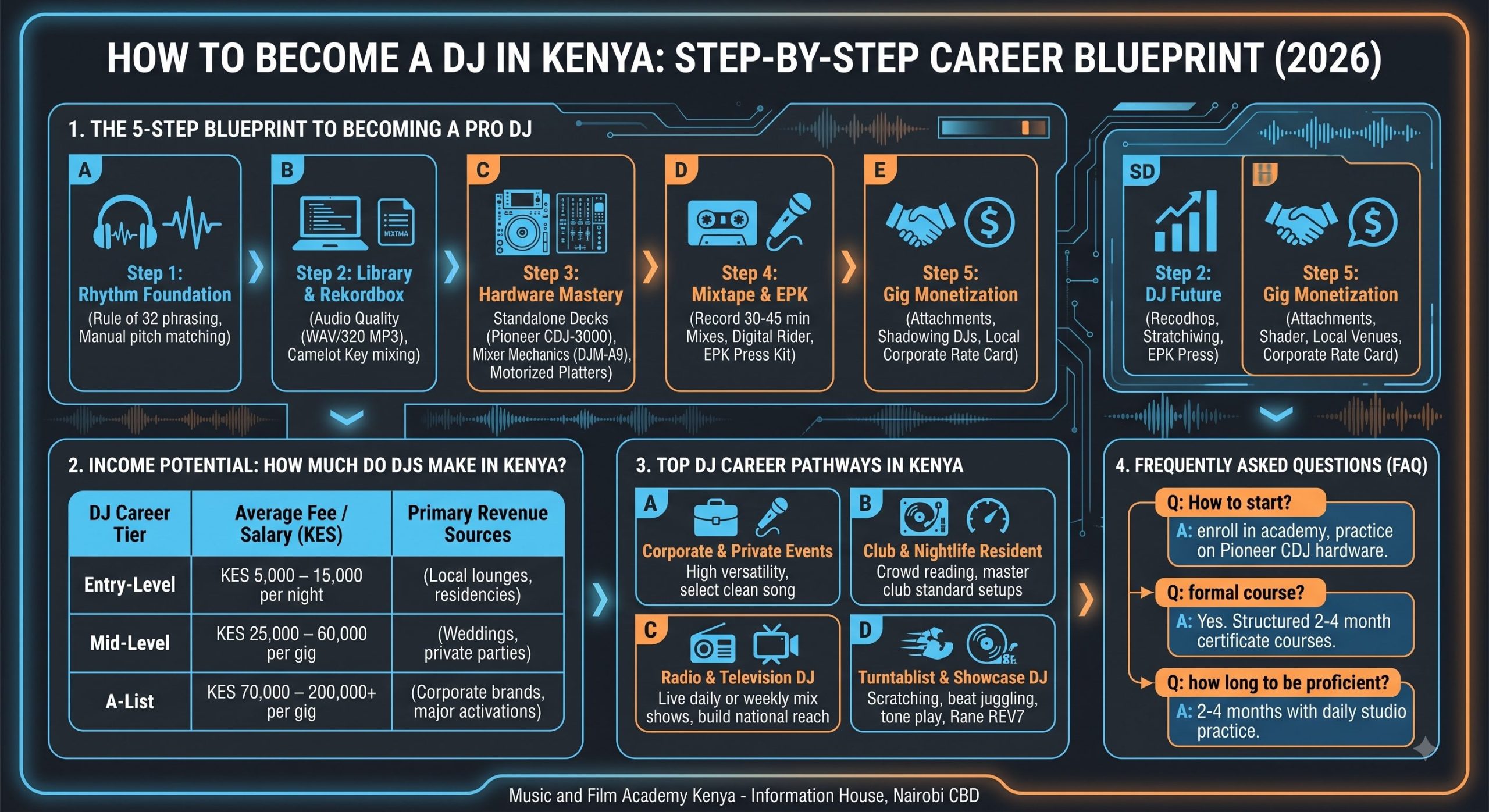
How to become a DJ in Kenya infographic. 5-step blueprint: Rhythm foundation, Rekordbox library, Hardware mastery (Pioneer CDJ-3000), Mixtape portfolio, and Gig monetization. Features DJ salary tiers KES 5k–200k.

How to Become a DJ in Kenya: Step-by-Step Career Blueprint (2026)

To become a dj in kenya, you must follow a structured 5-step roadmap: mastering tactile beatmatching mechanics, organizing your digital music library in Rekordbox, training on club-standard hardware, recording high-impact promotional mixtapes, and securing event bookings.

The entertainment market in Kenya offers vast commercial opportunities, with entry-level DJs earning KES 5,000 to KES 15,000 per night in local clubs, while established corporate DJs command KES 70,000 to KES 200,000+ per event. At Music and Film Academy’s DJ Department in Nairobi CBD, we accelerate this career transition through hands-on performance lab training and venue placements.

1. The 5-Step Blueprint to Becoming a Professional DJ

Plaintext

  [Step 1: Rhythm Foundation]  ➜  [Step 2: Library & Rekordbox]  ➜  [Step 3: Hardware Mastery]
  (32-Bar Rules, Pitch Matching)   (WAVs, Metadata Tags, Cues)      (Pioneer CDJ-3000, DJM-A9)
                                                                               │
                                                                               ▼
  [Step 5: Gig Monetization]    ◄────────────────────────────────   [Step 4: Mixtape & EPK]
  (Club Night, Corporate, TV)                                       (Serato Recording, Rate Card)

Step 1: Master Timing, Phrasing & Beatmatching

Before touching performance effects or sync buttons, you must develop natural ear training and rhythm perception:

  • The Rule of 32: Dance music is structured in 32-beat blocks (bars and measures). Understanding when a track’s intro, verse, build-up, and drop occur ensures seamless transitions without clashing vocals.
  • Manual Pitch Matching: Practice adjusting pitch faders by ear to match the BPM (beats per minute) of two separate tracks.

Step 2: Build & Organize a High-Resolution Music Library

Organized file management separates amateur hobbyists from professional working DJs:

  • Audio Quality: Always source uncompressed WAV/AIFF or 320kbps MP3 audio files. Low-quality audio downloads distort when played on high-wattage club PA systems.
  • Rekordbox & Serato Management: Set memory cues, hot cues, and grid markers inside Rekordbox. Use the Camelot Wheel key system to mix harmonically (matching compatible musical keys).

Step 3: Train on Industrial Club Hardware

Learning exclusively on budget laptop controllers leaves you unprepared for commercial venues. You must develop muscle memory on industry-standard consoles:

  • Standalone Decks: Pioneer CDJ-3000 and CDJ-2000NXS2 standalone players.
  • Mixer Mechanics: Pioneer DJM-A9 and DJM-900NXS2 mixers, mastering 3-band EQ isolation, gain staging, and sound color FX.
  • Motorized Decks: Rane REV7 or Rane Twelve MKII platters for vinyl feel, scratching, and DVS (Digital Vinyl Systems).

Step 4: Record Promotional Mixtapes & Build an EPK

Clients hire DJs based on proven sound, not verbal promises. Create a digital portfolio:

  • Recorded Mixtapes: Produce 30-to-45-minute thematic mixes (e.g., Afro-House, Amapiano, Gengetone, Reggae, or Old School R&B) and publish them on platforms like Mixcloud or SoundCloud.
  • Electronic Press Kit (EPK): Build a professional media kit containing high-resolution performance photos, bio, social media links, mixtape links, and a clear performance rider.

Step 5: Secure Gigs, Attachments & Business Monetization

Transforming technical capability into a sustainable business requires active networking and licensing compliance:
  • Venue Attachments: Shadow senior DJs at local lounges, clubs, and corporate functions.
  • Copyright Compliance: Ensure your performance operations align with local copyright licensing bodies like PRISK, KAMP, and MCSK for legal commercial broadcast.
How to become a DJ in Kenya infographic. 5-step blueprint: Rhythm foundation, Rekordbox library, Hardware mastery (Pioneer CDJ-3000), Mixtape portfolio, and Gig monetization. Features DJ salary tiers KES 5k–200k.
Visual roadmap outlining how to become a professional DJ in Kenya, detailing technical steps, essential hardware platforms, portfolio building, commercial monetizing pathways, and average gig rates at Music and Film Academy in Nairobi CBD.

2. Income Potential: How Much Do DJs Make in Kenya?

The DJ industry in Kenya offers distinct earning tiers based on experience, brand positioning, and market focus:

DJ Career TierAverage Fee / Salary (KES)Primary Revenue Sources
Entry-Level / Club ResidentKES 5,000 – KES 15,000 per nightLocal lounge sets, mid-week club residencies, campus events.
Mid-Level Event DJKES 25,000 – KES 60,000 per gigWeddings, high-end club headlining, private parties, regional concerts.
A-List / Corporate DJKES 70,000 – KES 200,000+ per gigMajor corporate brand activations, international tours, radio/TV residency.

3. Top DJ Career Pathways in Kenya

Depending on your musical style and business goals, you can specialize in distinct sectors:

  1. Corporate & Private Event DJ: High-paying sector focusing on corporate launches, product activations, trade expos, and weddings. Requires high versatility, clean song selection, and professional contract negotiation skills.
  2. Club & Nightlife Resident: High-energy environment focusing on crowd reading, peak-hour pacing, and mastering club-standard setups under intense sound levels.
  3. Radio & Television DJ: Fixed media employment hosting live daily or weekly mix shows on top stations, building massive national reach.
  4. Turntablist & Showcase DJ: Competition-level performance focusing on fast scratching, beat juggling, tone play, and live remixing using motorized vinyl platters.

4. Frequently Asked Questions (FAQ)

How do I start becoming a DJ in Kenya?

To start, enroll in a hands-on DJ academy to learn rhythm phrasing, timing, and Rekordbox file management. Practice on commercial Pioneer CDJ hardware, record a 30-minute mixtape, and build an EPK to approach venue managers.

Is there a formal course to become a DJ in Kenya?

Yes. Music and Film Academy in Nairobi CBD offers structured 2-to-4-month TVETA-mapped certificate courses covering Basic Beatmatching, Advanced Harmonic Mixing, and Master Turntablism.

How long does it take to become a proficient DJ?

With daily studio practice on 1:1 hardware, you can master basic beatmatching and transition mechanics in 2 months. Achieving advanced turntablism, scratching, and crowd control takes 3 to 4 months.

Launch Your Career at Music and Film Academy

Start your journey toward becoming a professional DJ at Music and Film Academy’s DJ Department.

  • Location: Information House, Hakati Road, Nairobi CBD
  • Explore Programs: View our full range of DJ Courses in Kenya.