Phone:
+254 719 428 550
Physical address:
Information House, Hakati Road,
Nairobi, Kenya.

Phone:
+254 719 428 550
Physical address:
Information House, Hakati Road,
Nairobi, Kenya.
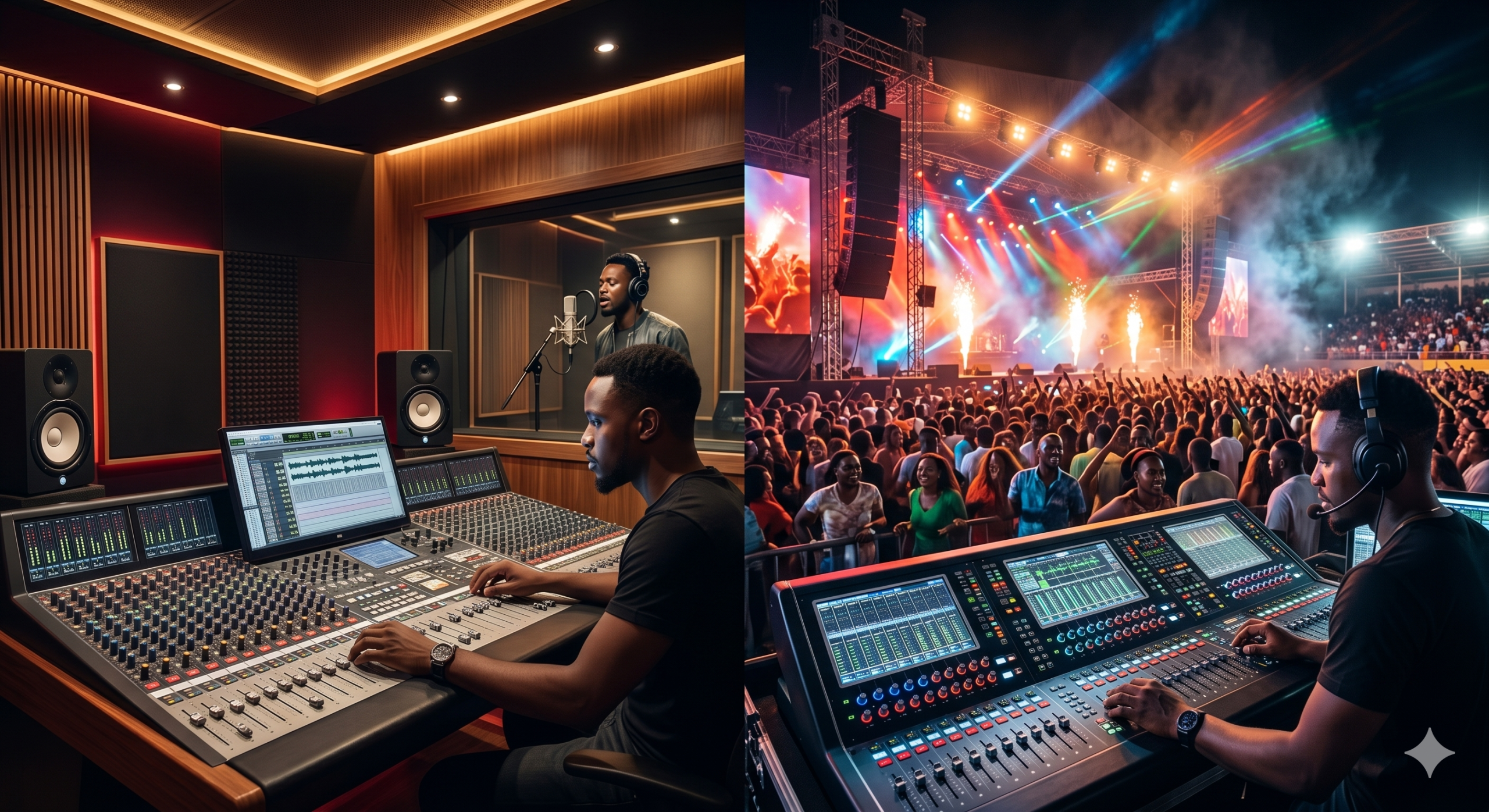
As the creative economy in Nairobi continues to professionalize in 2026, aspiring audio professionals often find themselves at a crossroads: live sound vs studio engineering. Both disciplines are rooted in the same fundamental physics of audio, yet they require vastly different temperaments, technical workflows, and environmental adaptations. Choosing the right path is not just about your love for music; it is about how you want to interact with sound on a day-to-day basis. Whether you crave the high-stakes energy of a concert at the KICC or the surgical precision of a recording session in the CBD, your journey begins with professional sound engineering courses.
At the Music and Film Academy, we believe that a “Mastery” mindset requires a deep understanding of both worlds before specializing. While the tools—microphones, mixers, and processors—are often shared, the application of those tools changes the moment you move from a controlled studio environment to a dynamic live stage. This guide breaks down the essential differences to help you decide which path aligns with your long-term career goals.
Studio engineering is the discipline of the “Decisive Version.” In the studio, time is a tool. You have the luxury of multiple takes, infinite “undos,” and the ability to microscopicly edit a vocal performance or a drum hit until it is flawless.
In the studio, the engineer’s goal is to capture the best possible signal at the source. This involves meticulous microphone placement, selecting the right pre-amps, and ensuring that the room’s acoustics are perfectly tuned. As we emphasize in our sound engineering courses in kenya, studio work is where the “Science of Sound” meets the “Art of Patience.” You might spend three hours just getting the right tone for a snare drum before a single note is recorded.
Once the recording is complete, the studio engineer moves into the mixing phase. This is a solitary, highly focused process where you balance levels, apply EQ, and use spatial effects like reverb and delay to create a cohesive sonic landscape. For those also interested in music production courses, this is where the two fields most heavily overlap.
If studio engineering is about perfection, live sound is about “Performance.” In the world of live audio, there are no “second takes.” Once the band starts playing, the sound engineer must manage a complex, shifting environment in real-time.
The Live Sound Engineer (often called the FOH Engineer) is responsible for what the audience hears. This involves battling the natural acoustics of a venue, managing feedback loops, and ensuring that the mix is powerful yet clear across a wide area. In the fast-paced Nairobi event scene, live sound requires a “Combat Medic” mentality—you must be able to troubleshoot technical failures in seconds while thousands of people are watching.
A specialized sub-discipline of live sound is monitor engineering. This professional focuses entirely on what the performers hear on stage. Whether using floor wedges or In-Ear Monitors (IEMs), the monitor engineer ensures the band can hear themselves perfectly, which is essential for a great performance.
The choice between live sound vs studio engineering often comes down to where you feel most comfortable working.
While both paths require the foundational knowledge taught in our School of Music Technology, the specific “muscles” you use are different.
In both worlds, you must master signal flow. However, in the studio, this usually involves routing signals through high-end outboard gear and into a DAW like Pro Tools. In live sound, it involves complex patching of stage boxes, digital snakes, and massive PA systems.
When comparing live sound vs studio engineering in the local market, the financial structures differ:
| Factor | Studio Engineering | Live Sound Engineering |
| Primary Clients | Recording Artists, Film Directors, Ad Agencies | Event Planners, Churches, Touring Bands |
| Work Schedule | Project-based; can be irregular but stable | Weekend-heavy; involves late nights and travel |
| Income Type | Per Project or Per Hour | Day Rates or Retainers |
Many successful alumni of our sound engineering courses choose to do both. They might spend their weekdays mixing projects in a studio in the CBD and their weekends managing sound for major festivals. This “Hybrid Model” is the most sustainable way to build a legacy in the Kenyan creative economy.
You cannot learn the difference between live sound vs studio engineering through a screen. You need to feel the vibration of a kick drum through a professional PA system and hear the subtle nuances of a high-end condenser microphone in a treated room.
At the Music and Film Academy, we provide:
For those looking to add a performance edge to their technical skills, we also recommend exploring our DJ schools in Kenya, as the crossover between live sound engineering and professional DJing is significant.
Ultimately, the debate of live sound vs studio engineering isn’t about which is “better”—it’s about which version of you is better suited for the task. Do you want to build a sonic masterpiece layer by layer, or do you want to command the energy of a crowd in real-time?
Regardless of the path you choose, the foundation remains the same: technical excellence, a disciplined ear, and professional certification. Are you ready to find your place in the sound booth? Explore our sound engineering courses in kenya today and join us at Information House to start your journey. Visit the Home Page to see our full range of creative programs.