Phone:
+254 719 428 550
Physical address:
Information House, Hakati Road,
Nairobi, Kenya.

Phone:
+254 719 428 550
Physical address:
Information House, Hakati Road,
Nairobi, Kenya.
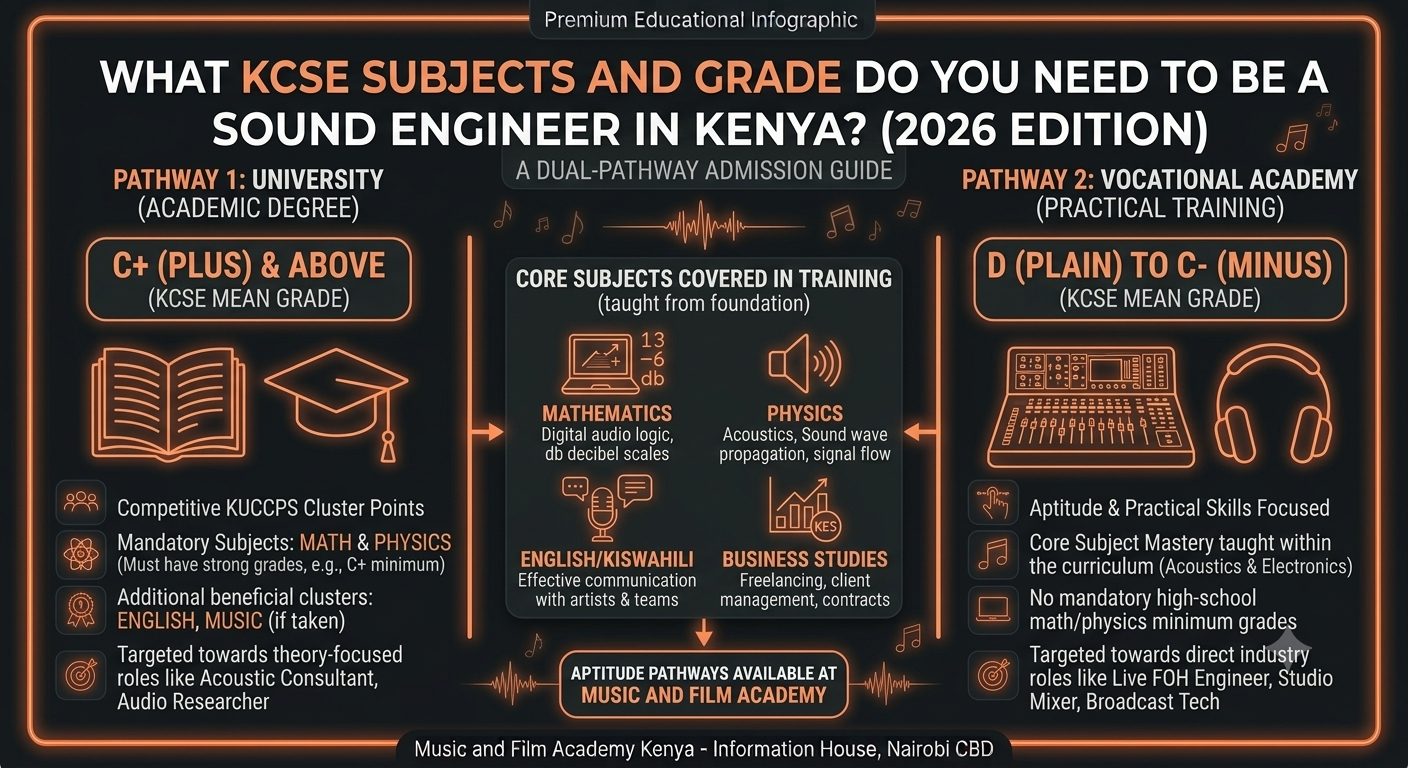
The specific KCSE subjects and mean grade you need to become a sound engineer in Kenya vary significantly based on your preferred educational pathway: a university academic degree requires a minimum KCSE mean grade of C+ (plus) with mandatory credits in Physics and Mathematics, while a specialized vocational certificate prioritizing practical skills requires KCSE mean grades starting from D (plain) with no rigid subject constraints.
It is critical to distinguish between traditional university-level Electrical Engineering (which focuses on theoretical math and circuit physics) and modern Sound/Audio Engineering (which focuses practically on acoustics, Digital Audio Workstations, signal flow, and mixing consoles).
At Music and Film Academy’s Sound Engineering Department in Nairobi CBD, we follow TVETA-aligned admission models focused on capability. We teach necessary acoustic physics and digital math from the ground up, providing direct pathways for students with KCSE scores from D (plain) to C- (minus) to become industry-qualified audio engineers.
| Pathway | Mandatory KCSE Mean Grade | Must Hold Credits In: (Cluster Subjects) | Admission Model | Target Credential |
| University Track (e.g., TUK, KU, Kabarak) | C+ (Plus) and above | Physics AND Mathematics (usually C+ minimum in each) | Competitive Academic Cluster Points | Bachelor of Music Technology (Degree) |
| Vocational Track (e.g., Music and Film Academy) | D (Plain) to C- (Minus) | No mandatory subjects required | Aptitude & Creative Potential Assessment | TVETA Level 5/6 Certificate or BTEC Diploma |
While no subject is strictly “required” for vocational entry, certain high school courses provide a foundational logical framework for audio training:
To navigate the admissions landscape in Kenya effectively, understand that different departments classify audio engineering differently:
If you apply to study traditional engineering (e.g., Electrical) aiming to specialize later in acoustics, universities require:
For a Bachelor of Music Technology, universities still require:
For specialized programs like our 1-Year Certificate in Sound Engineering or our 2-Year Pearson BTEC Diploma, we bypass rigid academic scoring.
We follow TVETA and international accreditation guidelines that accept capability entry points for Level 5/6 vocational tracks:
Yes. specialized vocational sound engineering academies in Nairobi CBD offer accredited TVETA and Pearson BTEC certificate pathways that explicitly accept KCSE Mean Grades of D (plain), focusing on aptitude and digital capability rather than academic scoring.
Traditional university-level academic engineering degrees require a mandatory minimum KCSE mean grade of C+ (plus) with strong results in Mathematics and Physics. However, professional vocational audio training requires grades starting from D (plain) upwards.
If you are pursuing a Bachelor of Music Technology degree, yes. However, for specialized practical vocational Certificate/Diploma pathways at academies like Music and Film Academy, no specific grades in Mathematics or Physics are required; we teach the relevant concepts of acoustics and digital math practically within the curriculum.
Master digital mixing consoles, acoustics, and live PA reinforcement at Music and Film Academy in Nairobi CBD.