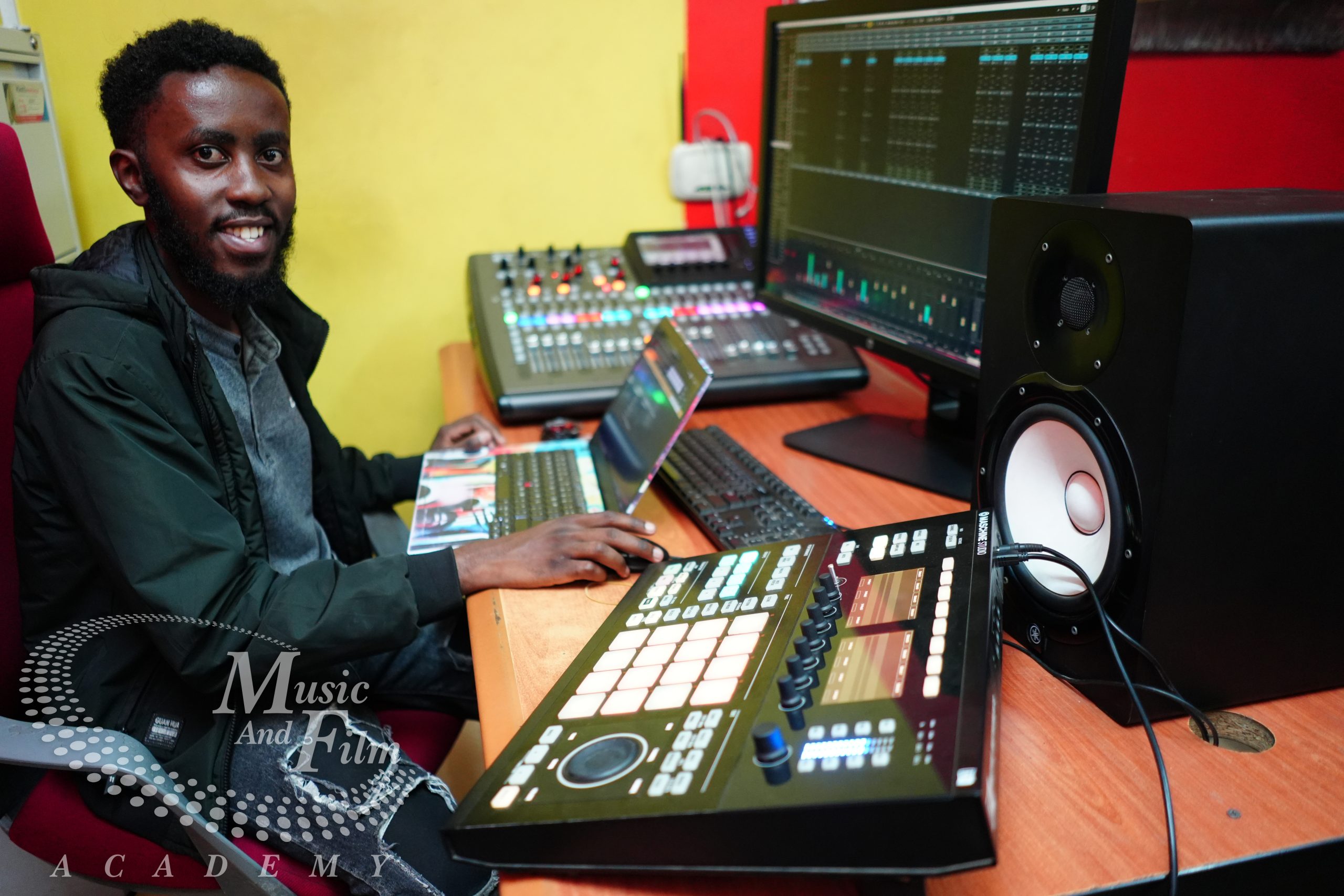
Gain hands-on experience with industry-standard audio gear and production software in our modern Nairobi campus labs.
Certificate in Music Production | School of Music Technology
Are you looking to break into the dynamic world of audio engineering, but don’t know where to start? The Certificate in Music Production at the Music and Film Academy is your premier fast-track gateway to mastering the art and science of studio recording, mixing, and digital audio workstation (DAW) manipulation. Designed specifically for aspiring creators, beatmakers, podcasters, and upcoming sound technicians, this intensive program delivers hands-on, practical expertise right in the heart of Nairobi.
Navigating the modern creative economy requires more than just passion—it demands structural, industry-recognized technical skills. Whether your ultimate goal is to produce chart-topping hits, engineer live sound events, or compose spatial audio for film, securing a foundational Certificate in Music Production ensures you bypass years of frustrating trial-and-error. Our modern studio environments bridge the gap between creative intuition and professional technical execution, preparing you to hit the ground running from day one.
This professional track is engineered for deep competency, balancing heavy practical studio runtime with rigorous theoretical foundations aligned with TVETA frameworks and international Pearson BTEC criteria.
The global music industry has democratized, but the barrier to entry for clean, commercial-grade audio remains exceptionally high. Many self-taught producers spend years watching fragmented online tutorials without ever understanding the fundamental physics of sound or proper gain staging.
Choosing a structured Certificate in Music Production collapses that learning curve into a focused, highly interactive curriculum.
Accelerated Career Entry: Unlike longer academic paths, a certificate focuses strictly on core competencies, allowing you to enter the market and start earning within months.
Structured Learning Path: Move systematically from basic acoustic principles to advanced dynamic processing without gaps in your technical knowledge.
Studio Equipment Familiarization: Gain direct access to industrial-grade gear, condenser microphones, acoustic environments, and premium monitoring systems that home setups lack.
If you are trying to decide between a short-term foundational program or a more extensive academic commitment, you can compare our tracks by viewing our comprehensive breakdown of music production courses in Kenya.
Institutional Accreditation & Global Standards
At the Music and Film Academy, we prioritize professionalizing the creative economy through structured, competency-based education. This program is fully compliant with local statutory requirements and international elite benchmarks:
TVETA Registration: Our curriculum is fully aligned with the Technical and Vocational Education and Training Authority (TVETA) standards, ensuring your credential carries full regulatory weight within Kenya.
Pearson BTEC Certification: Built to meet international requirements, our training pathways incorporate global industry frameworks, giving our graduates a competitive edge both locally and internationally.
Core Course Modules & Curriculum Structure
Our curriculum is built around real-world competencies, strictly aligned with modern international benchmarks and regional technical standards. Every module is designed to give you a tangible skill set that you can monetize immediately.
🎹 Term 1: Digital Audio Architecture & Foundational Engineering (Weeks 1–12)
Weeks 1–2: The Digital Signal Path & Hardware Calibration
Technical Deep-Dive: Dive into the core physics of digital conversion—specifically Analog-to-Digital (A/D) and Digital-to-Analog (D/A) pathways. You will study how acoustic sound pressure waves are converted into binary voltage steps, mastering the math behind Sample Rates (44.1kHz vs. 96kHz) and the deployment of 24-bit depth to achieve a pristine 144 dB theoretical dynamic range.
Learning Outcome: Configure audio interfaces, internal clocks, and hardware preamps to secure pro-fidelity, jitter-free recording setups.
Week 3: The DAW Engine Optimization
Technical Deep-Dive: An exhaustive exploration of the internal processing architecture of FL Studio 24 and Ableton 12. Students will analyze the relationship between Asio driver buffer sizes (samples vs. milliseconds) and CPU strain to prevent audio dropouts, buffer underruns, and digital crackles during track-heavy production sessions.
Learning Outcome: Master the ability to isolate and resolve complex hardware/software driver conflicts on any studio computer.
Week 4: Precision Gain Staging & Headroom Architecture
Technical Deep-Dive: Deconstruct the -18 dBFS Rule and its vital application to the “Digital Ceiling.” You will learn why pushing digital meters into the yellow/red creates harsh clip distortion, practicing how to stage analog modeling plugins to hit their optimal nominal operational sweet spots.
Learning Outcome: Achieve mathematically clean, unclipped audio tracking chains with enough preserved headroom for high-end mixing.
Weeks 5–6: Waveform Physics & Phase Management
Technical Deep-Dive: Exploring acoustics, transducer principles, and cyclic waveforms (Sine, Sawtooth, Square, and Triangle). This module features intensive training on Phase Correlation meters and the deployment of Phase Inversion (180 Degree polarity flip) to instantly repair thin, hollow, or comb-filtered multi-mic setups.
Learning Outcome: Diagnose and solve phase cancellation anomalies instantly when recording multi-mic or layered acoustic sources.
Week 7: Microphone Technology & Electro-Acoustics
Technical Deep-Dive: An analytical comparison between Dynamic and Condenser microphone physics, breaking down Electromagnetic Induction vs. Electrostatic variable capacitance principles. You will learn the correct routing and application of +48V Phantom Power to protect fragile circuitry.
Learning Outcome: Match and select the perfect microphone type and polar pattern tailored to specific vocal registers or acoustic instruments.
Technical Deep-Dive: Deconstruct the intricate micro-timing of the classic 4/4 “Boomba” beat (the engine of Gengetone and Kapuka). Students move entirely away from standard grid-locked quantization, learning manual Velocity Editing and micro-delay shift techniques to capture the organic swing and pocket of Nairobi’s urban club music.
Learning Outcome: Produce authentic, humanized, and highly infectious Kenyan urban rhythms from scratch.
Weeks 10–11: East African Diatonic Theory & Melodic Architecture
Technical Deep-Dive: Harmonic analysis of the foundational chord structures that dominate East African airwaves. Master the transposition and functional harmony of I-IV-V and I-V-vi-IV triads, learning how to layer suspended chords and passing tones to enrich local pop and regional gospel hooks.
Learning Outcome: Compose radio-ready, catchy, and culturally relevant melodic and harmonic backing structures.
Week 12: Final Project Exporting & Industry-Standard Delivery
Technical Deep-Dive: Advanced bouncing protocols within your DAW. Master structural bounce parameters including dither types (POW-r, triangular), normalization settings, metadata tagging, sample rate conversion artifacts, and archiving clean audio stems for the current 2026 global distribution standards.
Learning Outcome: Deliver a fully polished, 2-minute radio-ready instrumental compiled to pristine industry specifications.
🎛️ Term 2: Surgical Mixing Foundations & Global Beat Aesthetics (Weeks 13–24)
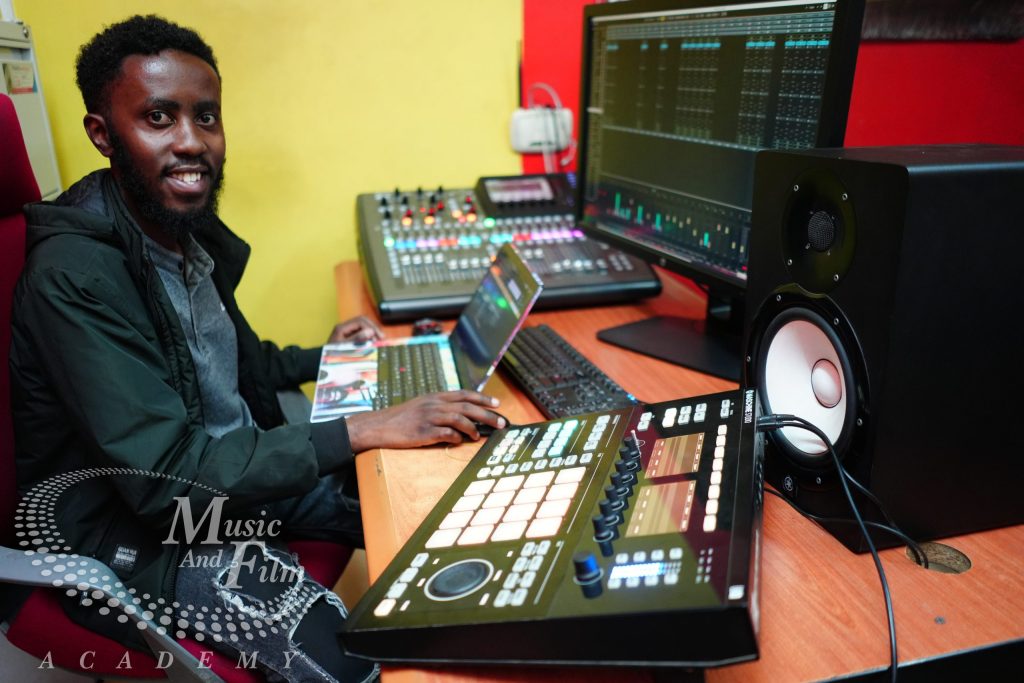
Gain hands-on experience with industry-standard audio gear and production software in our modern Nairobi campus labs.
Weeks 13–14: Parametric EQ Mastery & Frequency Carving
Technical Deep-Dive: Command the Q Factor (Bandwidth calculation) across multi-band parametric equalizers. Learn the distinct clinical differences between Surgical EQ (using high-Q resonant frequency sweeping and precise filtering to remove unpleasant room resonances) and Musical EQ (wide-Q shelving to add expensive air or warmth). Master the placement of High-Pass (HPF) and Low-Pass (LPF) filters.
Learning Outcome: Carve clean frequency “pockets” for every single instrument to completely eradicate overlapping muddy zones.
Weeks 15–16: Dynamics Processing I (The Foundations of Compression)
Technical Deep-Dive: An exhaustive breakdown of Dynamic Range Compression through its five foundational pillars: Threshold, Ratio, Attack time, Release time, and Makeup Gain. Students will learn to analyze how these variables alter the transient envelope, distinguishing between RMS (Root Mean Square) sensing and instantaneous Peak detection compression styles.
Learning Outcome: Anchor lead vocals and volatile acoustic tracks so they sit solidly “front and center” within a commercial mix.
Technical Deep-Dive: Designing three-dimensional depth using algorithmic and convolution reverbs and multi-tap delay lines. Master the fine-tuning of Pre-delay to separate dry, upfront transients from wet, ambient reflections, alongside configuring specialized Ping-Pong and Slapback configurations optimized for modern Dancehall riddims.
Learning Outcome: Inject lush width, depth, and distance into a mix without causing muddy frequency build-ups.
Weeks 19–20: Global Rhythms & Harmonics (Beatmaking II)
Technical Deep-Dive: Production ethics for global urban genres, including heavy Trap, international Dancehall, and Contemporary R&B. You will learn to use tape, tube, and soft-clip Saturators to add upper-mid, odd-order harmonics to sub-heavy 808 bass lines, allowing low frequencies to cut through consumer environments.
Learning Outcome: Ensure sub-bass frequencies retain distinct definition and audibility when played through small smartphone speakers and laptops.
Technical Deep-Dive: Creative audio archeology. Learn the techniques of digitizing, restoring, and manipulating vintage Benga or Zilizopendwa vinyl records or archival tape. Master precision Zero-Crossing editing to guarantee that cut samples are free from distracting digital clicks, pops, and cyclic phase discontinuities.
Learning Outcome: Create seamless, high-fidelity sample integration that breathes new life into historic sonic gems.
Weeks 23–24: Subtractive Synthesis & Advanced Jazz Theory
Technical Deep-Dive: Demystifying sound design through classic Subtractive Synthesis. Students will manipulate raw Voltage-Controlled Oscillators (VCOs), Voltage-Controlled Filters (VCFs), and ADSR envelopes to synthesize custom lead patches and bass instruments. This is paired with harmonic exploration of Seventh Chords (Maj7, m7, Dominant 7) and slick ii-V-I turnarounds.
Learning Outcome: Move past generic stock presets to build custom, bespoke lead and bass instruments completely from scratch.
🎙️ Term 3: Advanced Microphone Technics & Stereo Space Imaging (Weeks 25–36)
Technical Deep-Dive: Step into the specialized acoustic profile of Ribbon Microphones. You will map their bidirectional Figure-8 polar patterns and analyze the physics behind their natural high-frequency roll-off, applying this acoustic smoothing to tame harsh, transient-heavy instruments like traditional acoustic Kenyan Mugithi or high-mid-heavy Benga lead guitars.
Technical Deep-Dive: Advanced multi-microphone capture paradigms. Master the physical geometry, distance math, and phase realities of XY, ORTF, and Mid-Side (M/S) configurations. You will learn to route an M/S matrix manually in your DAW mixer using phase-inverted duplicate tracks to gain absolute, continuous authority over the stereo width of complex acoustic sources.
Learning Outcome: Produce perfectly phase-aligned, immersive stereo imaging for massive gospel choirs or acoustic instrument ensembles.
Weeks 33–36: Parallel Processing Engines
Technical Deep-Dive: Implementing high-level Parallel Processing pipelines (commonly called “New York Compression”). You will configure complex auxiliary groups to blend completely untouched, highly dynamic “dry” tracking paths with heavily crushed, saturated, and fast-attack compressed signal paths.
Learning Outcome: Construct incredibly impactful, heavy, and punchy commercial drum and vocal mixes without losing the natural, transient punch of the performance.
🚀 Term 4: Complex Sidechain Theory, Heritage Fusion & The Kenyan Music Economy (Weeks 37–48)
Weeks 37–40: Frequency-Specific Sidechaining
Technical Deep-Dive: Moving past basic broad-band sidechain compression. Students will configure advanced internal and external dynamic sidechain key inputs, targeting spectral bands so that the transient peak of a kick drum dips only the low-end sub frequencies (20 Hz – 90 Hz) of a bass guitar or synth, leaving the upper-mid harmonics untouched.
Learning Outcome: Deliver ultimate clarity, definition, and separation in highly dense, complex Afro-Fusion arrangements.
Weeks 41–44: Heritage Fusion Synthesis (The Modern African Palette)
Technical Deep-Dive: Exploring Frequency Modulation (FM) Synthesis to construct the iconic, hollow, percussive Amapiano Log Drum from raw sine operators. This module explores the art of Heritage Fusion—the precision blending of traditional acoustic shakers, gourds, and congas with hyper-electronic 808 transients and digital wave-tables.
Learning Outcome: Achieve total programming mastery over the signature sounds driving the modern African electronic dance music market.
Weeks 45–48: Music Biz Kenya: Rights, Metadata & Monetization
Technical Deep-Dive: Navigating the legal and operational architecture of the Kenyan creative arts sector. Gain comprehensive insight into Collective Management Organizations (CMOs) including the Music Copyright Society of Kenya (MCSK), Kenya Association of Music Producers (KAMP), and Performers Rights Society of Kenya (PRISK). Learn how to embed immutable ISRC (International Standard Recording Code) and ISWC (International Standard Musical Work Code) metadata tracking into your audio masters.
Learning Outcome: Secure absolute protection for creative intellectual property while setting up bulletproof pipelines for international and digital royalty collection.
Hands-On Studio Infrastructure & Practical Lab Work
We firmly believe that audio engineering cannot be mastered purely through a textbook or a lecture slide. Our campus features fully sound-conditioned tracking rooms and control surfaces designed to give you an authentic industry experience.
During your lab hours, you will step out from behind the computer screen and take command of professional mixing consoles. You will learn to configure live tracking sessions, manage multi-microphone configurations, and troubleshoot signal paths under real-world pressure. This intensive practical exposure ensures that when you step into any commercial facility globally, you feel completely at home.
Career Pathways for Certified Music Producers
Completing your Certificate in Music Production unlocks a massive array of professional avenues across the rapidly expanding creative economy. The skills you acquire are highly transferable across multiple media sectors.
Independent Music Producer & Beatmaker
Craft original instrumentals, collaborate with local vocalists, and build an online brand selling production packages to artists globally through platforms like Beatstars or through direct studio bookings.
Podcast Producer & Audio Editor
With the massive global explosion of spoken-word content, companies and media houses are actively seeking skilled audio technicians to record, edit, clean up noise, and master weekly podcast episodes.
Sound Designer for Visual Media
Every video game, film trailer, and corporate advertisement requires bespoke audio elements. Learn to create custom sound effects, clean up location dialogue, and layer ambient soundscapes for filmmakers.
Admissions, Fee Structure, and Next Steps
Our enrollment cycles run throughout the academic year, structured around small cohorts to guarantee personalized studio time.
Course Duration: 1 Year (4 Terms)
Tuition Fees: KES 45,000 Per Term
Entry Requirements: A passion for audio, basic computer literacy, and a commitment to rigorous creative execution.
Certification: TVETA-aligned and Pearson BTEC certificate validation upon successful completion of your practical portfolio assignments.
If you find yourself wanting to go beyond these foundational systems to master advanced acoustic design, surround sound mixing, and comprehensive media business management, we recommend looking into our comprehensive Diploma in Music Production track to see which timeline aligns best with your long-term career aspirations.
Secure Your Spot in Our Next Intake
Don’t let your creative dreams stay on hold. Join a vibrant community of elite mentors, industry professionals, and fellow creators at the Music and Film Academy.
Visit our campus at Information House, Nairobi CBD, to tour our professional recording spaces, meet our instruction team, and watch a live studio session in action. Spaces for our hands-on practical labs are strictly limited per cohort to guarantee personalized attention for every student workstation. Complete your enrollment registration today and take the first definitive step toward mastering your creative destiny.
Frequently Asked Questions
Is this Music Production Certificate recognized in Kenya?
Yes. The Music and Film Academy is fully registered and accredited by the Technical and Vocational Education and Training Authority (TVETA). Additionally, our curriculum framework aligns with international Pearson BTEC standards, ensuring your credential carries significant regulatory and professional weight both locally and globally.
What are the minimum grade requirements to enroll in the Certificate course?
The official entry requirement for our TVETA-accredited Certificate program is a KCSE mean grade of D (Plain) or above.
However, because we strictly practice Competency-Based Education and Training (CBETA) and prioritize raw creative potential, we also offer an alternative Prior Learning and Aptitude Assessment. If you have a passion for music, a strong ear, or basic experience but do not meet the minimum KCSE grade, you can book a practical interview and studio listening session with our academic team to determine your eligibility for enrollment.
Are there evening or weekend classes available?
Yes. We offer dedicated Evening classes (5:30 PM – 7:30 PM, Monday Wednesdays and Friday) and an intensive Saturday-only option (10:00 AM – 1:00 PM). These tracks are explicitly designed for working professionals, university students, or creators with busy weekday schedules.
What is the total cost of the course, and can I pay in installments?
Tuition is KES 39,000 per term across a 4-term academic year (1 Year total). To make the program accessible, the Academy offers flexible, structured internal installment plans per term. Please contact our admissions office at Information House, Nairobi CBD, to get a personalized breakdown of the payment schedule.
Do I need to own a laptop or instrument before joining?
No. Our campus is equipped with professional, fully loaded student workstations featuring FL Studio 24, Ableton 12, midi controllers, and studio monitoring hardware. While owning a laptop helps you practice at home, you will have dedicated, hands-on access to our production labs and recording booths throughout your enrollment.