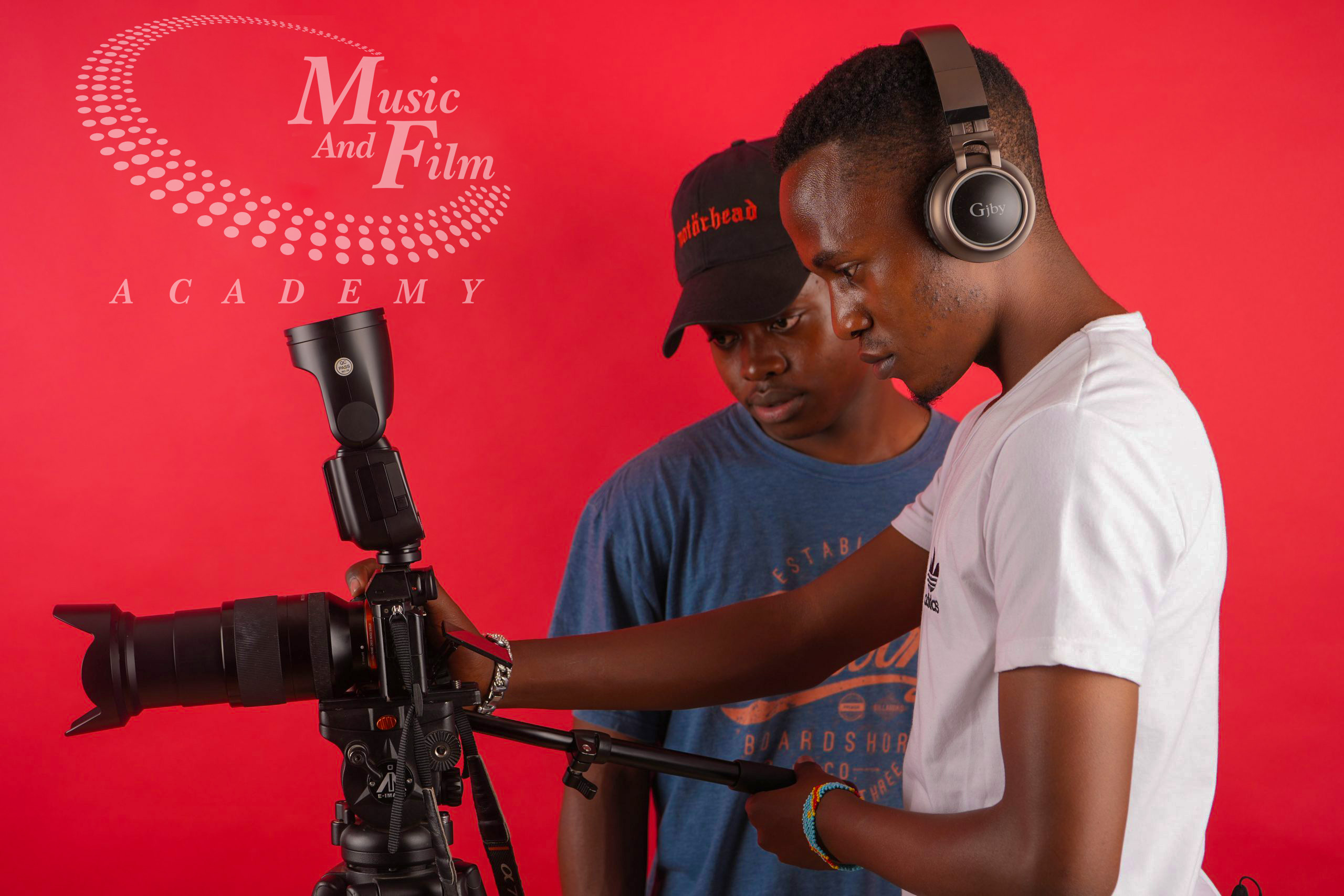
Developing technical camera handling, fluid-head tripod navigation, and real-time audio monitoring habits in our School of Visual Arts labs.
Certificate in Film Production
Are you driven to master the mechanics of visual storytelling and transform your creative vision into broadcast-grade cinematic assets? The comprehensive Certificate in Film Production at the Music and Film Academy is a highly intensive, vocational training track engineered specifically to transition ambitious beginners and content creators into industry-ready crew members, editors, and directors. Operating from our high-performance visual arts laboratories at Information House, Nairobi CBD, this one-year, full-time program eliminates automatic dependencies. Students take complete manual control over cinema camera packages, professional pre-production logistics, continuous set lighting architectures, and non-linear video editing environments under real-world conditions.
Succeeding in today’s highly competitive media landscape demands structured, competency-based skills rather than guesswork. Earning a Certificate in Film Production establishes your professional authority, proving your technical capability to leading creative agencies, independent production houses, and international networks. Under our signature 1:1 student-to-gear training framework, you will spend your time actively running production sets and cutting media assets rather than sitting through static theory lectures. Whether your goal is to operate cinema cameras on commercial sets, capture pristine location audio, or master professional post-production workflows, this curriculum delivers the precise technical foundation required to step onto any set with absolute confidence.
Modern smartphone cameras and editing apps are highly accessible, but professional cinematic delivery relies on an intimate understanding of visual continuity, structural pacing logic, on-set power distribution, and strict asset formatting standards. Attending an accredited institution ensures you learn to anticipate production bottlenecks, manage crew logistics, and output assets that fulfill international broadcast delivery specifications.
By developing a versatile command over screenplay architecture, multi-source lighting, and diagnostic scope monitoring, you build a competitive, highly monetizable professional portfolio. If you are researching broader creative pathways or advanced specialized tracks, you can explore our full visual arts portal for accredited film production courses in kenya. Our primary tv and film production courses directory allows you to compare different levels of training to line up your education perfectly with your career aspirations.
📊 Program Overview & Fee Structure
This 1-year certification is split into four distinct technical terms, combining hands-on on-set execution with global vocational assessment standards.
Parameter
Specification
Course Duration
1 Year (4 Terms)
Tuition Fees
KES 39,000 Per Term
Study Mode & Timing
Full-Time, Weekday Delivery Structures
Department
School of Visual Arts
Vocational Frameworks
Pearson BTEC Verification & TVETA Board Licensing
Campus Location
Information House, Nairobi CBD, Kenya
💡 Explore Your Academic Options: Want to see how this foundational certificate tracks against short-form visual boot camps or advanced digital masterclasses? Review our directory options directly on our film production courses in kenya category hub page.
🗺️ Detailed Year-Long Curriculum Architecture
Our professional filmmaking curriculum focuses entirely on commercial-grade technical mastery. Every module is uniquely structured to ensure complete technical fluency from initial script layout to final master render.
Term 1: Screenwriting Foundations & Pre-Production Logistics
Students master the structural engineering of scriptwriting, visual asset mapping, and the organizational frameworks required to manage a physical film set safely.
The Script-to-Screen Blueprint: Mastering the mechanics of the classic Three-Act Screenplay Structure (setup, confrontation, and resolution phases) to craft compelling short-form narrative architectures. Configuring industry-standard software parameters, including margins, scene headings, action blocks, parentheticals, and dialogue spaces. Building believable protagonist and antagonist character development arcs rooted in clear personal motivations and shifting stakes. Navigating dedicated desktop screenplay writing tools to automate pagination and real-time formatting transitions. Applying dialogue polish protocols to refine conversational text so it sounds completely natural while effectively revealing subtext and moving the plot forward.
Production Management Mechanics: Developing script breakdown matrices to analyze text lines and isolate required props, talent characters, scene sets, and wardrobe assets. Establishing location scouting frameworks to evaluate potential shooting sets based on ambient noise issues, available light sources, and local accessibility logistics. Structuring shooting schedule architecture by grouping script scenes logically by location, talent availability, and lighting conditions to maximize efficiency. Drafting official call sheet generation documents complete with daily weather warnings, emergency hospital routes, and landing hours. Managing line-item budget allocations to distribute limited financial resources efficiently across catering needs, equipment rentals, transport operations, and emergency cash reserves.
Visual Continuity & Storyboarding: Mapping storyboards by translating written action lines into clear, hand-drawn or digital frame panels to preview composition shapes. Building descriptive director shot lists detailing required frame sizes, camera angles, movement paths, and lens selections per scene. Executing the physical 180-Degree Continuity Rule on set to guarantee consistent screen directions across cuts. Implementing eye-line matching mechanics to position cameras carefully, ensuring actors appear to be looking at each other across separate close-up shots. Managing motion continuity tracking to preserve physical movement directions across successive cuts, entirely preventing jarring action jumps during final assemblies.
Term 2: Camera Operations, Optics & On-Set Production Lighting
Trainees drop all automatic settings to master the physics of manual camera sensors, continuous lighting design configurations, and camera support systems.
Cinema Camera Anatomy: Managing the strict manual exposure triangle relationships between lens apertures, shutter speeds, and sensor ISO values to lock in clean exposures. Calibrating framerate frameworks using specific temporal rates, including 24p cinematic pacing, 25p PAL television broadcast, and 60p/120p high-speed slow-motion captures. Configuring flat LOG profile setups to maximize highlight and shadow retention for post-production color grading. Overriding automatic sensor white balance management by programming manual Kelvin temperatures to prevent unwanted color shifts under mixed light sources. Operating focus assist systems, including peaking indicators, pixel magnification windows, and manual follow-focus rings to guarantee sharp subject isolation.
On-Set Lighting Design: Operating high-power LED fixtures, heavy-duty continuous LED mats, and chip-on-board (COB) spotlights safely using active local power inputs. Constructing 3-point lighting architectures comprising strong key lights, soft fill layers, and sharp rim highlight contours. Deploying light modification tactics, including diffusion panels, flag frames, and grids to control beam spreads and minimize unwanted shadows. Executing contrast ratio adjustments to balance the intensity between key and fill sides, switching cleanly from high-key commercial looks to moody, low-key cinematic scenes. Balancing color temperature by gelling fixtures or adjusting bi-color controls to seamlessly blend artificial interior lighting with incoming natural sunlight.
Camera Support & Movement Dynamics: Tuning fluid-head tripod mechanics, including pan and tilt drag resistance systems, to execute ultra-smooth camera frames free of sudden stutters. Calibrating 3-axis motorized gimbals across different camera payloads to execute fluid, cinematic tracking shots. Configuring physical slider rail dynamics to slide camera rigs smoothly across revealing establishing frames. Building handheld rig operating forms, including multi-point shoulder or cage configurations, to capture organic, documentary-style action shots safely. Managing jib arm sweep configurations to execute sweeping vertical crane arcs that inject grand scope and perspective into outdoor environments.
Term 3: Field Audio Recording & Non-Linear Video Editing
Developing technical camera handling, fluid-head tripod navigation, and real-time audio monitoring habits in our School of Visual Arts labs.
This term bridges the gap between field asset acquisition and digital timeline workspaces, blending location audio routing with structural assembly logic.
Audio-Visual Location Capture: Configuring multi-channel portable field mixers to track individual microphones cleanly while managing gain structures to prevent clipping risks. Mastering boom pole deployment methods to position highly directional shotgun microphones just outside the camera frame line to secure clean voice frequencies. Concealing wireless lavalier rigging systems beneath actors’ wardrobe layers to minimize clothing friction and background noise. Executing external dual-system syncing using physical clapper slates and ambient matching tools to lock camera scratch tracks with high-resolution field recorders. Maintaining strict on-set acoustic monitoring using closed-back headphones to catch local wind rumbles, radio frequency dropouts, and surrounding traffic noise in real-time.
The Digital Post-Production Studio: Building organized multi-tier post-production file structures within Adobe Premiere Pro to sort video clips, external audio tracks, and graphic elements. Running automated multi-camera clip syncing loops to snap multi-angle clips together using matching acoustic waveforms. Assembling rough timeline sequences that follow the primary script blueprint precisely. Utilizing narrative pacing techniques to refine cut durations, emphasizing dramatic beats, comic timing, or fast-paced action moments. Maintaining clean timeline practices, including track color-coding, locking completed tracks, and stripping offline media clips.
Basic Motion Graphics & Visual Titling: Designing responsive lower-third text layouts inside non-linear editors to identify documentary interview subjects clearly. Formatting stylistic, screen-safe cinematic text overlays to set narrative tones or establish changing locations. Combining vector graphics with motion keyframes to animate opening title sequences. Constructing uniform, legible scrolling end credit structures that credit cast and crew members correctly. Tailoring dynamic overlay templates to keep design elements consistent across episodic series or web content.
Term 4: Color Grading, Sound Design & Capstone Portfolio Delivery
The final term details technical mastering pipelines, secondary color diagnostics, parametric speech restoration, and copyright legal framework management.
Cinematic Color Grading Engines: Reading professional waveforms, vectorscopes, and histograms inside DaVinci Resolve to evaluate exposure balances. Correcting black levels, midtones, and highlights using lift-gamma-gain wheels to establish clean primary exposure baselines. Calibrating white balance anomalies to neutralize bad green or magenta tint errors caused by wrong camera settings on set. Applying technical look-up tables (LUTs) to translate flat log assets cleanly into standard color spaces (Rec. 709). Executing scene-to-scene visual matching to equalize color traits across distinct camera sensors, ensuring complete visual continuity throughout the final edit.
Audio Post-Production Workshop: Deploying targeted spectral repair filters to strip out steady background noise, wind rumble, and low-frequency electrical hums from dialogue. Applying background noise gating and downward expanders to mute empty spaces between spoken lines, isolating principal voice layers cleanly. Sourcing, recording, and placing custom footsteps and clothing rustles to restore missing physical details via Foley asset spotting. Layering immersive atmospheric sound effects (SFX), including ambient wind noises, urban soundscapes, and sub-drones. Balancing dialogue, music, and effects tracks to build a clear final stereo master mixdown.
The Film Business Layout: Designing independent marketing blueprints, online promotion campaigns, teaser poster layouts, and digital press kits to build audience hype. Curing a commercial showreel montage that highlights your technical skills to potential clients and agencies. Navigating the registration frameworks of the Kenya Copyright Board (KECOBO) to legally shield master video files from piracy. Computing equipment depreciation, local transport overheads, and labor hours to calculate creative freelance rates and quote profitable client fees. Presenting your portfolio assets before an examination panel of instructors to clear graduate capability benchmarks.
Pearson BTEC Portfolio Validation: Organizing all practical portfolio folders to map clearly against specific international vocational learning goals. Writing step-by-step technical project reports detailing your gear choices, production challenges, and solutions. Archiving raw assets and project timelines to permit seamless quality audits by external BTEC assessors. Compiling creative self-critique documentation logs evaluating the technical strengths and weaknesses of your projects. Validating your collected practical outputs to claim officially recognized international vocational certificates.
💼 Career Paths & Industry Opportunities
Graduating with a Certificate in Film Production provides you with versatile, hands-on visual media skill sets that are highly sought after across television stations, commercial agencies, corporate media wings, and international film sets:
1. Camera Operator
The Role: Commanding the physical camera package on set. You will manage the manual exposure matrix, configure frame rates, align focus parameters, and execute controlled movements using fluid-head tripods, sliders, or jib arms to manifest the director’s vision.
Primary Industries: Broadcast television stations, advertising houses, independent production units, and digital media agencies.
2. Field Audio Recordist / Boom Operator
The Role: Running multi-channel field recorders, deploying directional hyper-cardioid boom microphones right at the edge of the lens line, concealing wireless lavaliers beneath wardrobe, and managing acoustic signal-to-noise ratios on location.
Primary Industries: Documentary production crews, news networks, commercial agencies, and feature film units.
3. Behind-The-Scenes (BTS) Videographer
The Role: Operating independent, mobile mirrorless camera setups on active film sets or corporate events to document production logistics, gather promotional clips, and edit engaging marketing reels for digital channels.
Primary Industries: Entertainment public relations firms, social media networks, movie production marketing departments, and corporate hubs.
4. Assistant Camera (1st / 2nd AC)
The Role: Managing lens changes, maintaining real-time follow-focus boundaries on moving actors, tracking camera logs, configuring scratch sync audio, and operating the physical clapper slate to anchor multi-system tracks.
Primary Industries: Feature film crews, high-budget music video spaces, and commercial campaign sets.
5. Production Assistant & Set Grip
The Role: Handling crucial on-set organization, drafting call sheets, managing location permits, setting up heavy-duty C-stands, operating continuous LED modifiers, and deploying safety cable matting across production paths.
Primary Industries: Film sets, live event switching crews, and theatrical production spaces.
📋 Course Eligibility & Admission Thresholds
To strictly protect our technical 1-to-1 gear distribution policy, all prospective trainees must satisfy the following entry guidelines prior to registration:
1. Academic Qualification Benchmarks
KCSE Entry Grade: A minimum mean grade of D (Plain) or above in the Kenya Certificate of Secondary Education (KCSE).
Technical Progression Option: Successful completion of a relevant Artisan Certificate (KNQF Level 4) in digital media, photography, videography, or any creative arts discipline from an officially registered TVETA institution.
International Equivalence: High school graduation documents or technical training certificates officially evaluated, recognized, and equated by the Kenya National Qualifications Authority (KNQA).
2. Physical & Technical Aptitudes
Visual & Auditory Capacity: Because the course moves aggressively into precise cinema exposure calibration, color balance normalization, and real-time location sound tracking, normal or corrected vision and hearing are required.
Basic Digital Literacy: Trainees must possess established computer operating skills (managing system file trees, moving directories, and running shortcut commands) to keep pace with the non-linear editing pipelines.
3. Registration Assets Checklist
Trainees who receive a formal offer of admission must present the following mandatory registration items to the admissions office at Information House, Nairobi CBD:
A fully completed Music and Film Academy Certificate Admission Form.
Certified copies of your KCSE Result Slip or official KNQA equivalence transcripts.
A clear copy of the candidate’s National Identity Card or valid Passport (or guardian’s ID if under 18 years of age).
Two recent, clear color passport-sized photographs for student logging cards.
⚠️ Equipment Allocation Advisory: Because our dedicated media labs operate on a strict 1-to-1 student-to-gear framework to prevent overcrowding and ensure maximum practical mastery, enrollment capacities are tightly capped per cohort. Spaces are secured strictly on a first-pay, first-allocated basis.
❓ Frequently Asked Questions
Which video editing and color grading software will I master in this program?
You will build complete operational fluency across industry-standard non-linear editing and post-production software. The course delivers comprehensive modules in Adobe Premiere Pro for structural cutting and timeline tracking, alongside DaVinci Resolve for video scope diagnostics and node-based color grading.
Do I need to buy an expensive cinema camera before joining the course?
No, absolutely not. The School of Visual Arts labs are fully stocked with 4K cinema cameras, motorized stabilization gimbals, field audio recording recorders, dynamic boom mics, and heavy-duty continuous LED spot lighting kits. You will have full, unshared access to these production assets during your scheduled practical hours under our 1:1 framework.
How do you prevent keyword cannibalization with your hub pages?
While our visual arts department offers several multi-disciplinary modules, this page is engineered strictly as a deep, structural landing space for the 1-year Certificate in Film Production. By optimizing this content around granular technical topics—such as screenplay structures, call sheet logs, and dialogue spectral cleanups—we ensure its search engine footprint remains clean and entirely distinct from our global directory pages.