Phone:
+254 719 428 550
Physical address:
Information House, Hakati Road,
Nairobi, Kenya.
Phone:
+254 719 428 550
Physical address:
Information House, Hakati Road,
Nairobi, Kenya.
A video editing course in Kenya costs between KES 30,000 and KES 85,000 for a 2-to-3-month practical certificate module at specialized vocational academies. At broader hybrid private institutes, tuition for multi-semester media programs ranges from KES 75,000 to KES 100,000+ per semester.
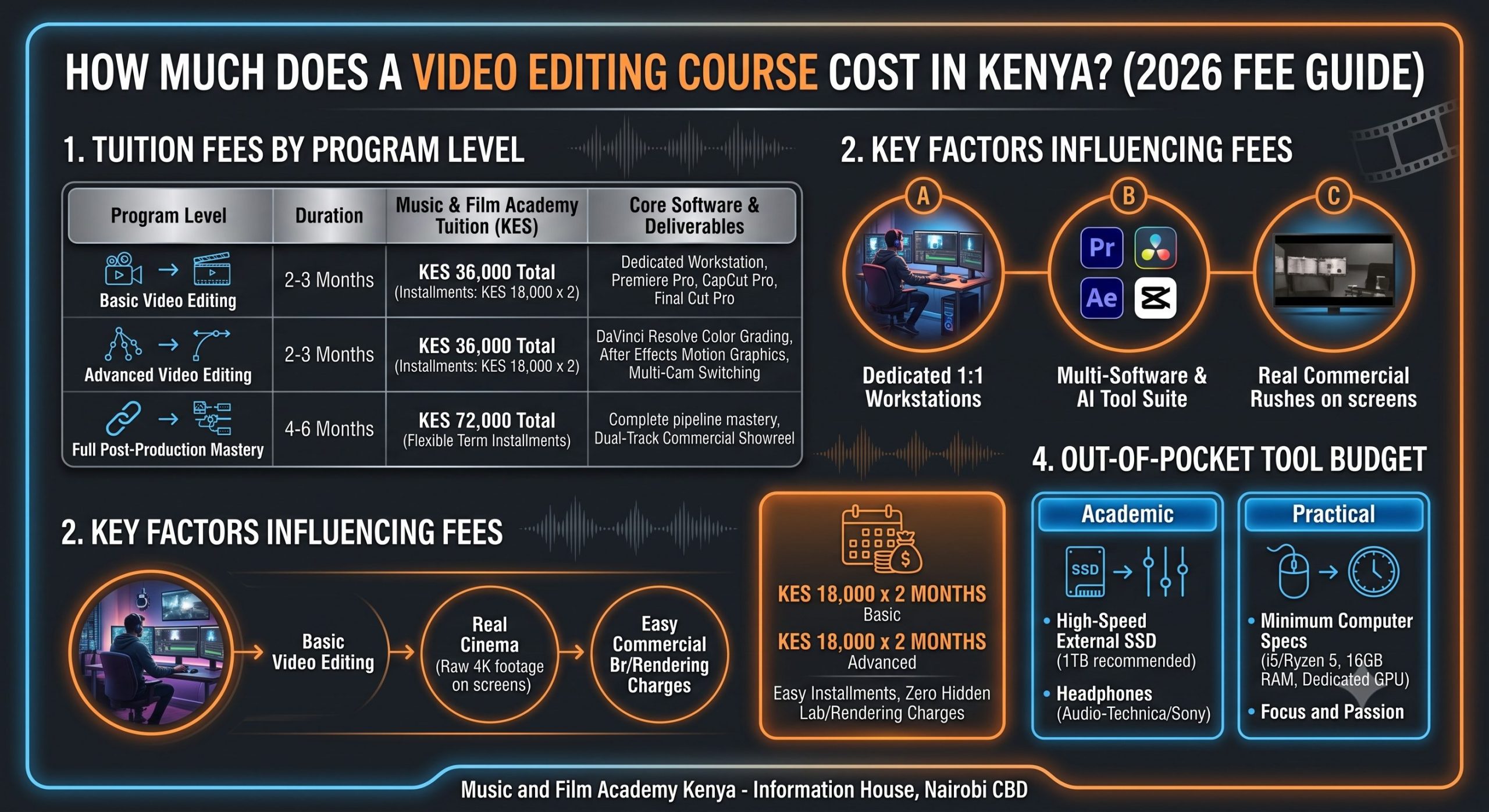
At Music and Film Academy’s Video Editing Department in Nairobi CBD, our tuition is structured at a flat rate of KES 36,000 per module (2–3 months) for both basic and advanced editing tracks. Our fees are fully transparent, TVETA-mapped, and include dedicated 1:1 high-performance workstation access, software licenses, raw 4K commercial rushes, and installment payment options with zero hidden lab or rendering fees.
To accurately budget for your post-production training, compare market tuition rates against specific software allocations and workstation deliverables:
| Program Level | Total Duration | Music & Film Academy Tuition (KES) | Included Core Software & Deliverables |
| Basic Video Editing Course (Technical Foundation) | 2 – 3 Months (8–12 Weeks) | KES 36,000 Total (Installments: KES 18,000 x 2) | 1:1 High-spec workstation, Adobe Premiere Pro, CapCut Pro, Final Cut Pro, proxy creation, J/L cuts, basic audio leveling, and H.264 render presets. |
| Advanced Video Editing Course (Masterclass & Color) | 2 – 3 Months (8–12 Weeks) | KES 36,000 Total (Installments: KES 18,000 x 2) | DaVinci Resolve node-based color grading, Adobe After Effects motion graphics, XML/EDL timeline conformed workflows, multi-cam live switching, and showreel finishing. |
| Full Post-Production Mastery (Basic + Advanced) | 4 – 6 Months (16–24 Weeks) | KES 72,000 Total (Flexible Term Installments) | Complete pipeline mastery spanning Premiere Pro, CapCut, DaVinci Resolve, and After Effects, yielding a dual-track commercial showreel. |
When evaluating post-production schools across Nairobi, look beyond the upfront price tag to four critical operational factors:
Video editing requires substantial computing power. Low-cost courses often force students to share computers or rotate rendering hours. Premium tuition guarantees a dedicated high-spec workstation equipped with fast NVMe SSDs, dedicated NVIDIA RTX graphics cards, and color-accurate monitors during every class.
Tuition should cover access to a comprehensive software ecosystem rather than just one application. At Music and Film Academy, your fee covers Adobe Premiere Pro, CapCut Pro (for rapid short-form social media editing and AI auto-captions), DaVinci Resolve, and Adobe After Effects.
Practicing on watermarked web rips or low-resolution clips does not prepare you for professional work. Quality institutions invest in high-volume, multi-camera raw logs, commercial project files, and music video rushes shot on cinema cameras.
Reputable institutions maintain flat, all-inclusive tuition rates. Avoid schools that charge extra for “rendering station time,” “software installation fees,” or “lab maintenance deposits.”
To execute class assignments, back up raw 4K project files, and edit on location, budget for a few essential personal tools:
A practical 2-to-3-month certificate course costs KES 36,000 for the Basic track and KES 36,000 for the Advanced track at Music and Film Academy’s Video Editing Department in Nairobi CBD. Hybrid private colleges charge KES 85,000 to KES 100,000+ per semester.
A 6-month comprehensive post-production program combining both Basic (Premiere Pro/CapCut) and Advanced (DaVinci Resolve/After Effects) modules costs KES 72,000 total at Music and Film Academy, payable in monthly installments.
Yes. Music and Film Academy offers flexible installment plans, allowing students to pay KES 18,000 per month across the 2-to-3-month study period.
Master Premiere Pro, CapCut Pro, DaVinci Resolve color science, and After Effects motion graphics at Music and Film Academy’s Video Editing Department.