Phone:
+254 719 428 550
Physical address:
Information House, Hakati Road,
Nairobi, Kenya.
Phone:
+254 719 428 550
Physical address:
Information House, Hakati Road,
Nairobi, Kenya.
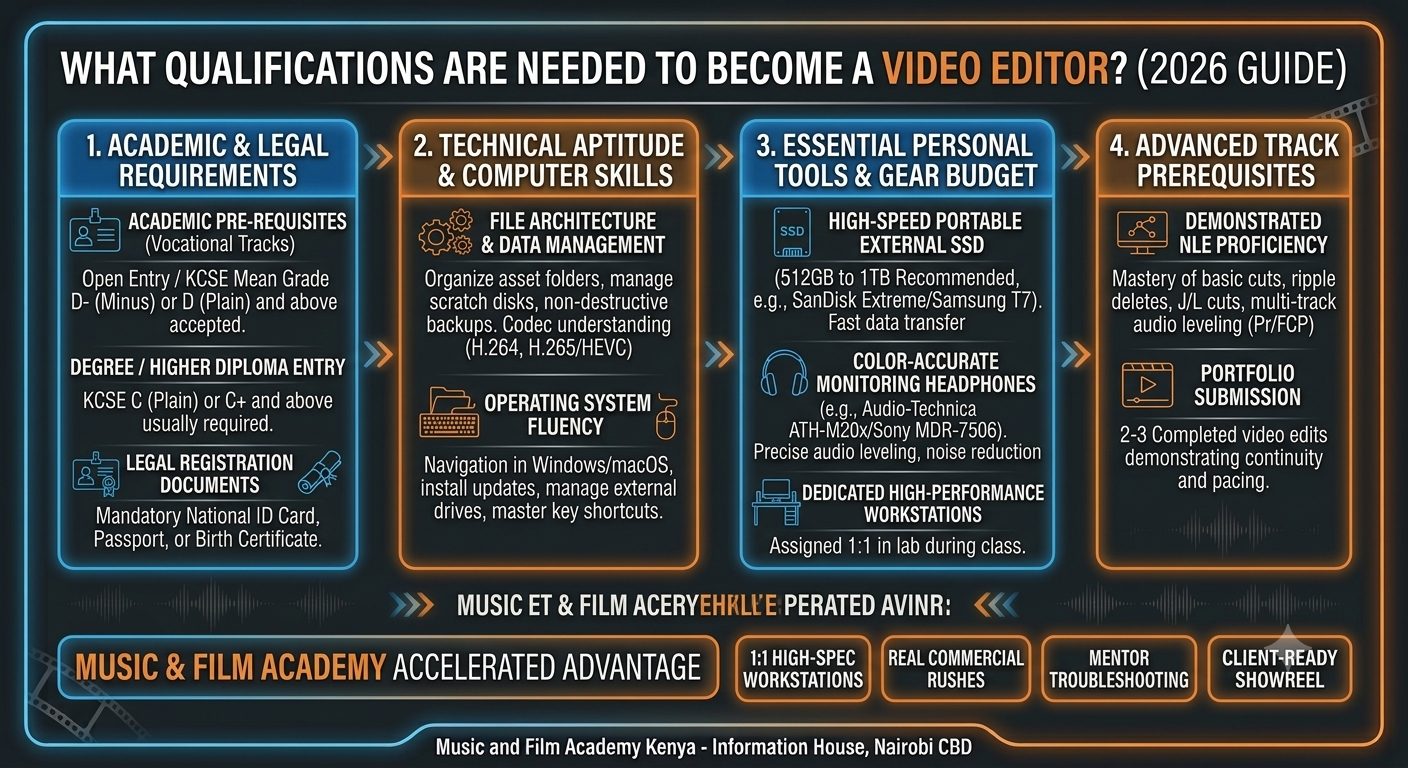
To become a professional video editor in Kenya, you need basic computer literacy, a national ID card or passport, and hands-on proficiency in industry-standard editing software (Adobe Premiere Pro, CapCut Pro, and DaVinci Resolve). Unlike traditional academic fields, practical vocational certificate programs in video editing do not require fine art drawing skills or minimum high school cluster subjects.
At Music and Film Academy’s Video Editing Department in Nairobi CBD, our entry-level tracks accept direct entry for any student with a KCSE mean grade of D- (minus) or D (plain) and above, focusing entirely on practical timeline mechanics, multi-cam editing, and portfolio building.
If you are enrolling in a TVETA-registered vocational institution or private media academy, academic entry requirements are intentionally open to foster creative talent:
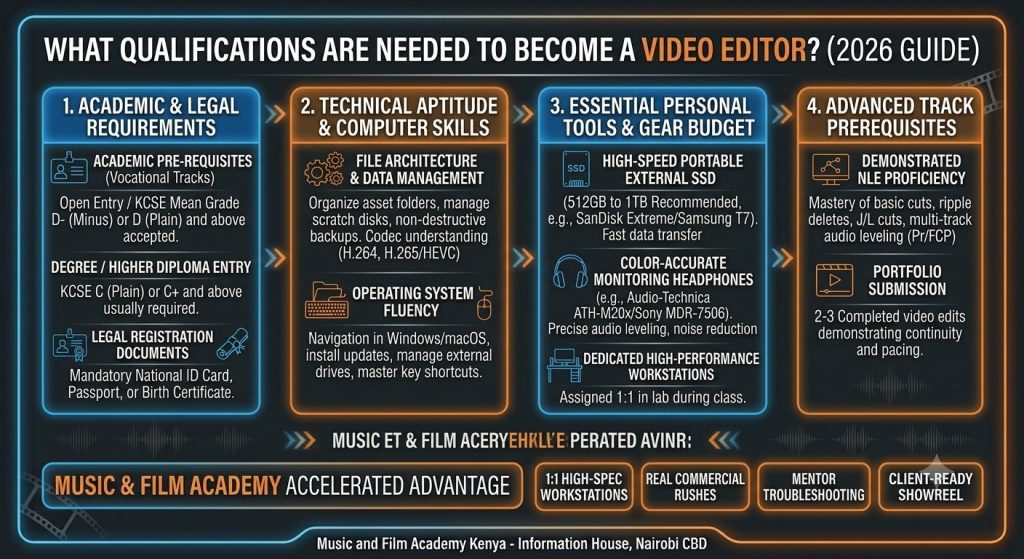
| Qualification Category | Requirement Threshold | Notes & Details |
| KCSE Mean Grade (Direct Entry) | D- (Minus), D (Plain), or C- and above | Vocational certificate tracks prioritize practical aptitude over high academic cluster points. |
| Degree / Higher Diploma Entry | C (Plain) or C+ and above | Required primarily for 3-year university degree programs in broadcast journalism or film production. |
| Legal Registration Documents | National ID, Passport, or Birth Certificate | Mandatory for TVETA student registration, exam processing, and certificate issuance. |
| Prior Media Background | None Required | Beginner tracks start from square one (workspace layout, file systems, and timeline cuts). |
While you do not need coding knowledge, operating non-linear editing (NLE) software requires a solid foundation in basic computing:
Video editing files take up vast amounts of disk space. A qualified editor must understand how to:
You should be comfortable navigating either Windows or macOS file systems, managing external drives, installing software updates, and utilizing keyboard shortcuts to speed up timeline operations.
While enrolling at an academy provides access to high-spec editing workstations during class hours, having these two personal items accelerates your learning curve:
If you intend to skip the foundation track and enroll directly in an Advanced Video Editing & Color Grading Course, institutions typically require a portfolio review or proof of prior technical capability.
To become a video editor, you need basic computer literacy, a national ID card, and hands-on mastery of editing software like Adobe Premiere Pro and DaVinci Resolve. Basic certificate tracks require a minimum KCSE mean grade of D- (minus) or D (plain).
No. Employers, production houses, and freelance clients hire video editors based on the strength of their video showreel and technical portfolio, not university degrees. Practical certificate courses provide the exact software and narrative skills required by the market.
No. At Music and Film Academy, every student is assigned a dedicated 1:1 high-spec editing workstation equipped with fast processors and dedicated graphics cards during class, meaning you do not need to purchase expensive hardware upfront.
Turn your passion into a high-demand creative skill at Music and Film Academy’s Video Editing Department.