Phone:
+254 719 428 550
Physical address:
Information House, Hakati Road,
Nairobi, Kenya.

Phone:
+254 719 428 550
Physical address:
Information House, Hakati Road,
Nairobi, Kenya.
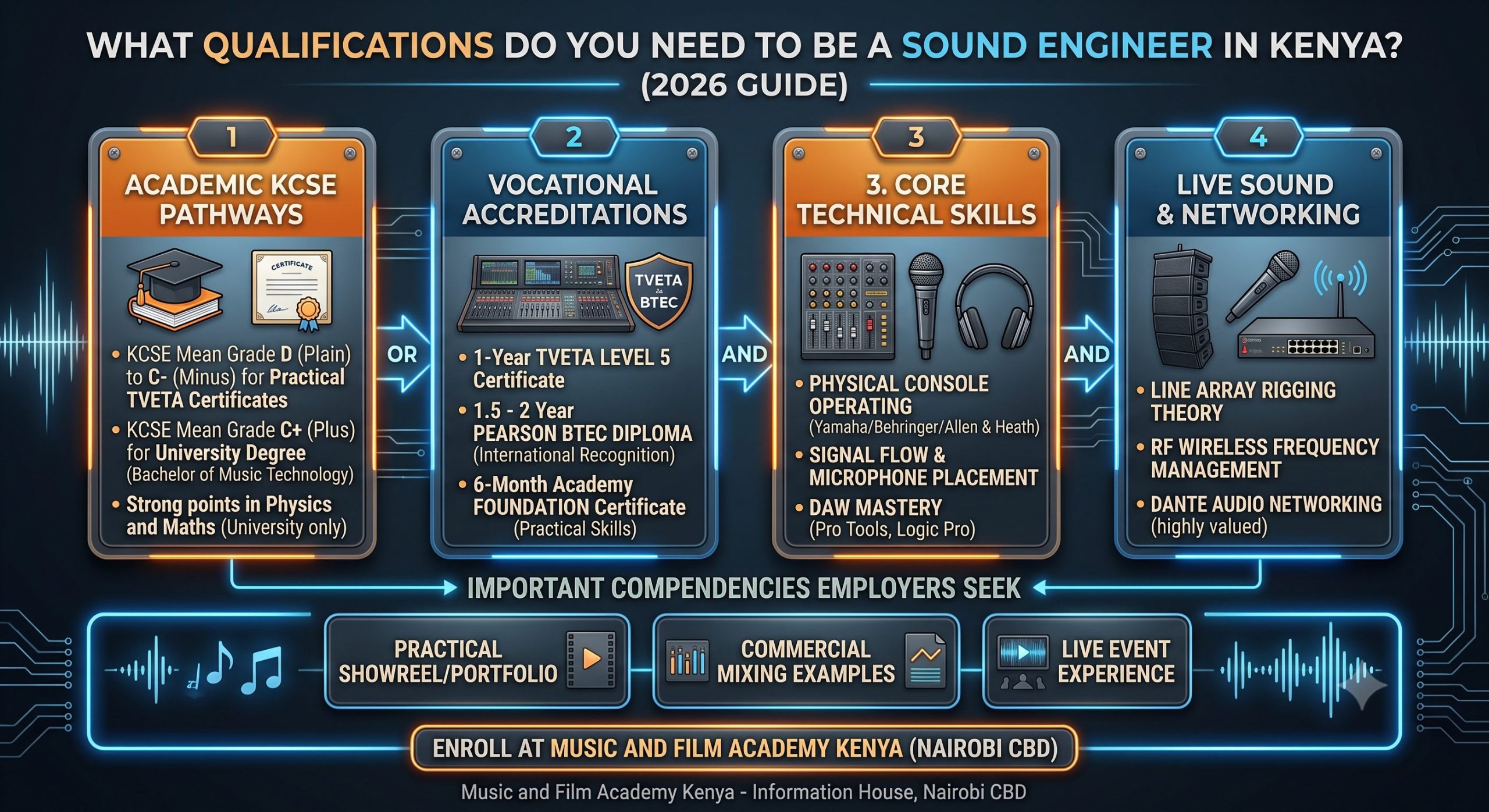
To become a professional sound engineer in Kenya, you need either a vocational qualification (a 3-month Short Course, 6-month Foundation, 1-year TVETA Certificate, or 2-year Pearson BTEC Diploma in Sound Engineering) or an academic qualification (a 4-year Bachelor of Music Technology degree).
Unlike traditional electrical engineering, becoming a studio or live sound engineer does not strictly require a university degree; commercial recording studios and live event companies prioritize practical competency on digital mixing consoles, signal flow knowledge, and DAW mastery over high school academic scores.
At Music and Film Academy’s Sound Engineering Department in Nairobi CBD, our programs are cumulative and aligned with national TVETA standards and international Pearson BTEC frameworks. This allows students with KCSE grades from D (plain) to C- (minus) or practical creative aptitude to enroll, master hands-on equipment, and build industry-standard portfolios.
Our curriculum is built on a cumulative modular structure: each higher level incorporates all previous skills (analog and digital signal flow) while introducing advanced technical modules, live PA systems, Dante audio networking, and international certifications.
| Qualification Level | Academic Prerequisites (KCSE) | Duration & Tuition Fee | Core Technical Certifications | Ideal Career Outcomes |
| 3-Month Short Course (Specialized) | Open Entry / Aptitude Interview | 1 Term (12 Weeks) KES 45,000 Total | Academy Certificate of Competency (Analog Signal Flow) | Junior studio assistant, podcast audio editor, basic sound technician. |
| 6-Month Foundation Course (Studio & Live) | Open Entry / Aptitude Interview | 2 Terms (24 Weeks) KES 45,000 / Term | Academy Foundation Certificate (Analog + Digital Consoles) | Assistant tracking engineer, church audio operator, home studio mixer. |
| Certificate in Sound Engineering (1 Year) | KCSE Mean Grade D (Plain) to C- (Minus) | 4 Terms (12 Months) KES 45,000 / Term | TVETA Level 5 Certificate | Studio tracking engineer, live PA technician, stage monitor engineer. |
| Diploma in Sound Engineering (1.5–2 Years) | KCSE Mean Grade C- (Minus) or Certificate progression | 6–8 Terms KES 45,000 / Term | Pearson BTEC Higher National Diploma & TVETA Level 6 | Senior Front-of-House (FOH) engineer, broadcast audio mixer, film sound designer. |
| Bachelor of Music Technology (4 Years) | KCSE Mean Grade C+ (Plus) with C+ in Music/Physics | 4 Years (8 Semesters) (University Rates) | University Bachelor’s Degree | Acoustic consultant, audio researcher, academic music technology lecturer. |
Beyond formal paperwork, commercial employers in Kenya’s broadcast, live events, and music industries look for four specific technical benchmarks:
A sound engineer must hold hands-on proficiency in industry-standard software environments:
Employers expect engineers to physically operate commercial analog and digital mixing consoles (such as the Behringer Wing, Midas M32, Yamaha QL/CL series, and Allen & Heath SQ series). You must understand acoustic signal transduction, mic placement physics, phantom power (+48V), gain staging at -18 dBFS, and phase coherence.
For live sound roles, qualifications extend into physical stage box patching, RF wireless frequency scanning (preventing microphone dropouts), line array speaker rigging, and digital audio networking protocols like Dante.
In audio engineering, an audible showreel carries significant weight. A strong portfolio showcasing multi-mic drum tracking, before-and-after vocal mixes, live concert multitrack mixes, or film dialogue editing often matters more to recording studios than academic transcripts.
A common misconception in Kenya is that sound engineering requires the same high KCSE cluster scores in Mathematics and Physics as civil or electrical engineering.
Yes. The vast majority of working studio mixers, live event audio technicians, and broadcast sound operators in Kenya hold vocational TVETA Certificates or Pearson BTEC Diplomas from specialized institutions like Music and Film Academy rather than four-year university degrees.
A sound engineer focuses on the technical execution of audio—microphone placement, acoustic signal flow, mixing dynamics, frequencies, live PA systems, and mastering. A music producer focuses on the creative direction—songwriting, musical composition, beat-making arrangement, and artist management.
A short foundational module takes 3 months (KES 45,000), a 6-month Foundation takes 2 terms, an accredited TVETA Certificate takes 1 year (4 terms), and an international Pearson BTEC Diploma takes 1.5 to 2 years (6 terms). Read our guide on schools offering sound engineering courses in Kenya for full institutional comparisons.
Master physical digital consoles, studio recording, live PA systems, and Pro Tools at Music and Film Academy.