Phone:
+254 719 428 550
Physical address:
Information House, Hakati Road,
Nairobi, Kenya.
Phone:
+254 719 428 550
Physical address:
Information House, Hakati Road,
Nairobi, Kenya.
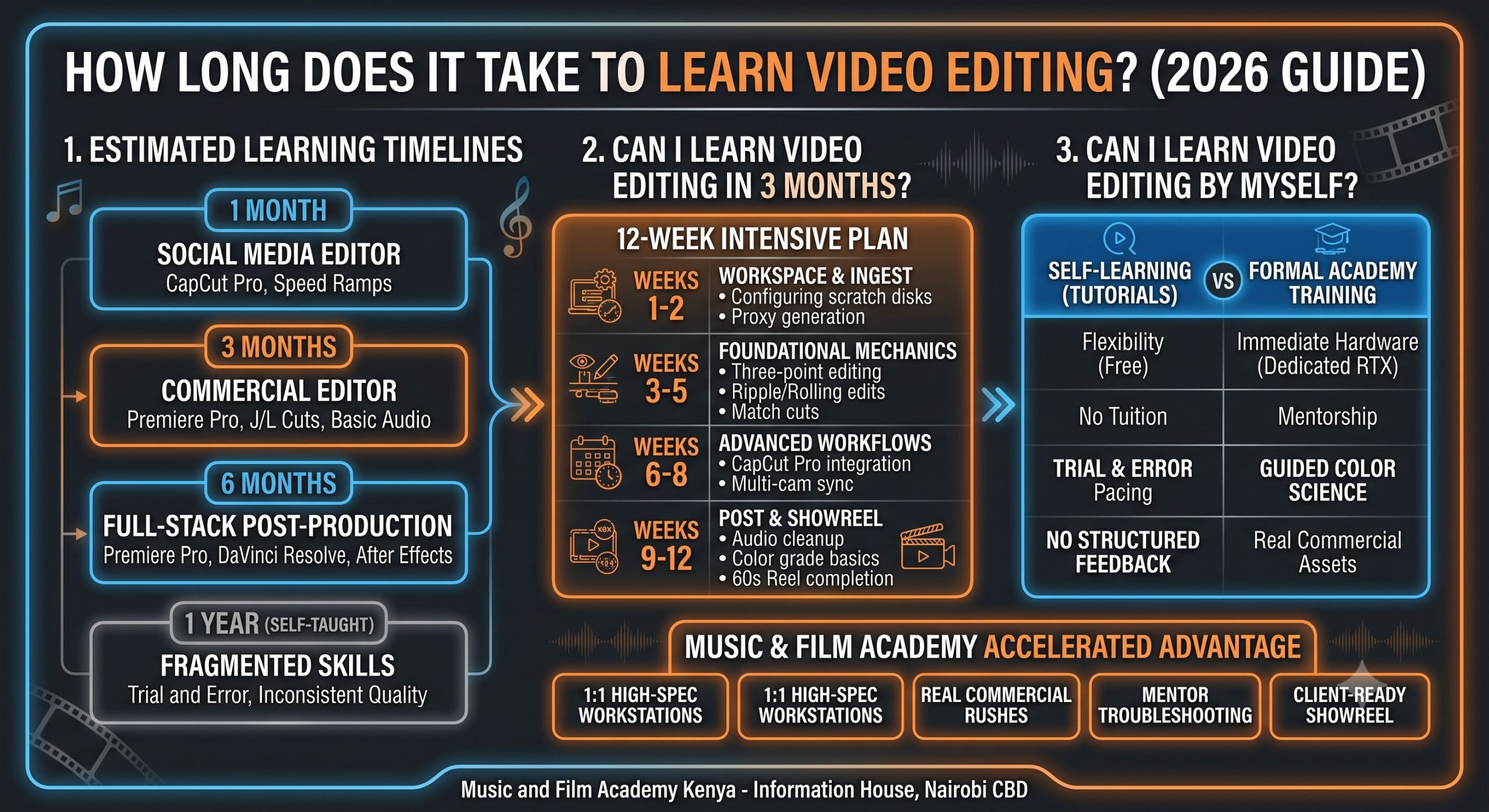
It takes between 2 to 3 months of focused, practical training to learn foundational video editing mechanics, software interfaces, and timeline assembly for commercial projects. To master advanced post-production—including node-based color grading in DaVinci Resolve, After Effects motion graphics, and multi-camera live switching—it typically takes 4 to 6 months of structured study.
At Music and Film Academy’s Video Editing Department in Nairobi CBD, our curriculum is engineered to compress years of trial-and-error into structured, intensive modules. By providing direct 1:1 access to high-spec workstations and real commercial raw rushes, students gain client-ready editing proficiency in just 12 weeks per track.
Your learning timeline depends heavily on your target career outcome, the software complexity, and whether you are receiving structured instruction or self-studying:
| Career Goal | Practical Duration | Key Software Mastered | Expected Portfolio Outcome |
| Social Media Editor & Content Creator | 1 to 2 Months | CapCut Pro & Adobe Premiere Pro | Viral short-form Reels/TikToks, AI auto-captions, speed ramping, and dynamic overlays. |
| Commercial Post-Production Editor | 2 to 3 Months (Basic Track) | Adobe Premiere Pro & Final Cut Pro | High-volume corporate promos, music videos, proxy creation, J/L cuts, and multi-track audio cleanup. |
| Full-Stack Post-Production Specialist | 4 to 6 Months (Basic + Advanced) | Premiere Pro, CapCut, DaVinci Resolve, After Effects | Commercial showreel featuring node-based color grading, 2D motion graphics, and multi-cam conformed workflows. |
| Self-Taught / Independent Learner | 9 to 12+ Months | Varies (Trial and Error) | Fragmented skills with potential gaps in color science, proxy workflows, and audio restoration. |
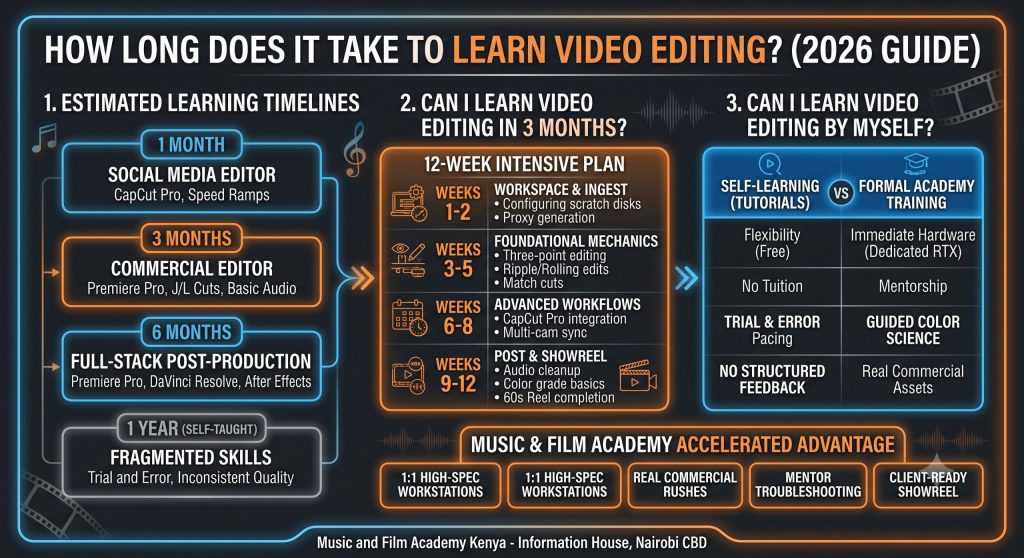
Yes, you can become a client-ready video editor in 3 months, provided you follow a structured, hands-on curriculum that eliminates wasted time.
In a 3-month intensive program like our Basic Video Editing Course, you do not waste time watching generic online tutorials. Instead, you spend 100% of your lab hours behind dedicated high-spec editing workstations, working directly with industry mentors. Within 12 weeks, you will master:
While thousands of editors begin by watching free online videos, self-learning comes with distinct advantages and major trade-offs when compared to formal vocational training in Nairobi:
If you want to cut your learning time in half and reach commercial speed faster, adopt these three industry practices immediately:
It takes 2 to 3 months to learn basic commercial video editing and software operation. Mastering advanced post-production, DaVinci Resolve color grading, and After Effects motion graphics takes 4 to 6 months of structured study.
Yes. A 3-month practical course at Music and Film Academy’s Video Editing Department gives you complete operational mastery over Adobe Premiere Pro and CapCut Pro, allowing you to edit commercial videos, YouTube content, and social media ads confidently.
Yes, but self-learning through online tutorials often takes 9 to 12+ months due to lack of structured feedback, missing commercial raw assets, and technical troubleshooting delays. Joining a structured academy accelerates the process and provides immediate industry networking opportunities.
Fast-track your creative post-production career at Music and Film Academy’s Video Editing Department.