Phone:
+254 719 428 550
Physical address:
Information House, Hakati Road,
Nairobi, Kenya.
Phone:
+254 719 428 550
Physical address:
Information House, Hakati Road,
Nairobi, Kenya.
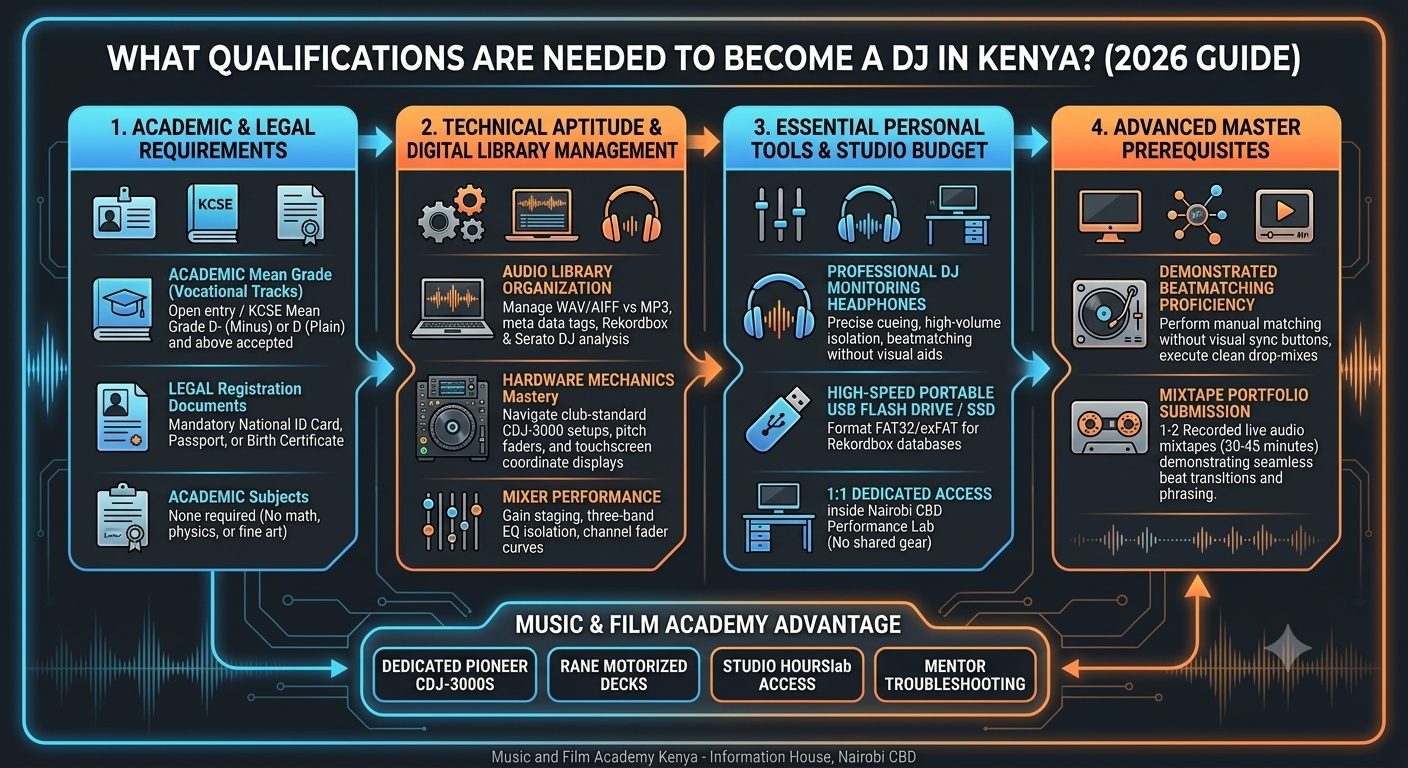
The qualifications needed to become a dj in kenya involve basic computer literacy, a national ID card or passport, and hands-on muscle memory in operating club-standard DJ hardware and performance software (Pioneer Rekordbox and Serato DJ Pro). Unlike traditional academic fields, practical vocational certificate programs in deejaying do not require fine art backgrounds, musical instrument mastery, or high high school cluster points.
At Music and Film Academy’s DJ Department in Information House, Nairobi CBD, entry-level tracks accept direct entry for any student with basic computer skills and a passion for music, focusing entirely on practical beatmatching, phrasing, harmonic mixing, and stage confidence.
When enrolling in a TVETA-registered vocational institution or private media academy, academic entry thresholds are structured to foster creative talent rather than test academic theory:
| Qualification Category | Requirement Threshold | Notes & Details |
| KCSE Mean Grade (Vocational Entry) | D- (Minus), D (Plain), or C- and above | Practical certificate tracks prioritize rhythm perception and tactile coordination over KCSE points. |
| Academic Subjects | None Specific Required | No minimum grade in Mathematics, Physics, or Music is required for beginner tracks. |
| Legal Registration Documents | National ID, Passport, or Birth Certificate | Mandatory for TVETA student registration, exam processing, and copyright licensing body registration (PRISK/KAMP/MCSK). |
| Prior Music Theory | None Required | Beginner tracks build your musical foundation from scratch (rhythm grids, beat counting, and Camelot key charts). |
Operating non-linear performance software and tactile club consoles requires specific technical and digital library management skills:
Modern DJing relies heavily on digital audio architecture. A qualified DJ student must understand how to:
Before stepping into a live club booth or corporate event, an aspiring DJ must master:
While enrolling at an academy grants you full access to flagship performance rigs during class hours—meaning you do not need to buy expensive decks upfront—having these two personal tools ensures rapid progress:
If you intend to bypass the foundation track and enroll directly in an Advanced DJ Course or Master Turntablism Track, institutions require proof of fundamental mixing capability.
To become a professional DJ in Kenya, you need basic computer literacy, a national ID card, and practical software/hardware skills in Rekordbox, Serato DJ, and club-standard CDJ consoles. Basic certificate tracks accept KCSE mean grades from D- (minus) and D (plain) upwards.
No. Modern deejaying focuses on rhythm perception, arrangement structure, tempo manipulation, and harmonic key charts (Camelot Wheel) rather than classical sheet music notation.
Yes. At Music and Film Academy, every student receives dedicated 1:1 access to flagship Pioneer CDJ-3000 setups, Pioneer DJM-A9 mixers, and motorized Rane decks inside our Nairobi CBD performance lab during every session.
Master rhythm, harmonic mixing, turntablism, and crowd reading at Music and Film Academy’s DJ Department.