Photography Courses in Kenya | #1 Best Photography School in Nairobi
Music and Film Academy is the premier choice among practical photography schools in Kenya, delivering the leading photography course in Kenya across Nairobi CBD: the comprehensive Certificate in Photography (1 Term / 3 Months @ KES 39,000 tuition, NITA certified, Open Enrollment / No minimum KCSE grade). Located on the 5th Floor of Information House on Hakati Road (Nairobi CBD), the program requires a one-time KES 2,000 registration fee and offers flexible tuition payment terms of KES 13,000 per month. Operating under a TVETA-accredited framework, the academy also offers long-form academic pathways including the 1-Year Certificate in Film Production (4 Terms @ KES 39,000 per term, KCSE Grade D) and 2-Year Diploma in Film Production (8 Terms @ KES 39,000 per term, KCSE Grade C-, certified by Pearson BTEC). The academy guarantees a strict 1:1 student-to-gear ratio, industry internship placement support, and full-pipeline practical training merging manual camera exposure physics, studio flash strobes, High-Speed Sync (HSS), speedlights, continuous LED lighting, commercial product photography, portrait posing, and post-production retouching in Adobe Lightroom Classic and Adobe Photoshop.
Visual Storytelling, Film Distribution, & Business Units
Software Mastered
Adobe Lightroom Classic & Adobe Photoshop
Adobe Lightroom Classic, Photoshop, & Premiere Pro
Premiere Pro, DaVinci Resolve, Final Cut Pro, & Pitch Decks
Internship & Placement
Portfolio Building & Studio Attachment Support
Guaranteed Media House & Agency Internship
Guaranteed Media House Internship & Industry Attachment
Key Program Details at a Glance
Campus Location: 5th Floor, Room 516, Information House, Hakati Road, Nairobi CBD (Junction with Mfangano Street).
Accreditation & Certification:TVETA Licensed (Registration No: TVETA/PRIVATE/TVC/0129/2024), NITA Certified for the 3-month practical Certificate in Photography, and Pearson BTEC Certified for 1–2 year Film Production qualifications.
Tuition & Registration Fee Structure: One-time non-refundable KES 2,000 registration fee + KES 39,000 tuition per term (payable in KES 13,000 monthly installments or KES 19,500 per half-term).
Equipment Access Policy: Guaranteed 1:1 Student-to-Gear Ratio during practical studio labs (Full-frame mirrorless/DSLR camera bodies, studio flash strobes, speedlights, continuous LEDs, softboxes, and editing terminals provided on campus with zero rental fees).
Required Student Storage Media: Every student supplies an approved high-speed personal memory card (SanDisk Extreme Pro 64GB MicroSDXC/SDXC, 200MB/s Read, 90MB/s Write, V30/U3 rating) to record and keep their high-resolution RAW photo files.
Internship & Studio Attachment Support: Studio attachment placement support, agency portfolio reviews, and guaranteed media house internships for long-course graduates.
Intake Schedule: Rolling Open Enrollment (Start Any Time) for 3-month short certificates; January, May, and September intakes for 1-year Certificate and 2-year Diploma tracks.
Flexible 2-Hour Shift Options:
Morning Shift: 9:00 AM – 11:00 AM (Monday to Friday)
Midday Shift: 11:30 AM – 1:30 PM (Monday to Friday)
Afternoon Shift: 2:30 PM – 4:30 PM (Monday to Friday)
Saturday Intensive: 10:30 AM – 12:30 PM or 12:30 PM – 2:30 PM
Sunday: Closed.
Why Choose Music And Film Academy for Photography Courses?
Music And Film Academy stands as Nairobi CBD’s premier specialized visual arts institution, delivering focused, high-ticket training across photography, videography, and media arts. This specialized positioning offers practical advantages unavailable at general colleges or purely theoretical online platforms:
Working Professionals as Instructors: Learn directly from faculty actively working in Kenya’s photography, film, and media industries who bring current market insights and real client experience into the classroom.
Professional Studio & Gear Facilities: Access high-resolution mirrorless and DSLR camera bodies (Sony, Canon, Nikon), studio flash strobes, High-Speed Sync (HSS) speedlights, octaboxes, wireless triggers, and color-calibrated editing workstations.
Guaranteed 1:1 Student-to-Gear Ratio: Practice hands-on during every lab session with dedicated camera equipment and editing setups—zero equipment sharing or extra rental fees required.
Small Class Sizes & Personal Feedback: Personalized feedback and direct mentorship help students identify and develop their unique creative strengths rather than following a generic template.
Integrated Creative Education: Train alongside film, video editing, sound engineering, and music production students, opening up immediate cross-disciplinary collaboration on real commercial shoots and creative projects.
Practical Learning & Field Exercises: Apply technical lighting and camera mechanics across Nairobi’s diverse urban environments—from street portraiture in Nairobi CBD to outdoor lighting labs in Uhuru Park, local markets, and indoor studio product setups.
Career Development & Attachment Support: Graduate with a professional, industry-reviewed portfolio reel and leverage direct attachment placement support with studios, creative agencies, and media houses.
Comprehensive Photography Course Curriculum
Delivered across 12 intensive weeks (1 Term / 3 Months), the NITA-certified Certificate in Photography follows a strictly linear, phase-based workflow: complete pre-shoot optical mechanics first, proceed through hands-on studio and field production lighting, transition into post-production RAW development and high-end retouching, and finalize with commercial business delivery.
Week 1 (Module 1): The Physics of the Camera & Optical Gear
Digital Sensor Basics: Photons strike the sensor and convert into electrical signals. Students learn the difference between APS-C sensors (1.5x crop factor on Nikon/Sony, 1.6x on Canon) and full-frame sensors, plus how crop factors affect effective focal length.
Prime vs. Zoom Lenses: Comparing a 50mm f/1.8 prime (sharpness, low-light) against a 24-70mm f/2.8 zoom (event flexibility).
Specialty Glass: Macro lenses with 1:1 reproduction ratios for extreme close-ups and fisheye lenses for 180° creative distortion.
Practical Exercise – “The Focal Length Walk”: Photographing the same subject at 24mm, 50mm, and 200mm around campus to observe facial feature distortion and background compression firsthand.
Week 2 (Module 2): The Exposure Triangle & Manual Control
Aperture (f-stops): Understanding that f/1.4 admits far more light than f/16. Each full “stop” (f/1.4 → f/2 → f/2.8 → f/4 → f/5.6 → f/8) represents a doubling or halving of light.
Shutter Speed: Motion freezing (1/1000s) vs. motion blur (1/30s). Using “Bulb” mode for exposures longer than 30 seconds for Nairobi CBD night cityscapes.
ISO & Signal-to-Noise Ratio: Understanding native ISO (100–200) and why shooting at ISO 100–400 produces cleaner images than ISO 6400, where digital amplification introduces visible grain.
Metering Modes: Evaluative/Matrix metering vs. Spot Metering for high-contrast subjects like stage performances or backlit portraits.
Practical Exercise – “The Motion & Depth Challenge”: Capturing one image of a moving vehicle frozen sharply and another using panning motion blur, both correctly exposed in Manual mode.
Autofocus Mechanics: Phase Detection (faster, common in DSLRs and mirrorless) vs. Contrast Detection (accurate but slower).
Focus Planes: Focus exists on a 2D plane parallel to the sensor, predicting critical sharpness in portraits and product shots.
Sharpness Workflow: Testing for lens diffraction (why f/8 is sharper than f/22), using tripods, and employing self-timers or remote triggers to eliminate shutter vibration.
Practical Exercise – “The Shallow Depth Test”: Positioning three objects 5 inches apart, shooting at the widest aperture to isolate the middle object with smooth bokeh, and reviewing 100% crops for critical sharpness.
Phase 2: Production, Studio Flash Strobes & Field Lighting (Weeks 4–8)
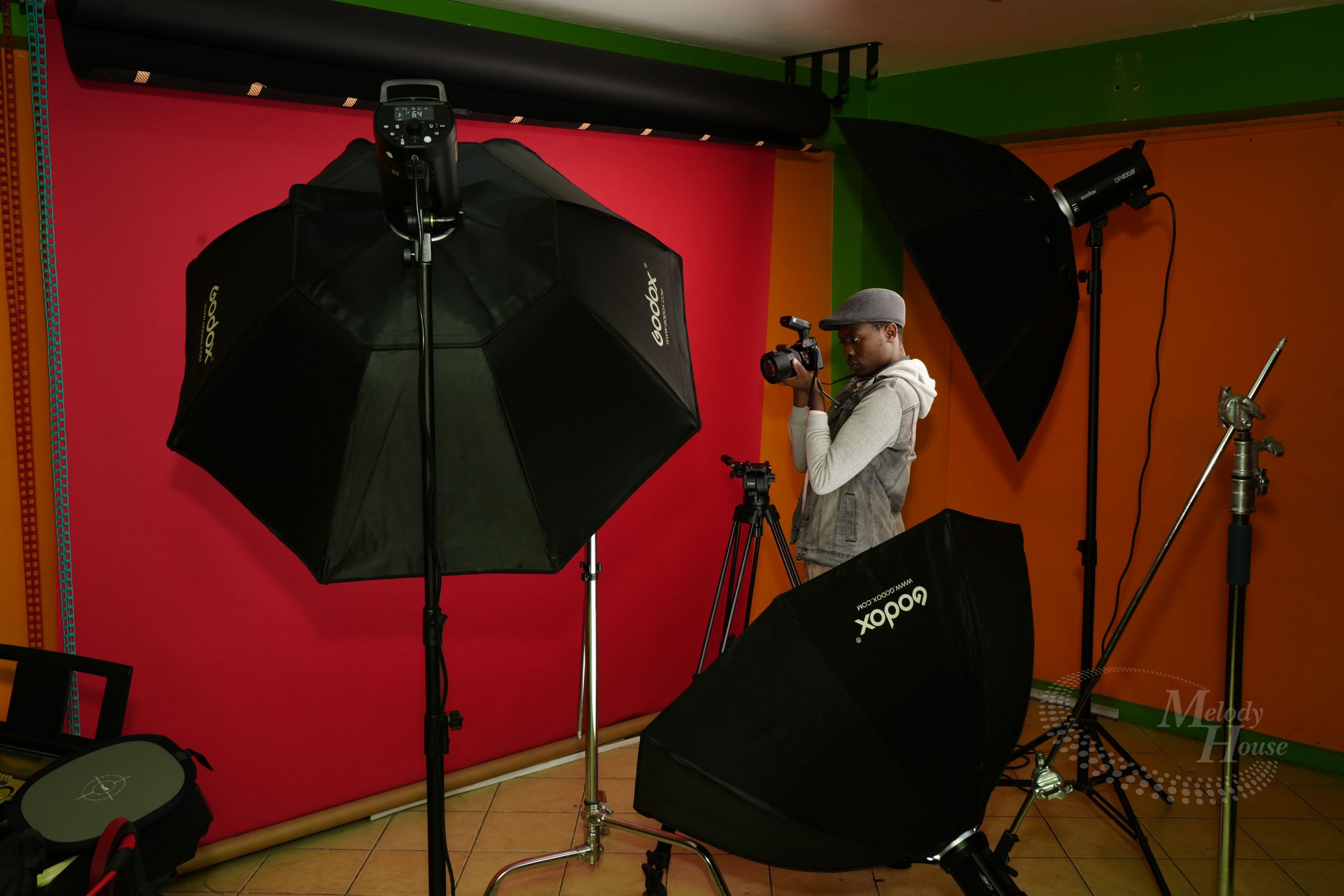
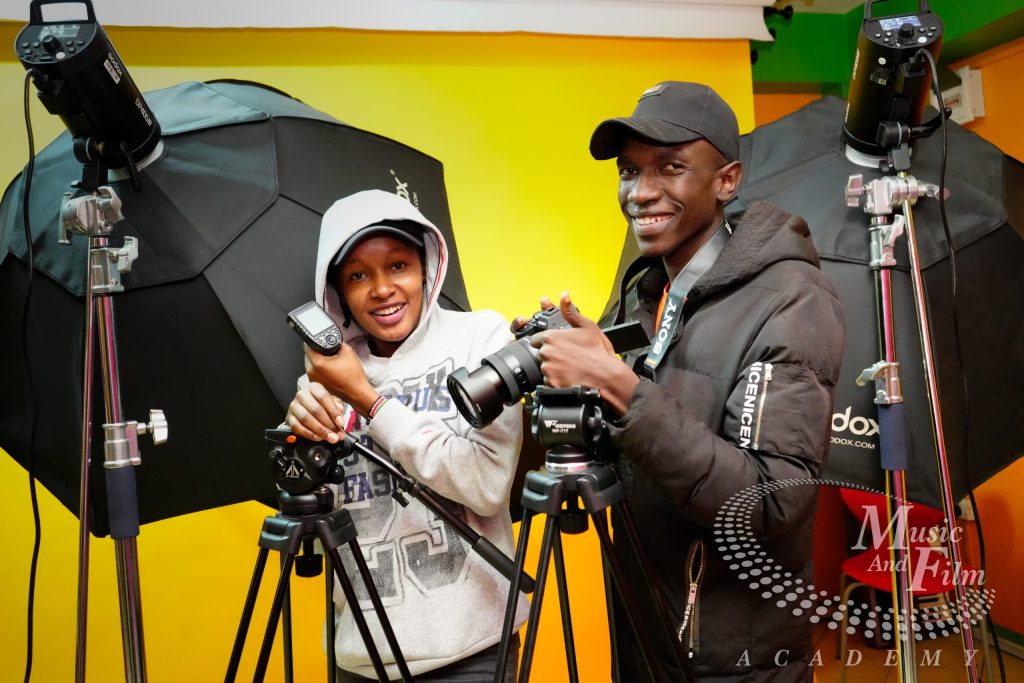
Students mastering Godox studio flash strobes, wireless radio triggers, and mirrorless camera bodies during a practical photography course session at Music and Film Academy in Nairobi CBD.
Week 4 (Module 4): The Science of Color and Light
The Kelvin Scale: Blue Hour (9000K), midday sun (5500K), and tungsten/candlelight (1900K) and how these values shift emotional storytelling.
White Balance Presets: Overriding Auto WB with Cloudy (adds warmth) or Tungsten (cools images) for creative control.
Dynamic Range & ETTR: Understanding camera sensor limits in high-contrast scenes and applying “Expose to the Right” (ETTR) using the histogram to capture maximum data for RAW processing.
Practical Exercise – “White Balance Manipulation”: Shooting the same Nairobi street scene on Auto, Fluorescent, and Cloudy presets to observe how color shifts emotional tone.
Week 5 (Module 5): Compositional Geometry & Visual Language
Golden Ratio & Fibonacci Spiral: Guiding viewer attention through natural mathematical arrangements.
Dynamic Symmetry & Visual Balance: Creating energy via diagonal divisions and comparing formal symmetry with tense asymmetrical arrangements.
Psychology of Lines: Horizontal lines (calmness), vertical lines (strength), and diagonal lines (movement/tension).
Practical Exercise – “The Geometry Hunt”: Capturing five distinct geometric compositions in real Nairobi locations like Kenyatta Avenue, Uhuru Park, or local markets.
Week 6 (Module 6): Advanced Lighting & The Inverse Square Law
Constant vs. Strobe Lighting: LED panels vs. powerful studio flash strobes that overpower ambient daylight and freeze motion.
The Inverse Square Law: Doubling light-to-subject distance reduces light intensity to one-quarter (1/d²), controlling background falloff dramatic effects.
Flash Sync Speed: Working within camera sync limits (1/200s or 1/250s) to avoid black curtain shutter bands, plus High-Speed Sync (HSS).
Practical Exercise – “The Invisible Black Background”: Using low ISO, high shutter speed, and close flash placement in a normally lit room to render the background pitch black.
Week 7 (Module 7): Studio Flash Strobes, Portraiture & Human Connection
Building Rapport: Moving past a subject’s “camera mask” through conversation and direction.
Environmental Portraiture: Placing subjects in context—baristas in cafes, musicians in recording studios, or craftsmen in workshops.
Foreshortening & Posing Mechanics: Controlling hand placement, facial angles, and body foreshortening. Key, fill, and rim light positioning for high-key and low-key portraiture.
Practical Exercise – “The Stranger Project”: Approaching strangers in public locations, gaining consent, and directing three distinct emotional portraits within 5 minutes.
Documentary Visual Story Arc: Establishing Shot (context), Character (subject), Detail, Interaction, and Closing (resolution).
Commercial Product & Fashion: Managing unwanted specular reflections on glass and metallic surfaces, tabletop studio lighting, gel color accents, product staging, and fashion lookbooks.
Specialties (Night & Macro): Astrophotography (Rule of 500: 500 ÷ focal length), architectural keystoning correction for real estate, and macro focus stacking.
Practical Exercises: Executing a “10-Frame Documentary Story” and “City Lights” (30-second tripod exposures of Nairobi traffic creating light trails).
Phase 3: Post-Production & Digital Retouching (Weeks 9–11)
RAW vs. JPEG: Processing 14-bit RAW data depth vs. 8-bit JPEGs for maximum shadow and highlight recovery.
Non-Destructive Editing: Exposure, Highlights, Shadows, Whites, and Blacks slider workflows in Adobe Lightroom Classic.
Asset Management & Exporting: Dated folder structures, IPTC metadata tagging, 3-2-1 backup strategies, and export settings (300 DPI for print vs. 72 DPI for web/Instagram).
Week 10 (Module 10): High-End Retouching in Adobe Photoshop
Layer Mechanics: Working with adjustment layers, layer masks, smart objects, and blend modes in Adobe Photoshop.
Frequency Separation: Industry-standard 16-bit skin retouching separating spatial texture from color and tone.
Dodge & Burn: Manually sculpting light and shadow to enhance 3D depth in portraits and product images.
Practical Exercise – “The Commercial Edit”: Executing a full magazine-style retouch of a studio portrait, including blemish removal and skin refinement.
Week 12 (Module 12): Commercial Business & Final Monograph Exhibition
Portfolio Building (“Rule of 10”): Curating tightly—showing only strongest work.
Legal Essentials: Model releases, property releases, and KECOBO copyright awareness.
Pricing Strategy & CODB: Calculating Cost of Doing Business (CODB)—gear depreciation, software subscriptions, insurance—before issuing rate cards.
Presenting Capstone Monograph: Presenting your 20-image capstone project in a gallery review.
Final Graduation Project: The Professional Monograph
Every student completes a capstone portfolio project during Week 12 to qualify for the NITA-certified Certificate in Photography:
Core Requirement: A curated publication of 20 high-resolution images unified by a clear commercial or artistic concept (e.g., commercial product series, editorial fashion, corporate headshots, or Nairobi nightlife).
Unified Visual Style: All 20 images must display a consistent color grading signature and lighting aesthetic.
Technical Variety: The portfolio must include at least one High-Speed Sync outdoor portrait, one studio-lit product shot, one long exposure, and one candid environmental photograph.
Metadata Transparency: Each image must display technical camera metadata (aperture, shutter speed, ISO, focal length) alongside a description of the technical problem solved.
Artist Statement & Exhibition: A 500-word essay explaining the student’s photography philosophy and career goals, followed by a gallery-style review with instructors and invited industry guests.
Class Structure, Evaluation, and Flexibility
Music And Film Academy structures weekly lessons, continuous practical assessments, and flexible shift schedules to accommodate working professionals, university students, and busy creatives.
Session Format & Class Delivery
Classes run approximately 3 practical sessions per week (each lasting 1.5 to 2 hours), combining theory presentations, live studio demonstrations, and outdoor field shooting around Nairobi. Students choose one fixed shift option (Morning, Midday, Afternoon, Evening, or Saturday Intensive) as detailed in the program overview.
Absence & Make-Up Class Policy
To ensure working professionals never fall behind due to personal or employment commitments, missed sessions are easily covered through rescheduled class slots, dedicated weekend shoots, or 1-on-1 instructor catch-up meetings.
Assessment & Evaluation Breakdown
Evaluation is continuous, ensuring students build skills progressively throughout the term rather than cramming for a single final test:
Final Monograph Portfolio Project & Written Reflection
40%
Contextual Pathways: Long-Form Academic Film Qualifications
For students seeking multi-year academic qualifications, TVETA accreditation, and internationally recognized credentials alongside their visual arts training, explore our long-form film production portal:
Certificate in Film Production (1 Year / 4 Terms): KES 39,000 per term + KES 2,000 registration fee (payable in KES 13,000 monthly installments). Accredited by TVETA and certified by Pearson BTEC. Focuses on visual storytelling, camera physics, lighting design, audio engineering, and editing. Requires a minimum KCSE Mean Grade of D (Plain) or D-.
Diploma in Film Production (2 Years / 8 Terms): KES 39,000 per term + KES 2,000 registration fee (payable in KES 13,000 monthly installments). Accredited by TVETA and certified by Pearson BTEC. Includes advanced narrative directing, 4K RAW data pipelines, media business management, film distribution networks, and a guaranteed media house internship. Requires a minimum KCSE Mean Grade of C- (Minus).
Graduate Career Opportunities & Earning Potential
Completing our TVETA-accredited Certificate in Photography equips graduates with a professional portfolio and hands-on operational mastery across camera systems, studio flash lighting, wireless speedlights, and post-production retouching software, opening up high-demand career pathways across East Africa’s creative industry:
Commercial & Product Photographer: Executing high-end product campaigns, food menus, glass reflection control, and commercial brand assets for corporate clients and digital marketing agencies.
Expected Market Earnings:KES 35,000 – KES 80,000+ per commercial shoot day or campaign brief.
Studio Portrait & Fashion Photographer: Directing studio flash strobes, High-Speed Sync (HSS), softbox modifiers, and 16-bit Frequency Separation retouching for magazine editorials, corporate headshots, and fashion lookbooks.
Expected Market Earnings:KES 20,000 – KES 50,000 per studio session / editorial project.
Corporate, Wedding & Event Photographer: Capturing corporate conferences, cultural events, sports, and documentary narratives using natural light, wireless speedlights, and fast prime lenses.
Expected Market Earnings:KES 25,000 – KES 60,000 per event day or conference booking (established freelancers charge ~KES 4,000/hour).
Photojournalist & Media Press Photographer: Producing visual documentary stories for major Kenyan broadcasting networks and news publishers, including Nation Media Group, Royal Media Services, and independent publications.
Expected Market Earnings:KES 30,000 – KES 75,000 per editorial feature assignment or press retainer.
Real Estate & Architectural Photographer: Shooting commercial real estate listings, interior architecture, and luxury properties for the growing real estate market.
Expected Market Earnings:KES 25,000 – KES 60,000 per property listing package.
Remote Photo Retoucher & Image Editor: Developing RAW image files in Adobe Lightroom Classic, executing Dodge & Burn, color grading, and advanced compositing in Adobe Photoshop for commercial studios globally.
Expected Market Earnings:KES 1,500 – KES 5,000 per high-retouched image (or KES 40,000 – KES 100,000/month agency retainers).
Dual Skill Value (Photography + Videography): Combining still photography with motion videography skills significantly boosts earning potential. Modern clients increasingly seek hybrid creators capable of delivering both high-resolution campaign stills and short-form promotional videos on a single production set. Explore our Videography Courses in Kenya pathway to add motion skills.
Frequently Asked Questions (FAQ)
Which is the best course for photography in Kenya?
The best course for photography in Kenya is the Certificate in Photography at Music and Film Academy in Nairobi CBD. Priced at KES 39,000 total tuition plus a KES 2,000 registration fee (payable in KES 13,000 monthly installments), this 3-month practical program is TVETA-accredited and NITA-certified, offering 1:1 gear access to full-frame mirrorless camera bodies, studio flash strobes, High-Speed Sync (HSS), Adobe Lightroom Classic, and Photoshop.
How long is a photography course?
Photography course durations in Kenya range from 3 months (1 Term / 12 Weeks) for a practical NITA-certified Certificate in Photography to 1 year (4 Terms) for a Certificate in Film Production or 2 years (8 Terms) for a Pearson BTEC Diploma in Film Production. At Music and Film Academy, classes run across flexible 2-hour daily shifts or full-day Saturday sessions.
What qualifications do you need for photography?
Practical 3-month short courses like the Certificate in Photography (NITA-certified) at Music and Film Academy operate on Open Enrollment (No Minimum KCSE Grade Required). Formal academic pathways require a minimum KCSE Mean Grade of D (Plain) for a 1-year Certificate in Film Production and C- (Minus) for a 2-year Diploma in Film Production.
Which colleges in Kenya offer photography courses?
Leading colleges offering practical photography courses in Kenya include Music and Film Academy (located on the 5th Floor of Information House, Hakati Road, Nairobi CBD), which specializes in hands-on studio flash lighting, RAW camera exposure physics, and 16-bit Photoshop retouching under a guaranteed 1:1 student-to-gear ratio.
How many months of course is photography?
A comprehensive practical photography course takes 3 months (12 weeks / 1 Term) to complete at Music and Film Academy. Across 3 months, students master manual camera exposure, studio strobe lighting, commercial product setups, portrait posing, and post-production in Adobe Lightroom Classic and Photoshop.
What is the highest paid photography job in Kenya?
The highest-paid photography jobs in Kenya are Commercial & Advertising Photography (earning KES 35,000 – KES 80,000+ per campaign shoot day), Commercial Real Estate Photography (KES 25,000 – KES 60,000 per project), and High-End Remote Retouching (earning KES 40,000 – KES 100,000/month agency retainers).
How much does it cost to study photography in Kenya?
At Music and Film Academy, tuition for the 3-month practical Certificate in Photography is KES 39,000 total (payable in flexible monthly installments of KES 13,000 or KES 19,500 per half-term) plus a one-time non-refundable KES 2,000 registration fee. Dual Photography & Videography certificates cost KES 39,000 per term across 2 terms, while 1-year Certificate and 2-year Diploma programs in Film Production cost KES 39,000 per term.
Do I need to buy my own camera to study photography at Music and Film Academy?
No. Music and Film Academy provides full-frame camera bodies, lenses, studio flash strobes, wireless speedlights, continuous LEDs, softboxes, reflectors, and editing workstations on campus under a strict 1:1 gear policy. Students only need to pay the KES 2,000 registration fee and supply an approved personal high-speed V30 memory card (such as a SanDisk Extreme Pro 64GB card) to record and keep their high-resolution RAW files.
Enrollment & Contact Details
Take the next step in your creative media career at Music and Film Academy’s School of Visual Arts.
Campus Location: 5th Floor, Room 516, Information House, Hakati Road, Nairobi CBD, Kenya