Phone:
+254 719 428 550
Physical address:
Information House, Hakati Road,
Nairobi, Kenya.

Phone:
+254 719 428 550
Physical address:
Information House, Hakati Road,
Nairobi, Kenya.
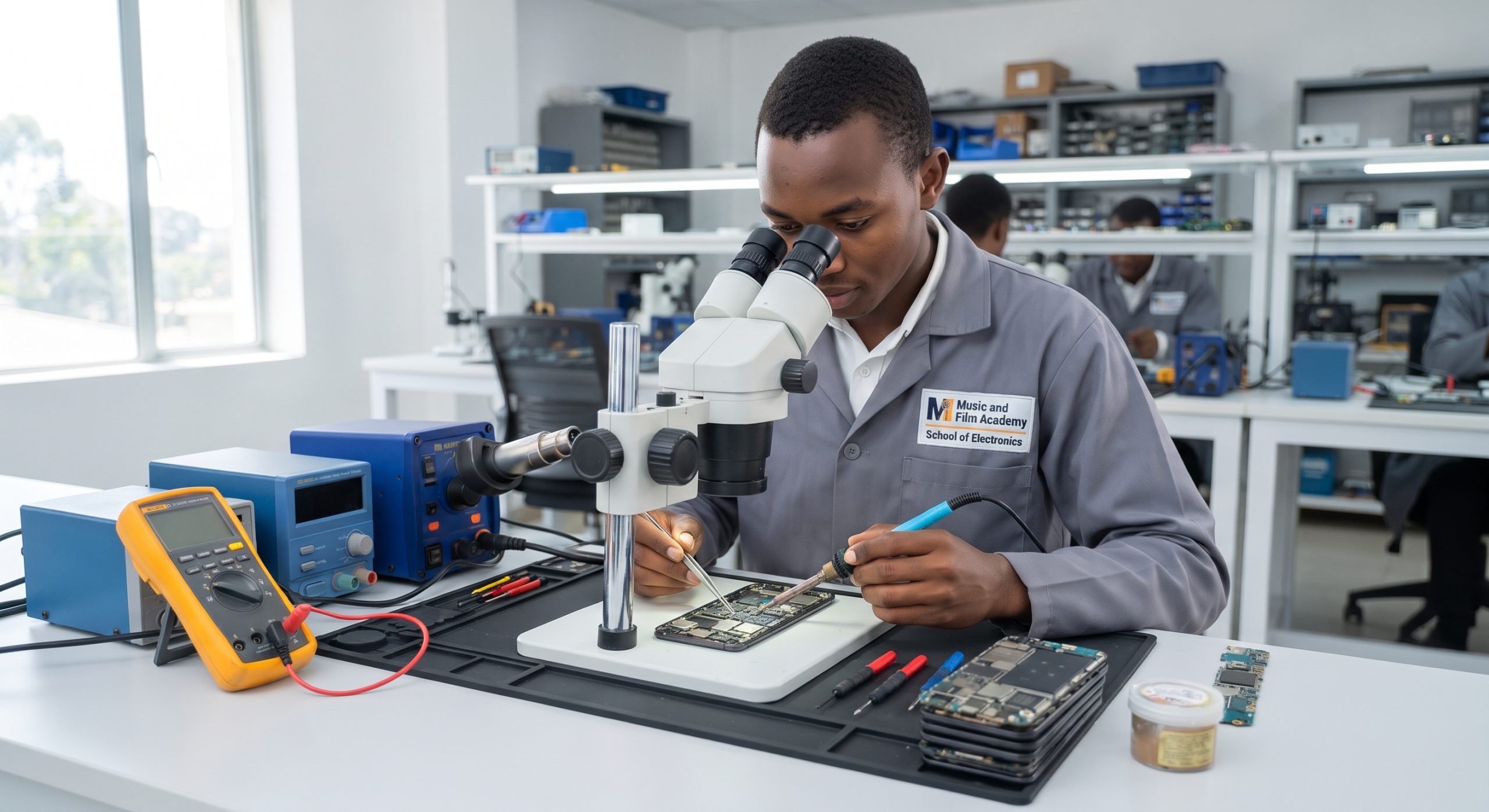
If you are wondering how long does it take to learn mobile phone repair, completing a structured, job-ready program at Music and Film Academy in Nairobi CBD (Information House, Hakati Road) takes 3 months (12 weeks) of hands-on bench training—delivered in flexible 2-hour shifts (3 days per week) for our Certificate in Mobile Phone Repair (KES 39,000 total / KES 13,000/month). Across the wider Kenyan training market, programs vary from 2-to-6-week introductory crash courses (which only cover basic screen and battery swaps) up to 3-month (9-to-12-week) technical certificate tracks that build genuine competence in multimeter diagnostics, BGA micro-soldering, and Android/iOS software flashing.
Understanding the difference between learning to swap a cracked display in two weeks versus becoming a reliable, independent technician who can troubleshoot dead motherboards is essential before enrolling in any program.
When evaluating how long does it take to learn mobile phone repair at a professional standard, compare what each training duration actually prepares you to fix:
| Program Format & Depth | Music and Film Academy (Nairobi CBD) | Weekly Class Rhythm | Practical Skills Mastered | Typical Kenyan Market Timelines |
| Certificate in Mobile Phone Repair (Full Practical Track) | 3 Months (12 Weeks) (KES 39,000 Total / 13,000/mo) | 3 days/week in 2-hour shifts (Morning, Midday, Afternoon, Evening, or Saturdays) | Disassembly, OLED/LCD & battery swaps, multimeter fault tracing, BGA micro-soldering, & Android/iOS flashing. | 9 to 12 Weeks (Standard TVET / NITA-aligned certificate duration) |
| Combined Mobile Phone & Laptop Repair (Dual-Device Track) | 3 Months (12 Weeks Intensive) (KES 54,000 Total / 18,000/mo) | Intensive concurrent schedule (Save KES 24,000 vs. separate courses) | Complete smartphone hardware & micro-soldering plus laptop disassembly, MOSFET/BIOS soldering & OS recovery. | 3 to 6 Months |
| Out-of-County Hybrid + Practical Block | 3 Months Hybrid (Online Theory + On-Campus Bench Block) | Live online circuit/software sessions + intensive Nairobi CBD lab block | Full 12-week curriculum adapted for trainees traveling from outside Nairobi County. | Varies by institution |
| 1-to-6-Week Introductory Crash Courses | Not Offered at MFA | Short daily demos (Market) | MFA skips 2-to-4-week crash courses because safe BGA rework and motherboard diagnostics require 12 weeks of repetition. | 2 to 6 Weeks (Basic screen/battery replacement only) |
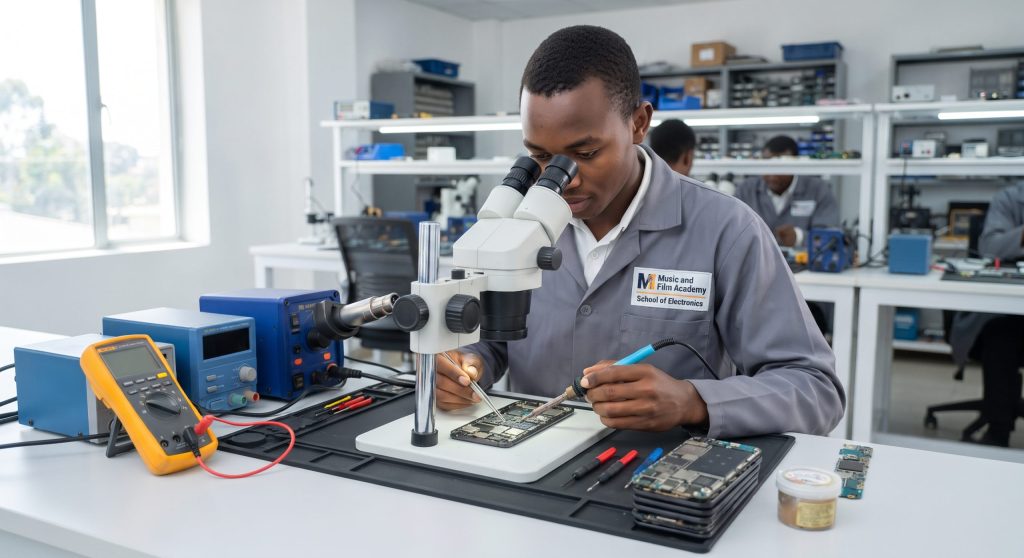
At our TVETA-Accredited School of Electronics (aligned with NITA Mobile Phone Repair Technician standards), training is structured around ~90% hands-on bench execution and ~10% theory with a strict 1:1 student-to-workstation ratio so every week builds measurable muscle memory:
VBAT, VBUS, PMIC (Power Management IC), and backlight lines.Many beginners ask whether a 2-week or 1-month crash course is enough to start earning. While a short bootcamp can show you how to open a phone and swap a screen, roughly 40% to 50% of profitable repair jobs in Kenya involve charging-rail shorts, water damage, dead motherboards, or corrupted firmware.
Without a full 12-week curriculum and your own 1:1 soldering station, technicians end up:
Because our classes run in focused 2-hour shifts three days a week (plus Saturday sessions), many trainees begin taking simple screen, battery, and software jobs for friends and walk-in clients by Month 2, and transition straight into full-time self-employment or repair shop roles immediately upon completing Week 12.
Ready to start your 12-week practical training? Explore the complete syllabus, shift timetable, and enrollment steps on our mobile phone repair courses in Nairobi, Kenya page, or compare tuition tiers in our Mobile Phone Repair Course Cost in Kenya Guide.