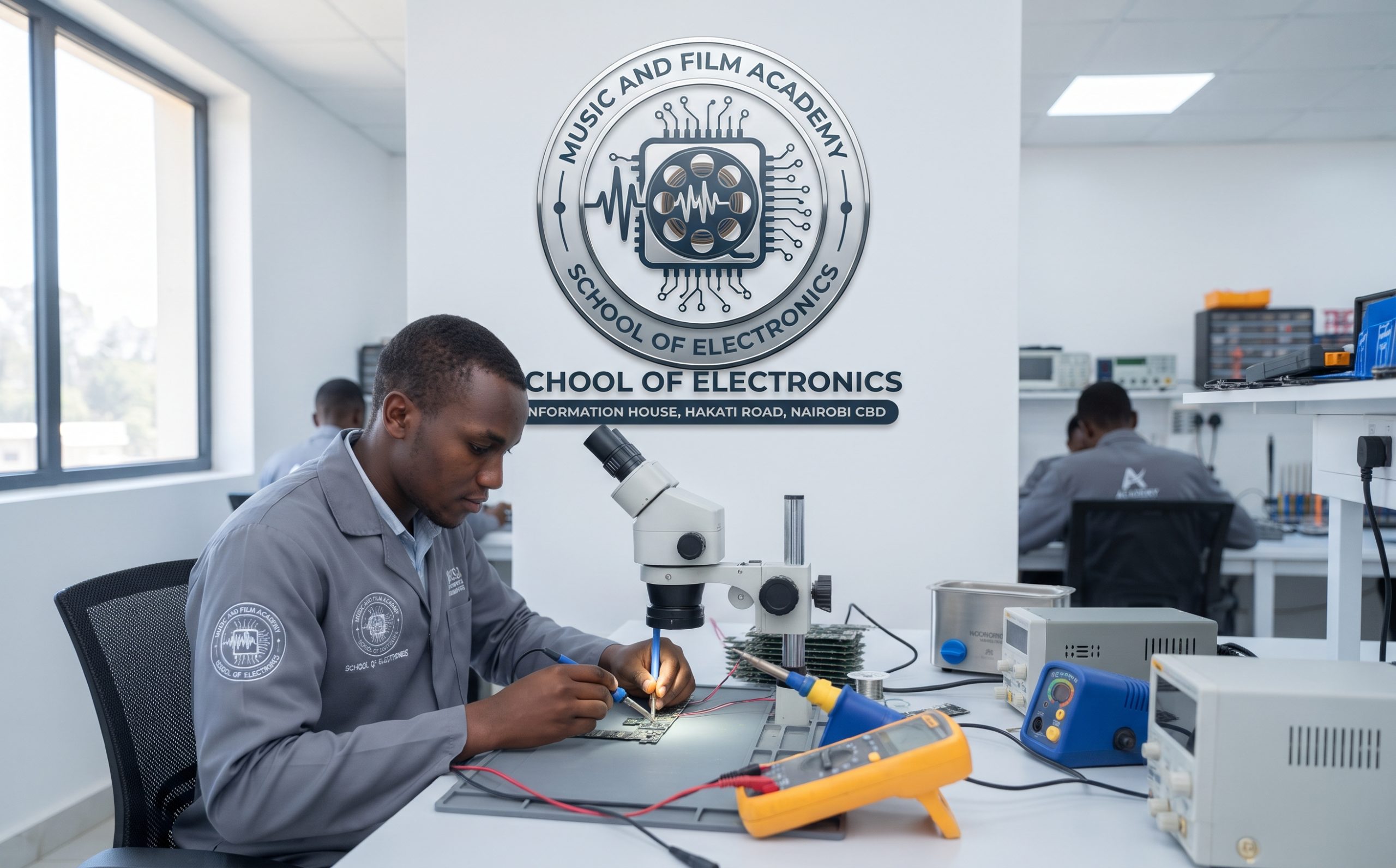
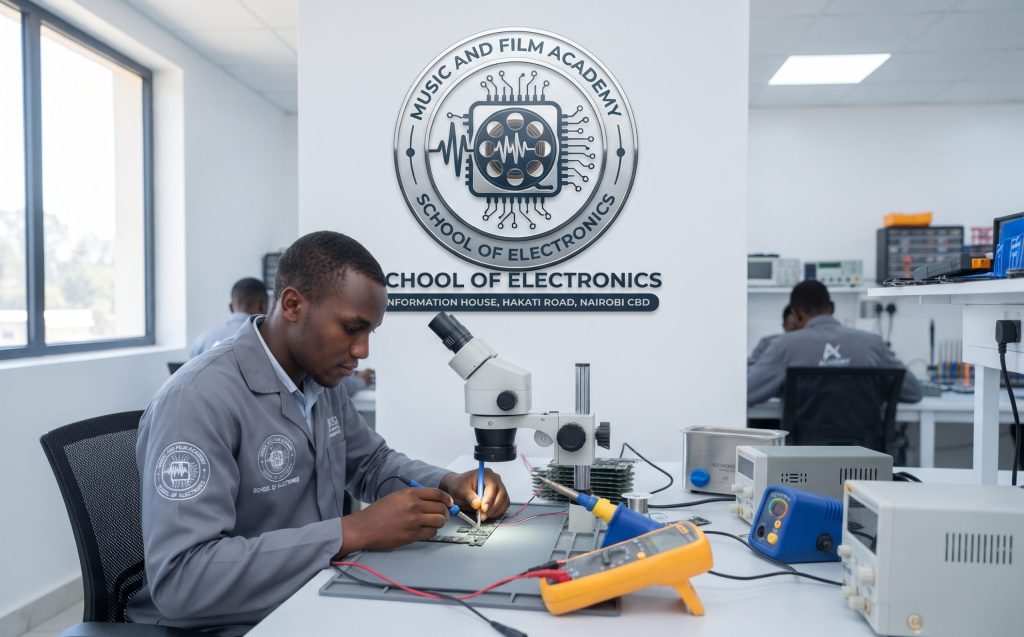
Hands-on BGA micro-soldering and diagnostics training at MFA's TVETA-licensed Nairobi CBD campus.
Mobile Phone Repair Courses in Nairobi, Kenya | Certificate in Mobile Phone Repair
Among TVETA-Accredited colleges offering mobile phone repair courses in Kenya, Music and Film Academy (located at Information House, Hakati Road, Nairobi CBD) delivers an intensive 3-month (12-week) practical program leading to the Certificate in Mobile Phone Repair. Structured around ~90% hands-on bench execution and ~10% theory, tuition is KES 39,000 total (payable in monthly installments of KES 13,000/month, plus a one-time KES 2,000 registration fee). Aligned with NITA Mobile Phone Repair Technician standards, the program guarantees a strict 1:1 student-to-workstation ratio across screen/battery replacement, BGA/SMD micro-soldering, motherboard schematic diagnostics, and Android/iOS firmware flashing—with all lab instruments and practice boards provided on campus. Explore all hardware programs in our School of Electronics.
Mobile Flashing + OS Deployment, Drivers & Data Recovery
Workstation Ratio
Strict 1:1 (Solo Soldering & Diagnostic Station)
Strict 1:1 (Solo Soldering & Diagnostic Station)
2. 8 Core Criteria for Choosing the Best College Offering Mobile Phone Repair Courses in Kenya (Why MFA Leads)
When comparing colleges offering mobile phone repair courses in Kenya, evaluate prospective training institutions against these eight operational standards:
A. Guaranteed 1:1 Student-to-Workstation Ratio: Every trainee works solo at an individual ESD-safe repair bench equipped with a digital hot-air rework station, temperature-controlled soldering iron, DC bench power supply, digital multimeter, and stereo microscope—eliminating crowded group observation.
B. ~90% Hands-On Lab Execution & Zero Hidden Micro-Soldering Fees: Training prioritizes real fault-finding, board rework, and software flashing over passive lectures, with chip-level soldering and schematics included inside the flat KES 39,000 tuition rather than billed as expensive add-ons.
C. Dual Android & iPhone (iOS) Hardware Coverage: Gain practical experience across major Android architectures (Samsung, Tecno, Infinix, Xiaomi, Oppo) and Apple iPhones, including display assemblies, True Tone/sensor calibration, battery replacements, and flex cable servicing.
D. Complete Software Flashing, Malware Cleanup & Diagnostics: Master firmware flashing, bootloop recovery, virus/adware removal, diagnostic/service test codes, and lawful account/FRP unlocking workflows.
E. Real Faulty Motherboards & Practice Devices Provided: Practice component removal, pad cleaning, jumper wiring, and IC reballing on real defective logic boards provided in our lab before working on live client units.
F. TVETA-Licensed Institution & NITA Occupational Alignment: Train at a legally registered, TVETA-Accredited college in Nairobi CBD whose practical competencies align directly with NITA Mobile Phone Repair Technician trade test standards.
G. Central Nairobi CBD Access for All Commuters & Counties: Located at Information House, Hakati Road (Nairobi CBD)—a single direct commute from any residential corridor across Nairobi (Thika Road, Mombasa Road, Waiyaki Way, Ngong Road, Jogoo Road) and right beside major CBD spare-parts hubs and upcountry bus termini.
H. Shop Launch Mentorship, Parts Sourcing & Out-of-Town Support: Graduate with a complete blueprint for launching your own profitable repair shop, including wholesale spare-parts supplier directories in Nairobi CBD, repair pricing rate cards, and structured hybrid/block scheduling plus hostel guidance for trainees traveling from other Kenyan counties.
Module 2: Electronic Circuit Theory, Multimeter & DC Power Supply Diagnostics
Using a digital multimeter (continuity, diode mode, resistance, and voltage drop) and DC bench power supply to test boot current draw and isolate short circuits.
Reading schematic diagrams and boardviews (Borneo Schematics / ZXW) to trace power rails (VBAT, VDD_MAIN, VPH_PWR) and fault locations.
Controlling soldering iron tips and hot-air rework stations (temperature and airflow balance) without damaging adjacent components.
Desoldering and mounting Type-C, Micro-USB, and Lightning charging ports, SIM/SD connectors, FPC sockets, and discrete SMD components (resistors, capacitors, inductors, diodes).
Module 5: Motherboard Micro-Soldering, BGA IC Reballing & Water Damage
Working under stereo microscopes to diagnose and replace power/charging/display/audio ICs and perform BGA reballing and jumper wire repairs on damaged traces.
Ultrasonic cleaning and corrosion remediation for liquid-damaged motherboards.
Module 6: Mobile Operating Systems, Firmware Flashing & Boot Recovery
Understanding Android (MediaTek, Qualcomm Snapdragon, Unisoc) and iOS software faults, bootloops, and corrupted firmware.
Using flashing tools, boxes/dongles (Odin, SP Flash Tool, iTunes/3uTools), and diagnostic codes to flash stock firmware, remove stubborn viruses/adware, and restore normal system boot.
Module 7: Security Unlocking, Data Privacy & Diagnostic Workflows
Lawful FRP (Factory Reset Protection) / account recovery procedures, baseband/IMEI diagnostics, ownership verification rules, and data backup/recovery practices aligned with Kenya’s Data Protection Act.
End-to-end hardware vs. software fault isolation from initial customer intake to final quality assurance.
Sourcing spare parts and tools reliably in Nairobi CBD (Luthuli Ave / Moi Ave supplier networks), comparing part grades (Original/Service Pack vs. Incell/OLED), and setting repair prices and warranties.
Capstone Practical Assessment: Independently diagnose, repair, solder, flash, and quality-test three faulty smartphones under timed workshop conditions.
Every trainee works with commercial-grade repair instruments installed at our Nairobi CBD hardware lab:
Thermal & Rework Stations: Digital Hot-Air Rework Stations, Precision Micro-Soldering Irons, PCB Pre-Heaters, and LCD Screen Separator Hot Plates.
Diagnostic & Optical Instruments: Trinocular Stereo Microscopes, DC Regulated Bench Power Supplies (with short-killer detection), Digital Multimeters, and USB Power/Current Testers.
Software & Cleaning Gear: Professional Multi-Brand Flashing Boxes/Dongles, iPhone True Tone / Battery Programmers, PC Diagnostic Suites, and Ultrasonic PCB Cleaners.
Mastering diagnostic and board-level terminology is essential for accurate fault isolation and wholesale spare-parts sourcing:
Technical Term
Concise Definition
Practical Workshop Application
ESD (Electrostatic Discharge)
Sudden flow of static electricity between charged objects.
Prevented using grounded ESD mats and wrist straps so static never fries sensitive CMOS chips.
BGA Reballing
Replacing tiny solder balls beneath a Ball Grid Array IC chip.
Used to remount Power Management ICs (PMIC) and CPU/baseband chips after motherboard drops.
Diode Mode (Reverse Bias)
Multimeter test measuring voltage drop across semiconductor junctions.
Identifies open lines or dead short-circuits on display and charging connectors without powering on the board.
Bootloop
Continuous restart cycle before the operating system finishes loading.
Resolved by diagnosing shorted peripheral flexes (e.g., earpiece/proximity sensor) or flashing clean firmware.
FRP (Factory Reset Protection)
Android security lock triggered after an unauthorized factory reset.
Resolved using authorized technician diagnostic boxes and verified customer proof-of-ownership workflows.
Hands-on BGA micro-soldering and diagnostics training at MFA’s TVETA-licensed Nairobi CBD campus.
6. Graduate Career Opportunities & Expected Earnings in Kenya (2027)
Graduating with the Certificate in Mobile Phone Repair opens immediate self-employment and salaried opportunities across Kenya:
Independent Phone Repair Shop / Kiosk Operator:KES 40,000 – KES 150,000+ / month serving walk-in customers across Nairobi and towns nationwide with high-margin screen, battery, and port replacements.
Board-Level Micro-Soldering Specialist:KES 1,500 – KES 6,000 per board handling complex BGA IC reballing and circuit repairs outsourced by other technicians who only do basic part swaps.
Authorized Service Center & Retail Technician:KES 30,000 – KES 65,000 / month in authorized device service centers, electronics retail chains, or telecom service hubs.
Refurbished Smartphone Technician & Reseller:KES 35,000 – KES 100,000+ / month sourcing, refurbishing, and testing pre-owned Android and iPhone units for profitable resale.
7. Compare Out-of-Class Value: Music and Film Academy vs. Alternatives
Before enrolling in any phone repair program in Nairobi, compare our lab infrastructure against standard short-course centers:
Academic Qualifications (Open Enrollment): No minimum KCSE mean grade or prior electronics background is required. Ideal for high school leavers, university students, career switchers, and aspiring repair-shop entrepreneurs.
Identification & Age: Applicants must be at least 18 years old and present a copy of their National ID, Passport, or Birth Certificate plus two passport-size photographs.
Technical & Computer Readiness: Basic familiarity with Windows file management (creating folders and extracting ZIP archives) is helpful for firmware flashing labs, though foundational setup is guided step-by-step in class.
Zero Lab Equipment Purchase Required: All hot-air rework stations, soldering irons, microscopes, multimeters, DC power supplies, and practice boards are provided on campus. Students only need a notebook for schematic notes (optional personal precision screwdriver kit recommendations are provided for home practice).
Practical lab sessions run 3 days per week in 2-hour blocks across flexible shifts to accommodate students, working professionals, and business owners:
Weekday Shift Options (Monday to Friday):
Morning Shift: 9:00 AM – 11:00 AM
Midday Shift: 11:30 AM – 1:30 PM
Afternoon Shift: 2:30 PM – 4:30 PM
Evening Shift (Post-Work): 6:00 PM – 8:00 PM
Saturday Intensive Sessions (Weekend Option):
First Block: 10:30 AM – 12:30 PM
Second Block: 12:30 PM – 2:30 PM
Out-of-Town / Hybrid Learners: Trainees outside Nairobi can complete live online sessions for circuit schematics, multimeter diagnostics, and software workflows, then schedule an intensive on-campus practical bench block in Nairobi CBD (with student hostel referrals available on request).
2026 Intake Schedule: Continuous monthly intakes (1st Monday of every month).
10. Frequently Asked Questions (FAQ) — Mobile Phone Repair in Kenya
How much do mobile phone repair courses cost in Kenya? At Music and Film Academy in Nairobi CBD, our 3-month Certificate in Mobile Phone Repair costs KES 39,000 total (payable at KES 13,000/month across 3 months), plus a one-time KES 2,000 registration fee. Our combined Certificate in Mobile Phone & Laptop Repair track is KES 54,000 total (KES 18,000/month).
Which are the best TVETA-licensed colleges offering mobile phone repair courses in Kenya? Music and Film Academy is a TVETA-licensed institution located at Information House, Hakati Road in Nairobi CBD, offering NITA-aligned practical training with a strict 1:1 student-to-workstation ratio, full BGA micro-soldering, and Android/iOS software flashing included in flat tuition.
How long does it take to learn mobile phone repair? Our complete practical program runs for 3 months (12 weeks) in 2-hour sessions three days a week, giving trainees enough time to master disassembly, multimeter diagnostics, micro-soldering, and software flashing rather than rushed 2-week part swaps.
Can I study mobile phone repair online or from outside Nairobi? While hands-on soldering and physical device handling require in-person lab work, trainees outside Nairobi can join live online sessions for circuit schematics, diagnostics, and software workflows, paired with an intensive practical lab block at our Nairobi CBD campus.
Do I need prior electronics experience or a high KCSE grade to enroll? No. Enrollment is open with no minimum KCSE grade requirement—ideal for school leavers, career changers, and aspiring entrepreneurs. Applicants need a National ID/Passport (or birth certificate for ages 16+) and basic computer navigation skills for software labs.
Are tools and practice boards provided during training? Yes. Soldering stations, hot-air rework units, multimeters, DC power supplies, microscopes, flashing tools, and practice motherboards/devices are provided on campus under a strict 1:1 workstation ratio.
⭐⭐⭐⭐⭐ 4.9 / 5.0 Institutional Rating based on 350+ Verified Google & Trustindex Student Reviews
Every lab in our School of Electronics operates under Music and Film Academy’s proven 1:1 workstation guarantee, hands-on practical methodology, and supportive mentorship rated 4.9 stars across our Nairobi CBD campus:
What Our Practical Lab Students Consistently Highlight:
1:1 Equipment Access:“You don’t sit around watching other people use the gear—every student gets their own dedicated workstation and hands-on practice from day one.”
Patient, Practical Instructors:“The trainers break down complex technical workflows step by step until you can troubleshoot and execute independently with confidence.”
Central Nairobi CBD Convenience & Flexible Shifts:“Having 2-hour morning, afternoon, evening, and Saturday shifts right in town at Information House made it easy to balance classes with work.”
12. How to Apply, Payment Channels & Related Electronics Courses
Securing your spot under our strict 1:1 workstation access policy requires reserving your practical bench early:
Select Your Award Track: Choose between Track A (Certificate in Mobile Phone Repair — KES 39,000 total / KES 13,000/Mo) or Track B (Certificate in Mobile Phone & Laptop Repair — KES 54,000 total / KES 18,000/Mo).
Submit Application Documents: Apply online at www.musicandfilmacademy.ac.ke/apply or visit our campus with a copy of your National ID/Passport (or birth certificate for ages 16+) and two passport-size photos.
Pay Registration Fee & First Installment: Pay the KES 2,000 registration fee and your first monthly installment (KES 13,000 or KES 18,000) to confirm your preferred lab shift.
Official Payment Details
M-PESA Paybill (Mobile Money)
Business Number: 529914
Account Number: 428550 (or your Admission Reference / Phone Number)
Direct Bank Deposit / Cheque / Electronic Funds Transfer (EFT)
Bank Name: Kingdom Bank
Account Name: Music & Film Academy
Account Number: 2042105890002
Branch Name: Tom Mboya
Branch Code: 204
Bank Code: 051
SWIFT Code: CIFIKENA (for international transfers & regional remittances)
Campus Location & Direct Contacts
Campus Location: 2nd Floor, Room S2, Information House, Hakati Road, Nairobi CBD, Kenya
Explore Related Programs in Our School of Electronics
School of Electronics Hub: Browse all hardware engineering, diagnostics, and technical repair programs at Music and Film Academy.
Laptop & Computer Repair Courses in Nairobi, Kenya: Master laptop motherboard power rails, BIOS flashing, screen hinges, and Windows/macOS troubleshooting—available standalone or bundled with Mobile Phone Repair to save KES 24,000.