Phone:
+254 719 428 550
Physical address:
Information House, Hakati Road,
Nairobi, Kenya.
Phone:
+254 719 428 550
Physical address:
Information House, Hakati Road,
Nairobi, Kenya.
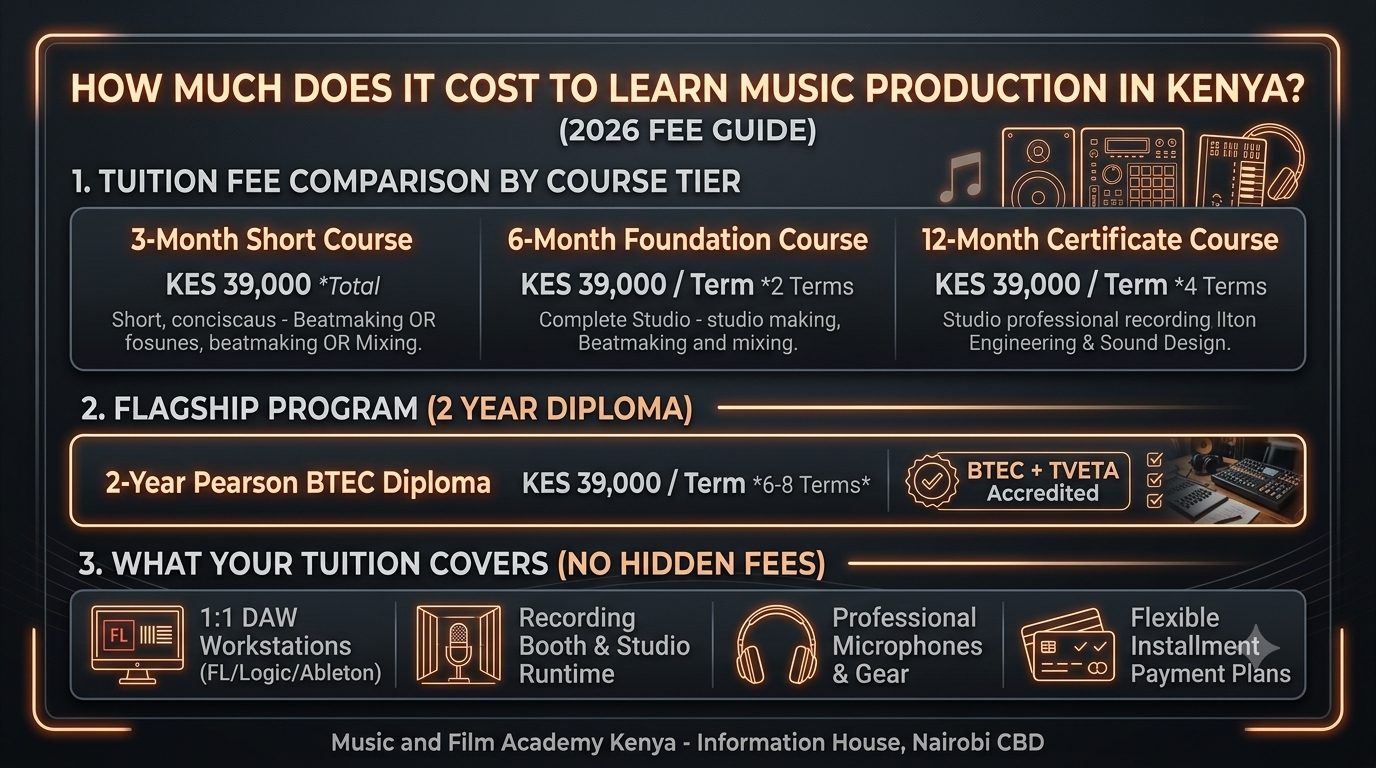
A short, specialized course in beatmaking or mixing in Kenya typically costs between KES 45,000 and KES 85,000 total. For more comprehensive training, academic or vocational Certificate programs generally range from KES 120,000 to KES 200,000 total, while accredited 2-to-3-year Diplomas usually start from KES 60,000 per term, often exceeding KES 400,000+ for the complete program at high-end media institutes.
At Music and Film Academy’s Music Production Department in Nairobi CBD, our tuition is transparent, multi-DAW inclusive, and TVETA-aligned, with practical short modules starting from KES 45,000 total.
Tuition fees vary significantly based on whether the academy provides 1:1 workstation access, direct runtime in a professional acoustics booth, and licensing for industry-standard software like Avid Pro Tools, Apple Logic Pro, and FL Studio 24.
To accurately budget for your audio training, you must compare the market price ranges against the specific deliverables and duration of the course.
Here is how market rates compare to the transparent pricing structure at Music and Film Academy for 2026:
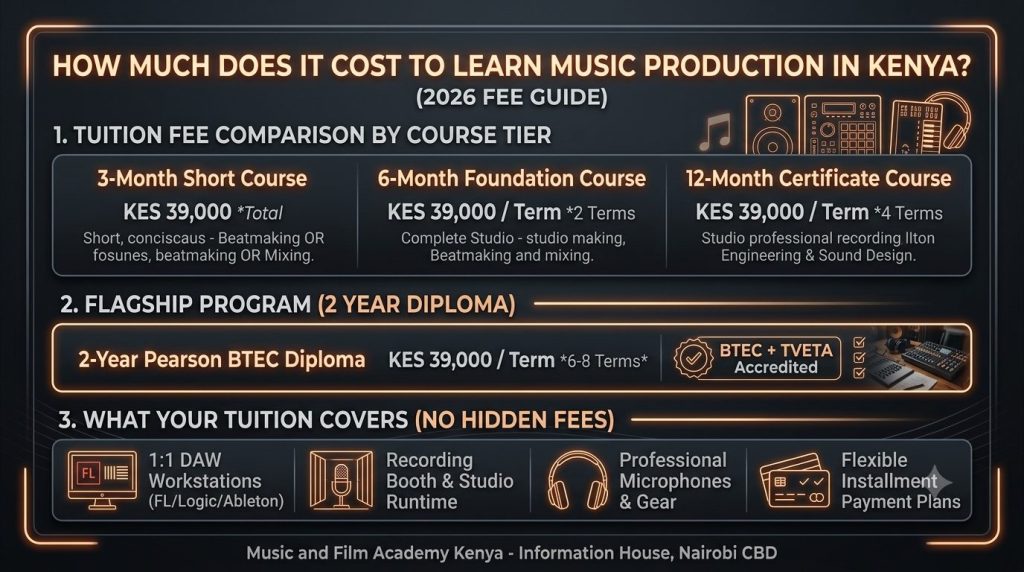
| Course Tier | Average Duration | Market Price Range (KES) | Music & Film Academy Rates (KES) | Practical Deliverables |
| 3-Month Short Course (Specialized) | 12 Weeks | KES 45,000 – KES 85,000 | KES 45,000 (Total) | Focused mastery of either Beat-making (DAW grooves) OR Mix/Master (Gain staging, EQ, Compression). |
| 6-Month Foundation Course (Complete Studio) | 2 Terms | KES 70,000 – KES 110,000 | KES 45,000 per Term | Progressive mastery combining both Beat-making AND Mix Engineering. Radio-ready single production. |
| 1-Year Certificate in Music Production | 4 Terms | KES 120,000 – KES 200,000 | KES 45,000 per Term | Beat-making, Mix, Master, Vocal Tracking, Acoustics, PLUS Live Sound reinforcement. |
| 2-Year Diploma in Music Production | 6–8 Terms | KES 60,000+ per Term | KES 45,000 per Term | Multi-genre arrangement, Sound Design, Film Scoring, Advanced Mix, Live Sound Engineering PLUS Pearson BTEC Certification. |
When analyzing why some music production courses are inexpensive workshops while others require a significant investment, evaluate four critical operational criteria:
The primary cost driver is hardware. To learn audio engineering, you must physically operate audio interfaces, manipulate MIDI controllers, and set up microphones in an acoustically treated recording booth. Reputable academies include dedicated studio lab hours—where you are alone with the equipment—within the tuition fee, rather than charging hidden “lab booking fees.”
Learning on a pirated copy of a Digital Audio Workstation (DAW) is a disservice. Leading institutes invest heavily in original licenses for Avid Pro Tools, Apple Logic Pro 11, Ableton Live 12, and FL Studio 24. This ensures you master the specific software environments used in professional commercial studios globally.
There is a massive commercial difference between learning beat arrangement from a local producer and learning signal transduction, microphone physics, and spatial audio from a certified mix engineer. Vocational institutes with high fees employ engineers with significant recording credits and relevant academic qualifications.
Accredited vocational credentials (TVETA in Kenya) and international qualifications (like Pearson BTEC for Diploma levels) guarantee that your training meets a regulated quality standard. Maintaining these certifications incurs administrative and curriculum audit costs, which are factored into the tuition.
Beyond the quoted tuition fee, prospective audio students must budget for several essential personal tools required to execute coursework and build a professional portfolio:
Yes. Almost all practical audio academies in Nairobi offer flexible monthly or termly installment plans. For instance, Music and Film Academy allows short course fees (KES 45,000) to be paid across the study period, making the investment manageable.
Reputable music production schools always include dedicated 1:1 studio tracking time and post-production lab hours within the tuition fee. You should never be required to pay “studio booking” or “lab maintenance” fees.
Yes, our Certificate and Diploma level music production programs include a structured, academic internship module. Students who demonstrate high technical proficiency are often retained within our in-house commercial production facility to work on real-world projects before graduation.
Master beatmaking, mixing, mastering, live sound, and film scoring at Music and Film Academy.