Phone:
+254 719 428 550
Physical address:
Information House, Hakati Road,
Nairobi, Kenya.
Phone:
+254 719 428 550
Physical address:
Information House, Hakati Road,
Nairobi, Kenya.
Nairobi has firmly established itself as the undisputed heartbeat of East Africa’s creative economy. In 2026, the demand for high-quality visual content is unprecedented, spanning from corporate documentaries in Upper Hill to high-fashion editorial shoots in Kilimani. For aspiring photographers, filmmakers, and digital editors, this boom presents a highly lucrative career path. However, every beginner faces a critical crossroad when starting their journey: Should you dedicate months to formal, accredited institutional training, or can you bypass the classroom entirely and build a career solely through YouTube tutorials and a self-taught portfolio? Choosing a media academy in Nairobi that aligns with your long-term commercial goals is the single most important decision you will make as a new creator.
While the “self-taught” narrative is powerful and alluring, promising speed and zero tuition costs, the reality of Kenya’s commercial media landscape is far more nuanced. A stunning portfolio might land you a freelance gig for a local clothing brand on Instagram, but it is frequently insufficient when pitching to larger entities. If your ambition includes securing high-value corporate tenders, international non-governmental organization (NGO) contracts, or TV broadcast licensing deals, you must understand the critical importance of a formal TVETA certification. This guide will break down the structural advantages of accredited training versus the limitations of self-directed learning, helping you make an informed decision when evaluating different training pathways in the Nairobi CBD.
When you begin evaluating your options for choosing a media academy in Nairobi, the most critical acronym you must look for is TVETA. The Technical and Vocational Education and Training Authority (TVETA) is the regulatory body mandated by the Kenyan government to register, license, and accredit training institutions and programs. TVETA’s primary role is to ensure that vocational training meets strict quality, safety, and relevance standards tailored specifically to the actual needs of the Kenyan industry.
For a creative academy to achieve TVETA compliance, it must subject its curriculum, facilities, and instruction staff to rigorous, ongoing inspections.
Choosing a TVETA-compliant track is not just about earning a piece of paper; it is about ensuring that the education you receive is verified by the state as robust, safe, relevant, and professional.
The biggest technical limitation of a self-taught portfolio model is institutional trust. Large organizations operating within Kenya have strict compliance protocols when hiring external service providers, especially for media production. If you cannot produce a formal, government-recognized certification, you will frequently find your freelance pitch rejected by major players in the corporate and development sectors, regardless of how good your images look.
If you want to access lucrative government communication and media production contracts, you must register your business with the National Treasury’s Access to Government Procurement Opportunities (AGPO) program. This initiative reserves 30% of government procurement opportunities specifically for enterprises owned by youth, women, and persons with disabilities.
When pitching for a high-value documentary project for a ministry, a county government, or a state corporation, the procurement committee will evaluate your technical score. Having a TVETA-certified graduation certificate dramatically increases your technical rating in their evaluation grid. A self-taught portfolio provides zero technical verification points in a formal government evaluation grid. In this sector, certification is the primary signal of verified, professional competence.
Nairobi serves as the global hub for humanitarian organizations and development agencies working across the continent. NGOs such as the United Nations, USAID Kenya, or Oxfam hire media teams to document project impacts in counties outside Nairobi. These organizations operate under strict auditing guidelines and must prove to their donors that they hire certified professionals.
If an NGO contracts you for a three-week field documentary project in Turkana, having a TVETA certificate proves to their procurement and compliance departments that your training included standardized safety protocols, project management, and ethical release workflows. A self-taught creator might possess the visual skill, but the agency cannot risk their donor funding on unverified, non-compliant operational standards. Formal accreditation opens doors to this highly lucrative, long-term market.
| Technical Parameter | Self-Taught Portfolio Model | TVETA Accredited Academy Model (e.g., MFA) | Impact on Kenyan Corporate/NGO Pitching |
| Trust Factor | Low; based purely on visual interpretation. | High; verified by government standards (TVETA). | NGOs require institutional verified standards. |
| AGPO/Tender Eligibility | Zero technical points awarded. | High technical points in evaluation grids. | Essential for accessing public sector contracts. |
| Operational Standard | Unknown; often casual or adapted from web tutorials. | Standardized to Industry requirements inside the curriculum. | Proof of ethical & professional field protocols. |
| Regulatory Alignment | Often unaware of KFCB/MCK codes. | Integrated legal and ethical modules in the syllabus. | Minimizes legal risk for corporate clients. |
The internet offers unparalleled access to knowledge, but learning video production or photography purely through self-directed web browsing creates subtle, critical technical gaps that can bottleneck your professional career. Many popular creators in Nairobi who claim to be “self-taught” often possess years of informal mentoring or underlying artistic backgrounds that generic global tutorials cannot replicate for a beginner.
Self-taught editors frequently master basic cuts and trendy color grades in mobile apps but lack a fundamental understanding of color spaces, video codecs, waveform monitors, and hardware acceleration physics. A self-taught videographer might unknowingly shoot on a cheap variable ND filter that ruins skin tones, or use an incorrect codec standard for an NGO documentary delivery, leaving the project unwatchable or requiring expensive post-production corrections on professional broadcast screens.
At a TVETA-accredited institution like the Music And Film Academy, we teach the core engineering before the creative fluff. In our dedicated Videography Courses in Kenya, students learn the specific color science of Rec.709 standards, how to troubleshoot ground-loop hum in professional audio systems, and the strict rules of managing high-volume data pipelines for multi-terabyte commercial projects.
Generic global tutorials cannot teach you how to legally and ethically operate within Kenya’s creative ecosystem. Many street photographers have experienced a security guard near the KICC demanding to see a permit, unaware that many public spaces in the CBD are protected security zones under the Protected Areas Act. Self-taught creators frequently run into legal issues regarding model releases, copyright ownership on corporate projects, or the strict licensing rules mandated by the Kenya Film Classification Board (KFCB) and the Media Council of Kenya (MCK).
An accredited curriculum integrates these critical legal, ethical, and bureaucratic modules directly into the training path. You graduate not only with visual skills but also with a solid understanding of how to protect your business and your clients from unexpected legal pitfalls on location.
💡 The MFA Factor: Ready to move past basic web tutorials and master the physical science of professional visual storytelling? Elevate your portfolio with accredited skills by exploring our foundational Photography Courses in Kenya hub to learn aperture physics and studio lighting composition hands-on.
A massive point of failure for self-taught creators is the lack of access to professional equipment. You can watch 100 tutorials on YouTube about “how to achieve a shallow depth of field,” but unless you physically handle a fast, large-aperture lens on a full-frame camera, you will not grasp the delicate physics of focus pull.
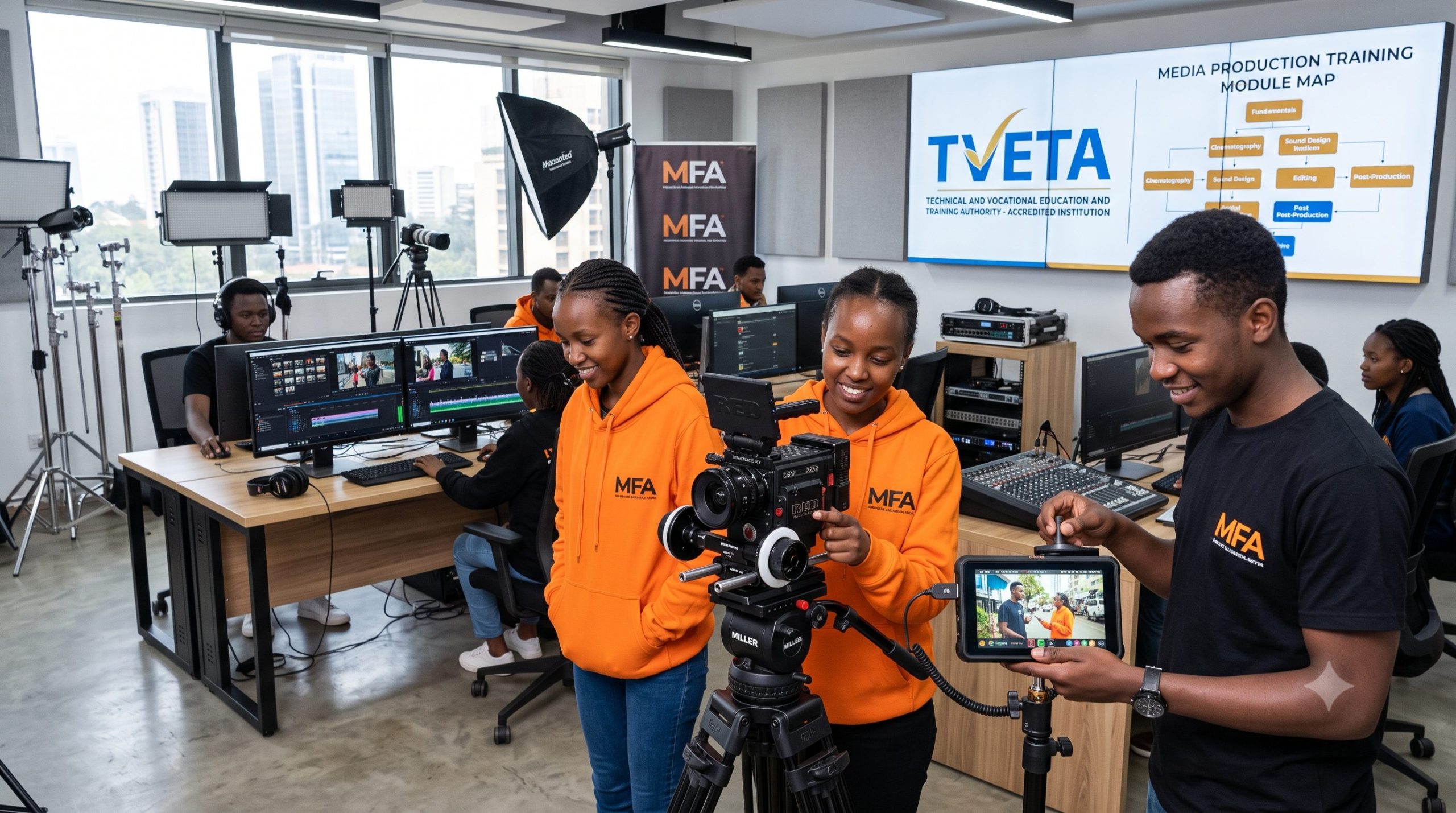
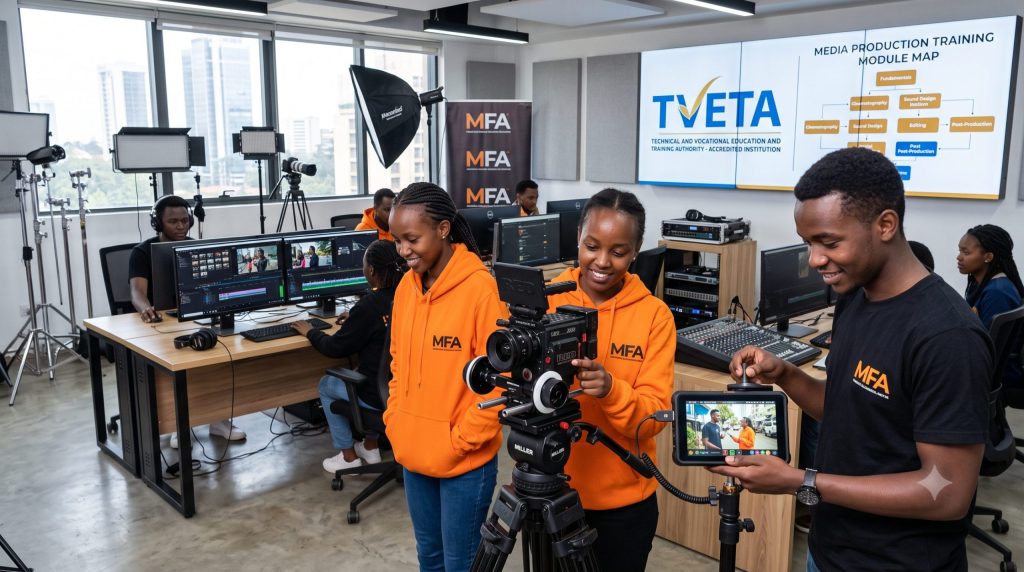
Photography and filmmaking are highly tactile skills. A TVETA-accredited academy is legally required to provide certified facilities, soundproofed recording studios, professional lighting grids, and dedicated, state-of-the-art editing iMac and Windows suites. At the Music And Film Academy, our enrollment philosophy is built on a strict 1:1 student-to-gear access ratio.
You do not learn how to fly a cinema drone or calibrate a 3-axis gimbal through a simulator; you learn by building it, balancing it, and flying it under the guidance of a veteran mentor. Our campus labs at Information House in the Nairobi CBD provide a safe, supported environment to make mistakes and build authentic mechanical muscle memory before you are ever placed on a high-pressure commercial set.
💡 The MFA Factor: The business of media is built on complete legal compliance. Want to build a bulletproof production agency that large corporate clients trust? Secure your technical future and learn advanced lighting setups, script prompting, and B2B workflow management by exploring our elite Advanced Certificate in Videography Course.
Finally, when choosing a media academy in Nairobi, you must select an institution that prepares you for the entire local regulatory ecosystem. To work professionally as a press photographer, documentary filmmaker, or to license a feature film or commercial for broadcast, you frequently need specific permissions from state bodies.
For photojournalists, documentary filmmakers, or even street documentary creators, having a press card from the Media Council of Kenya is essential for legitimacy, credibility, and ground-level protection. To obtain an independent freelancer MCK card, you must provide documented proof of specialized media training.
At the Music And Film Academy, our professional courses provide the documented academic requirements you need to apply for MCK accreditation. This certification is crucial for proving to security officials at public events, sensitive government installations, or during breaking news situations that you are a verified media professional, rather than a casual bystander.
Kenya’s Film and Stage Plays Act (Cap 222) requires all commercial films and advertising video content produced within the country to be registered and licensed by the Kenya Film Classification Board (KFCB). A self-taught vlogger might create brilliant content but often operates in a legal gray area regarding these commercial licenses, which can lead to hefty fines or project confiscation.
Accredited TVETA-compliant programs include dedicated training on how to navigate the KFCB licensing portal (often via eCitizen), manage operational daily filming fees, and align your production workflows with local content regulations. This operational knowledge ensures you are not just a creative but a fully compliant business operator in the eyes of the law.
                  [KENYAN REGULATORY ECOSYSTEM MAP]
                                  │
       ┌──────────────────────────┴──────────────────────────┐
       ▼                                                     ▼
[KFCB (Film Classification)]                   [MCK (Journalism & Media Council)]
       │                                                     │
Requires Commercial Permits                     Requires Freelance Press Cards
for Video Gigs/Web Series                      for Field Documentary/Street Photo
       │                                                     │
Verified via eCitizen Filing                    Verification requires proof of TVETA Training
Choosing a media academy in Nairobi that provides formal TVETA certification is not just a strategic educational choice; it is a vital business investment. While a self-taught portfolio can serve as a powerful creative outlet, the limitations of uncertified training become immediately clear when pitching for high-value government tenders, international NGO contracts, or TV broadcast licensing deals. Formal accreditation provides government-verified standards, unlocks the AGPO procurement program, builds essential regulatory compliance knowledge, and guarantees unlimited access to premium professional facilities and gear labs.
Sustained success in Kenya’s creative economy requires both exceptional creative vision and robust technical, operational, and regulatory compliance. At the Music And Film Academy, we are committed to preparing the next generation of visual storytellers for long-term success. Our Nairobi CBD campus at Information House provides TVETA-accredited modules designed by industry veterans to help you graduate with both a certified technical showcase portfolio and a nationally recognized credential.
Ready to explore your options for professional, certified training across both visual branches? Take your first step toward commercial media compliance by exploring our comprehensive Photography and Videography Courses in Kenya landing page to compare all TVETA-accredited pathways. Stop guessing with generic global tutorials. Upgrade your creative toolkit, refine your practical workflows, master local media laws, and enroll with us today.
To get a direct, unfiltered look at the professional facilities, dedicated studio labs, soundproofed recording booths, and industry-standard camera kits that TVETA compliance guarantees at the Music And Film Academy, watch this helpful video walkthrough of our Campus Video Editing, Sound & Film Labs. This guide provides a clear look at managing multi-camera configurations, checking audio ingestion pipelines, and adjusting professional broadcast settings within our dedicated CBD suites.