Phone:
+254 719 428 550
Physical address:
Information House, Hakati Road,
Nairobi, Kenya.
Phone:
+254 719 428 550
Physical address:
Information House, Hakati Road,
Nairobi, Kenya.
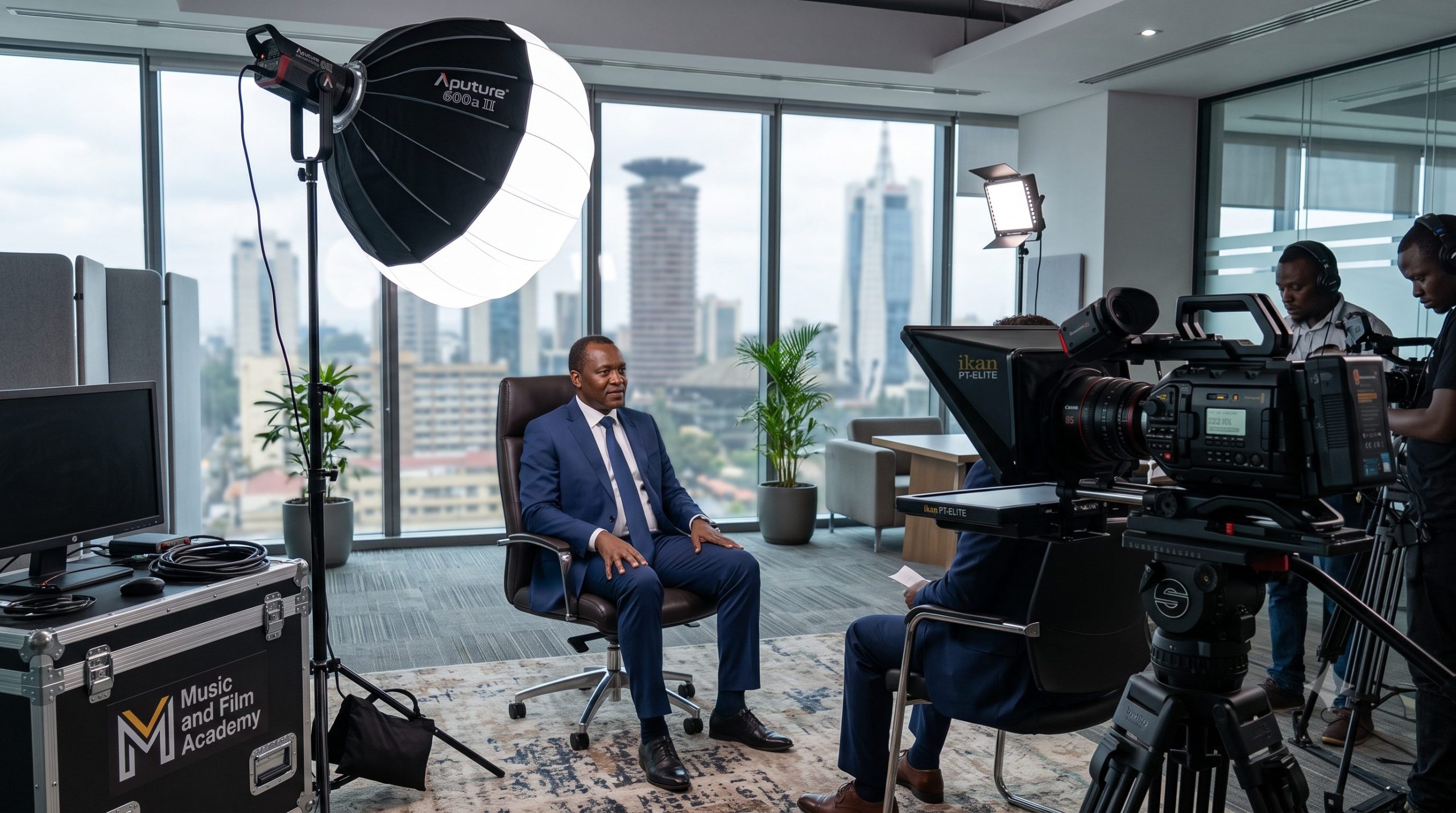
The business of visual storytelling in East Africa has evolved into a highly professional market, and at the top of this ecosystem is corporate media. For independent videographers and production houses, working with international non-governmental organizations (NGOs), multilateral agencies, and corporate entities headquartered along the skylines of Upper Hill, Westlands, and Kilimani is the most lucrative niche in the country. However, producing a premium talking-head asset requires far more than just pointing a high-resolution camera at a subject. If you want to consistently secure large corporate contracts, you must understand how to film high-end corporate interviews for NGOs and Brands in Nairobi by combining technical control with seamless client management.
Amateur productions often suffer from distracting backgrounds, uneven lighting, and nervous, stiff performances from corporate executives. High-value business clients expect a polished look that matches global broadcasting standards. To deliver that quality, you must manage your technical environment carefully—from handling complex script prompting tools to controlling lighting setups and coaching subjects to share natural, impactful soundbites. This definitive guide breaks down the step-by-step workflow required to plan, light, frame, and direct premium corporate interview sessions in modern executive spaces.
The first major challenge when learning how to film high-end corporate interviews for NGOs and brands in Nairobi is managing the room layout. Corporate boardrooms and executive offices in modern business hubs like Upper Hill are often built with heavy glass walls, highly reflective conference tables, and flat, overhead fluorescent tube lights. Setting up your gear in these spaces without a clear plan can easily result in green color casts, distracting background clutter, or reflections of your camera gear appearing in the glass panels.
Never position your subject directly against a flat white wall or a closed office door. Placing a subject too close to a background makes the shot feel small and flat, and it forces your lighting to cast harsh shadows directly onto the wall behind them. Instead, move the subject’s chair deep into the center of the room, pulling them at least 3 to 5 meters away from the nearest wall.
By pulling your subject forward and using a fast, high-quality lens (such as a 50mm or 85mm prime lens set to an aperture of f/1.8 or f/2.8), you create a shallow depth of field. This blurs out background details like office folders, computers, or distant cubicles into a smooth bokeh, keeping the viewer’s focus completely on the speaker while maintaining a professional office atmosphere.
[Deep Background: Blurred Office Skyline] ──► [Subject / Interviewee] ──► [Key Light / Softbox] ──► [Camera / Teleprompter]
             │                                         │
     3 to 5 Meters Space                       Sharp Foreground Focus
Upper Hill executive offices often feature large, floor-to-ceiling windows that provide striking views of the Nairobi skyline. While these views make for beautiful backgrounds, daylight shifts rapidly throughout the day, altering your exposure and color balance mid-interview.
When filming high-end corporate presentations, annual NGO updates, or stakeholder messages, time on set is expensive. Executives and country directors rarely have the time to memorize a 1,000-word script, and expecting them to improvise on camera often leads to stumbles, long pauses, and extended filming sessions. To streamline your production workflow and keep your schedule on track, mastering a professional teleprompter setup is essential.
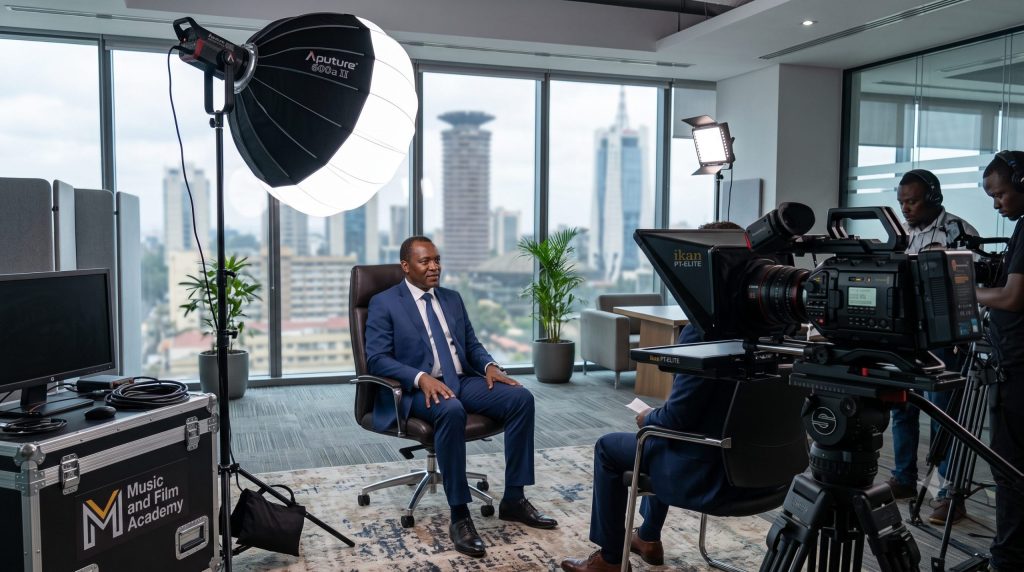
A professional teleprompter uses a specialized sheet of beamsplitter glass housed inside a matte box enclosure that mounts directly onto your camera’s lens rail system.
The biggest risk of using a teleprompter is a stiff, robotic reading performance where the speaker’s eyes can be seen scanning back and forth across the glass. To avoid this, position your tripod and camera assembly at least 4 meters away from the subject, and zoom in using a longer telephoto focal length to frame your shot. Moving the camera further back narrows the subject’s viewing angle, making their eye movements completely unnoticeable to the lens.
Additionally, configure your prompter software to display the text in a narrow column centered right in front of the camera lens, rather than stretching it across the full screen. This setup allows the subject to read naturally while maintaining direct, engaging eye contact with your audience.
| Teleprompter Operational Parameter | Target Value / Range | Tactical Technical Impact on Set |
| Physical Camera Distance | 3.5 to 5 Meters | Narrows the speaker’s viewing angle to hide side-to-side eye movement on camera. |
| Optical Glass Ratio | 70/30 Beamsplitter | Retains 70% light transmission for the camera lens while reflecting 30% for clear text legibility. |
| Focal Length Range | 50mm to 85mm | Provides a tight, flattering portrait frame without distorting facial features. |
| Text Margin Alignment | Center-justified, 40% width | Keeps the reading area directly in line with the lens center to maintain eye contact. |
💡 The MFA Factor: Corporate clients expect flawless lighting. Learn the exact executive setups hands-on in our professional video suites by exploring our specialized Videography Courses in Kenya hub page.
A major element of knowing how to film high-end corporate interviews for NGOs and brands in Nairobi involves soft skills and interview direction. Many high-level professionals who are comfortable speaking in front of large boardrooms can freeze or become visibly nervous when placed in front of large studio lights, a camera lens, and a crew. Your job as a professional director is to create a calm, supportive environment that helps your subject share natural, confident soundbites.
Never bring an executive straight onto a fully lit set and hit the record button immediately. Have your crew set up, position the lights, and adjust audio levels before inviting the client into the room.
If your corporate project uses a conversational Q&A format rather than a strict script, avoid asking simple “yes” or “no” questions. Questions like “Are you happy with the project’s progress?” will usually get short, uninspiring answers.
High-end corporate productions require pristine, broadcast-ready audio. A beautiful 4K or 6K visual frame will be completely undermined if your audio has a background air-conditioning hum, paper rustling, or clothing friction noise.
Never rely on a single microphone on a corporate set. Always set up a dual-system audio tracking configuration for safety redundancy:
                  [PRIMARY STUDIO SOUND PATH]
                               │
       ┌───────────────────────┴───────────────────────┐
       ▼                                               ▼
[Overhead Shotgun Boom Mic]                  [Wireless Lavalier Body Pack]
       │                                               │
Captures Rich Vocal Resonance                  Secures Direct Close-Up Sound Focus
Before calling out “Action,” request that the office floor manager temporarily turn off all central air conditioning systems and server room ventilation units within the immediate area. These systems create a constant low-frequency background hum that can muddy up your vocal frequencies.
Place heavy acoustic sound blankets on hard tile floors just outside your camera frame to help absorb unwanted room echoes. For a deeper look at international audio levels and signal compliance standards used in modern broadcast media, review the engineering workflows published by the Audio Engineering Society (AES).
💡 The MFA Factor: Want to transition from basic single-camera shoots to leading large, commercial crews on high-value corporate sets? Build a rock-solid foundation in camera movement and studio workflows by exploring our structured Basic Certificate in Videography Course track.
The final stage of your corporate production takes place inside your digital post-production suite. High-end business assets require precise color correction and clean audio sweetening before they are ready for final delivery to stakeholder groups or TV broadcast networks.
If your project uses a multi-camera setup (such as a wide A-cam and a tight B-cam profile), use professional editing software to sync your video tracks using their audio waveforms.
Export your final masters using high-quality professional codecs like Apple ProRes 422 or Avid DNxHR before creating compressed H.264 or H.265 files for web and social media uploads. For comprehensive updates on copyright laws, commercial usage terms, and distribution frameworks across East Africa, review the regulatory frameworks detailed by the Kenya Copyright Board (KECOBO).
💡 The MFA Factor: Ready to move past basic editing presets and master professional multi-camera editing, color management pipelines, and high-end commercial grading systems? Elevate your post-production career by checking out the advanced training programs on our main Video Editing Courses in Kenya page.
Learning how to film high-end corporate interviews for NGOs and brands in Nairobi is one of the most reliable ways to grow a profitable, respected commercial videography business. By mastering shallow depth-of-field separation in corporate office environments, configuring stable teleprompter rigs, managing client performance anxiety, and maintaining strict audio capture and set safety protocols, you separate your brand from casual content creators.
Sustained commercial growth in the media sector requires comprehensive, hands-on technical training. At the Music And Film Academy, we provide our students with industry-standard 4K camera systems, professional lighting kits, and high-end editing suites to help them build standout corporate portfolios. Invest in your professional development, study with veteran industry mentors, and join a collaborative creative network by enrolling in our Advanced Certificate in Videography Course at our Nairobi CBD campus today.