Phone:
+254 719 428 550
Physical address:
Information House, Hakati Road,
Nairobi, Kenya.

Phone:
+254 719 428 550
Physical address:
Information House, Hakati Road,
Nairobi, Kenya.
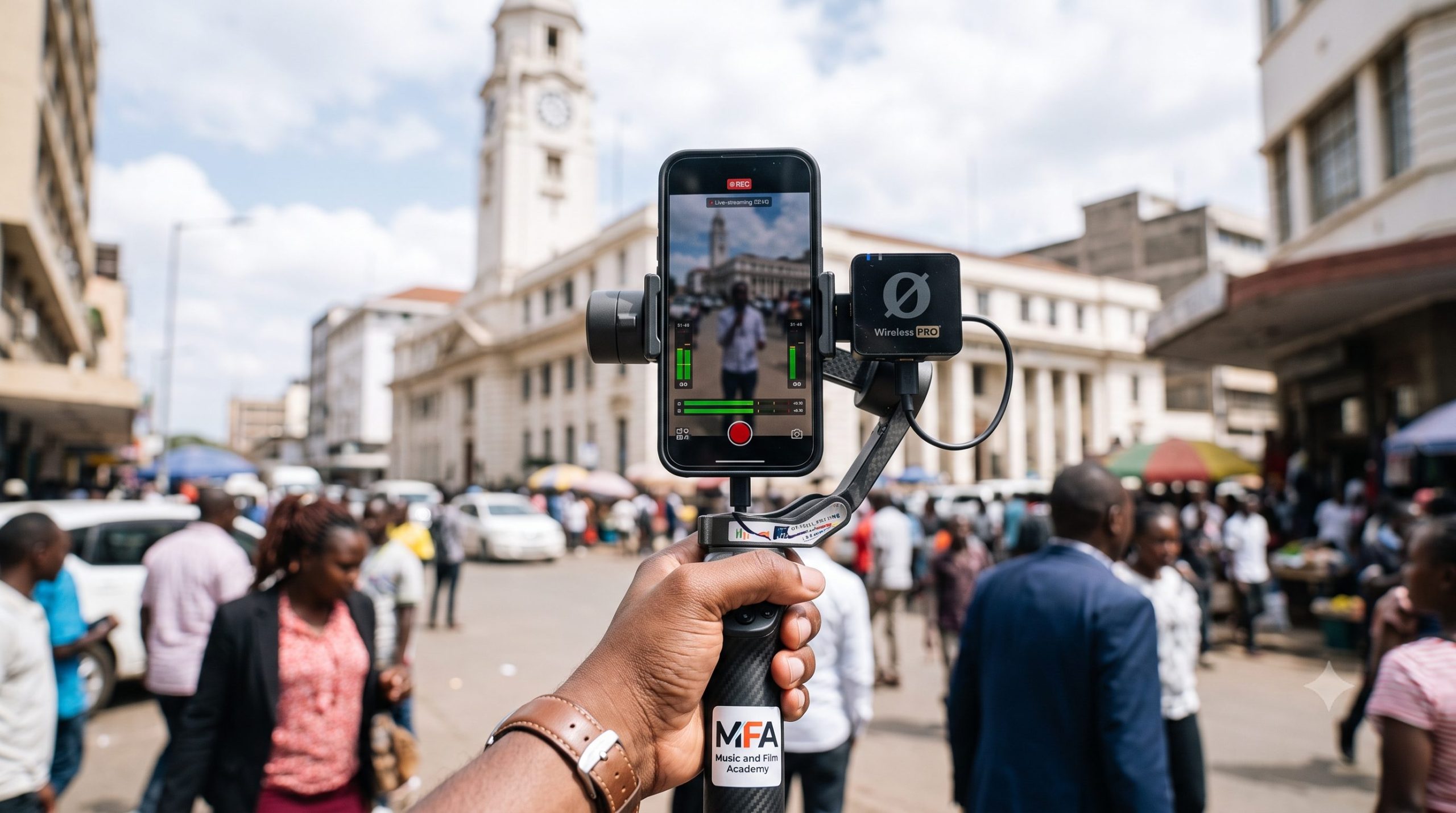
The media landscape in East Africa has fundamentally broken away from the traditional, rigid broadcast studios of the past. If you observe the streets of the Nairobi Central Business District (CBD) on any given weekday, you will notice a massive shift: independent creators, freelance correspondents, and digital-first reporters are bypassing heavy corporate camera crews entirely. The rise of mobile journalism (MoJo) has completely democratized real-time reporting. Today, some of the fastest-growing and most influential information channels across the continent exist entirely as vertical video grids. However, breaking into this competitive digital market requires far more than simply holding up a phone and hitting record. To cut through the endless noise of social media feeds, you must understand how to shoot professional TikTok and YouTube news packages in Kenya by blending high-speed tactical workflows with professional-grade mobile production principles.
Amateur mobile videos often suffer from unwatchable camera jitters, muffled wind noise that ruins interviews, and confusing, unedited pacing that loses viewer attention instantly. Modern social media audiences look for personality-driven, authentic content, but they still demand clean, broadcast-standard clarity. To build a credible, highly engaged digital news brand, you must take control of your mobile hardware and software tools—from balancing electronic stabilization systems on crowded streets to configuring dual-channel wireless audio receivers and using fast-turnaround mobile editing apps to post your packages before the competition. This masterclass breakdown provides the essential framework needed to transform your smartphone into an elite, field-ready broadcast asset.
The most immediate tell-tale sign of an amateur mobile production is shaky, unwatchable footage. When you are operating as a mobile journalist conducting real-time reporting or quick vox pops on busy Nairobi streets—such as near the Kenya National Archives along Tom Mboya Street or around the busy paths of Kencom—the physical environment is chaotic. Pedestrians, matatus, and street noise will constantly test your balance. Shaky video completely breaks user immersion, causing viewers to swipe away from your TikTok or YouTube short package within the first three seconds.
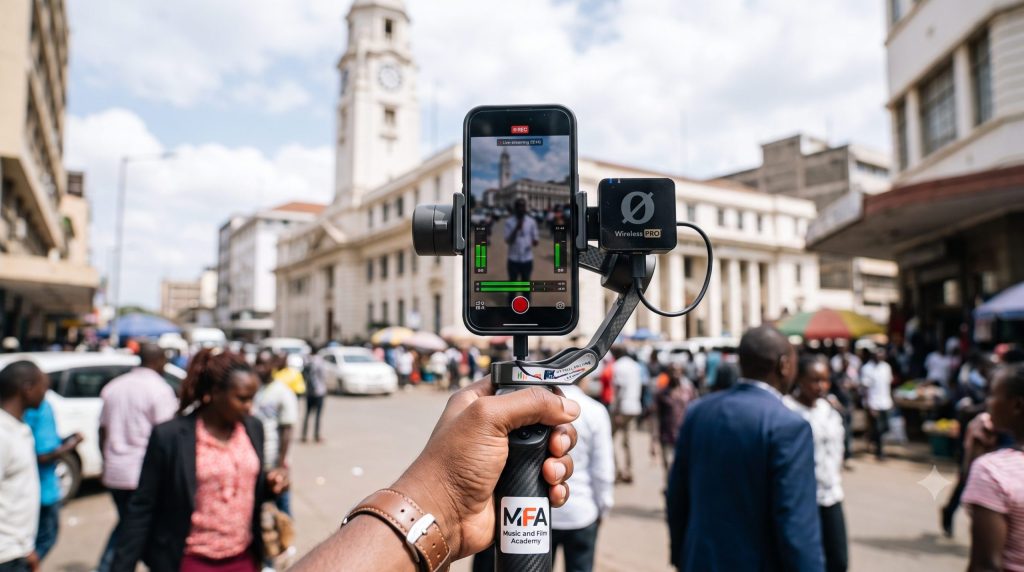
To capture smooth B-roll footage and clean on-camera presentations while walking, integrating a high-quality three-axis hardware gimbal (such as a DJI Osmo Mobile 6 or an Insta360 Flow system) into your field kit is non-negotiable.
[Smartphone Lens Axis] ──► [3-Axis Gimbal Motors] ──► [Hand Grip / Extension Rod] ──► [Stabile Ninja Walk]
When planning out your shot lists, remember that TikTok and YouTube news packages use completely opposite framing rules:
A beautiful 4K smartphone recording clip is completely useless if your audience cannot hear the speaker clearly. If you try to use your phone’s built-in microphone to capture an interview along a busy road, the device will record everything equally—the loud hiss of air brakes, background shouting, and wind glare across the glass capsule—burying your subject’s voice completely. When mastering how to shoot professional TikTok and YouTube news packages in Kenya, you must treat your sound capture with the exact same technical priority as your video resolution.
Professional mobile journalists rely on compact, external 2.4GHz wireless clip-on microphone systems like the DJI Mic 2, Rode Wireless PRO, or Hollyland Lark M2 arrays to maintain clean sound separation in the field.
[Subject: Wireless Transmitter Mic] ───(2.4GHz Signal)───► [Phone: Receiver Unit via USB-C / Lightning]
To configure these systems safely on location, follow this standard setup routine:
💡 The MFA Factor: Even on a phone, audio matters. Discover why external sound rules and master real-time audio isolation mechanics by deep-diving into our core Videography Courses in Kenya modules.
In the digital news space, speed is everything. The creator or journalist who packages, polishes, and uploads their video story first captures the lionshare of trending search traffic and algorithmic visibility. Waiting to go back to a traditional office desktop to edit can cause you to miss the breaking news wave entirely. Professional mobile journalists handle their entire editing workflow right in the field using highly optimized mobile apps like CapCut, Lumafusion, or Premiere Rush.
| Mobile Editing Phase | Technical Focus Area | Recommended Action Point | Algorithmic Impact |
| The Visual Hook | First 1 to 3 Seconds | Cut all silence; add a bold headline title overlay | Stops user scrolling behavior immediately |
| B-Roll Overlay | Narrative Pacing | Add context footage every 4 to 5 seconds | Boosts watch-time retention percentages |
| Text Generation | Viewer Accessibility | Run AI-driven Auto Captions with high contrast | Captures traffic from muted phone screens |
| Audio Sweetening | Clear Dialogue | Apply built-in “Reduce Noise” filters | Lowers bounce rates caused by bad sound |
💡 The MFA Factor: Want to take your editing skills past basic mobile apps and master high-end industry platforms like DaVinci Resolve or Adobe Premiere Pro? Learn how to manage professional post-production workflows by visiting our specialized Video Editing Courses in Kenya page.
When learning how to shoot professional TikTok and YouTube news packages in Kenya, managing your physical presence and understanding local street dynamics is just as vital as managing your camera settings. Operating a smartphone in public spaces can attract unwanted attention if handled carelessly.
Nairobi is a bustling, high-density city. When you are looking down at a smartphone screen to check focus or adjust your audio levels, you become temporarily unaware of your immediate surroundings.
                  [FIELD SAFETY PROTOCOLS]
                             │
     ┌───────────────────────┴───────────────────────┐
     ▼                                               ▼
[Discreet Movement]                          [Clear Site Clearance]
     │                                               │
Keep extra gear hidden                       Avoid restricted zones
until active filming begins                  (Military, Central Banks)
💡 The MFA Factor: Building a sustainable career in digital journalism requires a solid understanding of both creative skill and industry laws. Our practical Basic Certificate in Videography Course goes far beyond basic framing to help you navigate media copyright laws, safety frameworks, and professional field practices with confidence.
Once your mobile news package is polished and ready to go, your final step is optimizing the file metadata for platform search algorithms. Whether uploading to TikTok or YouTube Shorts, how you label your content determines how far it spreads.
Don’t use vague, unsearchable titles like “Check out my latest street vlog.” Instead, write clear, keyword-rich descriptions that mirror exactly what local users type into search bars. Use direct phrases like “Nairobi CBD Street Vendors Update” or “Behind the Scenes at the Westlands Markets.” Place your target keyword within the first two lines of your video description, and pair it with highly relevant, localized hashtags (such as #Nairobi, #KenyaNews, or #MoJoCreators) to help search engines index your video into trending local feeds.
After publishing your content, monitor your retention graphs through your creator analytics dashboard. Pay close attention to the point in the video where viewer drop-off is highest. If you notice a sharp dip at the 15-second mark, study that moment in your timeline—was the story moving too slowly? Was the audio inconsistent? Use these real-world data points to refine your pacing and improve your next production cycle. For comprehensive updates on global mobile news consumption shifts and short-form video engagement metrics, consult the annual data tracking studies published by the Reuters Institute for the Study of Journalism.
💡 The MFA Factor: Ready to move past basic smartphone setups and master high-end cinema packages, advanced multi-camera switching, and leading large commercial production crews? Elevate your creative future by joining our elite Advanced Certificate in Videography Course track.
Learning how to shoot professional TikTok and YouTube news packages in Kenya is one of the most accessible and exciting ways to launch a profitable digital media channel. By using three-axis stabilization gimbals, investing in external wireless microphones, mastering fast-turnaround field editing mobile applications, and following smart personal safety and ethical frameworks on location, you elevate your brand and build lasting trust with your audience.
True professional growth requires structured, hands-on practice under the guidance of active industry mentors. At the Music And Film Academy, we equip our students with modern production tools, advanced studio labs, and practical business networks to help them turn their creative passions into sustainable careers. Invest in your professional development, upgrade your production value, and join a collaborative network of content creators by enrolling at our Nairobi campus today.