What Qualifications Do I Need to Study Photography in Kenya? (2026 Guide)
Direct Answer / Quick Summary:
To study photography in Kenya, academic entry requirements depend on the credential level. A practical Certificate in Photography requires a minimum KCSE mean grade of D- (Minus) and covers camera optics, manual exposure, advanced studio lighting, and Adobe retouching. For formal film awards, students with a KCSE D Plain can enroll in a 1-year Pearson BTEC Certificate in TV & Film Production (4 terms @ KES 39,000/term), while a KCSE C- (Minus) qualifies students for the full 2-year Pearson BTEC Diploma in TV & Film Production (8 terms @ KES 39,000/term). At Music and Film Academy, all cameras, studio lights, and production equipment are provided for class training—students only need to bring a 64GB SanDisk Extreme PRO SD Card (UHS-I / V30 / U3 / Class 10, up to 200MB/s) and a card reader. Photography certificates are certified by NITA, while TV & Film programs are certified by Pearson BTEC under TVETA institutional accreditation.
When applying for visual arts and film training in Nairobi, admission criteria, course duration, tuition costs, and awarding bodies align with government-recognized qualification levels:
Course Level
Minimum KCSE Entry Grade
Tuition & Term Structure (2026)
Certifying Body & Accreditation
Core Training Scope
Certificate in Photography
D- (Minus)
KES 39,000 total tuition (+ KES 2,000 registration)
NITA Certified (TVETA Accredited)
Camera optics, manual exposure mechanics, commercial studio lighting, off-camera strobes, portraiture, e-commerce, & Adobe Lightroom/Photoshop retouching.
Pearson BTEC Certificate in TV & Film Production
D (Plain)
KES 39,000 per term (4 Terms / 1 Year) (+ KES 2,000 registration)
Pearson BTEC (TVETA Accredited)
Single & multi-camera techniques, sound recording, film editing, lighting setups, and foundational visual storytelling.
Pearson BTEC Diploma in TV & Film Production
C- (Minus)
KES 39,000 per term (8 Terms / 2 Years) (+ KES 2,000 registration)
Pearson BTEC (TVETA Accredited)
Advanced cinematography, multi-camera set management, studio direction, cinema camera rigging, audio post, & full film production.
Note: In Kenya’s TVETA framework, educational institutions do not offer a standalone “Diploma in Photography.” If your objective is to earn a higher-level Diploma credential, you will enroll in the Pearson BTEC Diploma in TV & Film Production, which incorporates advanced photography and camera optics units alongside motion picture production.
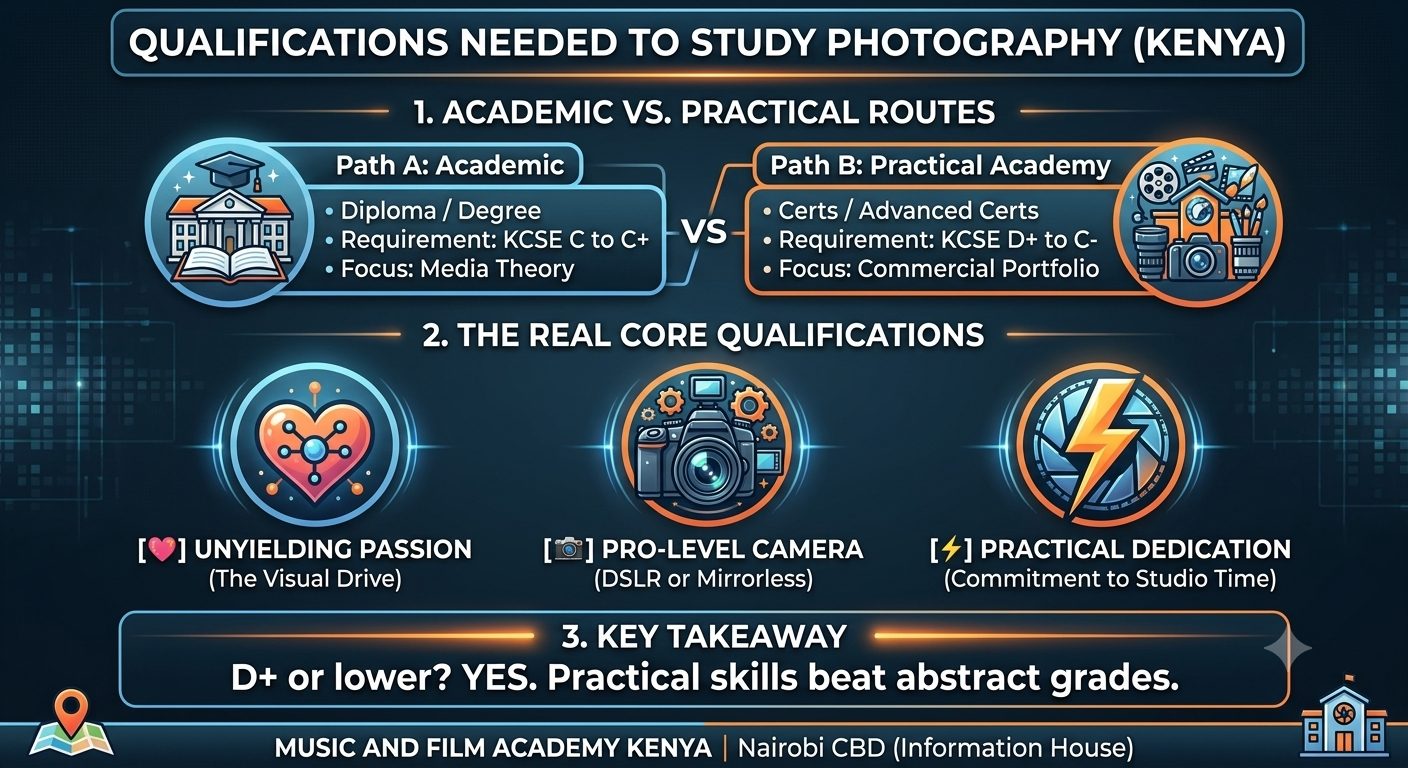
Visual summary of the entry requirements comparing academic grades for theory programs against the logistical and passion requirements needed for practical commercial photography training
2. Choosing Your Training Pathway
A. Certificate in Photography (KCSE D- | NITA Certified)
The Certificate in Photography is an intensive, commercial-focused program designed to make you fully market-ready.
Academic Requirement: KCSE mean grade of D- (Minus).
Awarding Body:NITA Certification (National Industrial Training Authority), fully accredited by TVETA.
Investment:KES 39,000 total tuition fee + KES 2,000 registration fee.
Core Curriculum: Mastery over camera optics, manual exposure controls, commercial multi-light setups (softboxes, strobes, continuous LED panels), client workflow, portraiture, product shooting, and professional retouching in Adobe Lightroom Classic and Photoshop.
Best For: Freelancers, content creators, and entrepreneurs looking to launch a commercial studio or monetize portrait and event photography quickly.
B. Pearson BTEC Certificate in TV & Film Production (KCSE D Plain | 1 Year)
For students who want an internationally recognized film credential without committing to a multi-year diploma immediately.
Academic Requirement: KCSE mean grade of D (Plain).
Awarding Body:Pearson BTEC International Certification (TVETA Accredited).
Investment:KES 39,000 per term (4 Terms / 1 Year duration) + KES 2,000 registration fee.
Core Curriculum: Camera operation, studio lighting, field audio recording, video editing, and production mechanics.
Best For: High school graduates with a D Plain seeking a structured 1-year film qualification that offers a direct stepping stone into the creative industry or progression into the Diploma track.
C. Pearson BTEC Diploma in TV & Film Production (KCSE C- | 2 Years)
For candidates whose personal or career goals require a comprehensive, high-level Diploma credential.
Academic Requirement: KCSE mean grade of C- (Minus).
Awarding Body:Pearson BTEC International Certification (TVETA Accredited).
Investment:KES 39,000 per term (8 Terms / 2 Years duration) + KES 2,000 registration fee.
Core Curriculum: Advanced cinematography, multi-light studio direction, documentary storytelling, cinema camera rigging, sound engineering, and post-production.
Best For: Visual creators aiming for an internationally recognized diploma qualification to direct commercial productions, manage broadcast studio sets, or run production agencies.
3. Required Student Accessories vs. Provided Studio Gear
A major concern for incoming students is whether they need to buy expensive cameras and lighting equipment before joining. At Music and Film Academy, we remove this financial barrier:
Gear Provided by the Academy: You do not need to buy a camera or studio lights to begin. The academy provides full access to high-end cameras, lenses, multi-light studio strobes, continuous LED panels, wireless lavalier systems, modifiers, and computer editing labs for all practical classes.
Student Essential Requirements (Accessories): Students only need to purchase their personal high-speed storage media and transfer tools to save, back up, and edit their practical shoot files:
High-Speed Memory Card:64GB SanDisk Extreme PRO SD Card
Specs required for high-bitrate video & RAW burst shots: UHS-I / V30 / U3 / Class 10
Read Speed: Up to 200 MB/s (UHS-I)
Write Speed: Up to 90 MB/s (UHS-I)
Multi-Card Reader: USB 3.0 / Type-C high-speed SD card reader for lab transfers and post-processing sessions.
4. Key Checklist Before Enrolling in a Nairobi Visual Arts School
Before submitting your application, verify that your school meets these essential standards:
Official TVETA Accreditation: Guarantees that the institution operates under recognized national technical standards.
Legitimate Certifying Bodies (NITA & Pearson BTEC): Ensures your qualification holds weight with local employers, corporate clients, government tenders, and international institutions.
Provided Gear & Equipment Ratios: Confirms the academy provides cameras, lighting, and audio gear so you don’t have to spend hundreds of thousands of shillings on gear upfront.
Transparent Pricing Structure: Clear term breakdowns (KES 39,000/term) and admission fees (KES 2,000) with flexible installment options.
Central Location: Studying at Information House on Hakati Road (Nairobi CBD) ensures proximity to commercial equipment suppliers, studio rental spaces, and field locations.
Launch Your Visual Arts Career at Music and Film Academy
Whether you want to build a commercial portfolio through our NITA-certified Certificate in Photography (KCSE D-) or pursue a formal qualification through our 1-Year Pearson BTEC Certificate (KCSE D) or 2-Year Pearson BTEC Diploma (KCSE C-), Music and Film Academy provides the gear, studio environment, and technical instruction to get you market-ready.
Registration Fee: KES 2,000 (One-time admission fee)
Tuition: KES 39,000 for Photography Cert | KES 39,000 per term for BTEC Certificate & Diploma programs
Required Accessories: 64GB SanDisk Extreme PRO SD Card (V30/U3/200MB/s) & Card Reader (All cameras & lights provided by MFA)