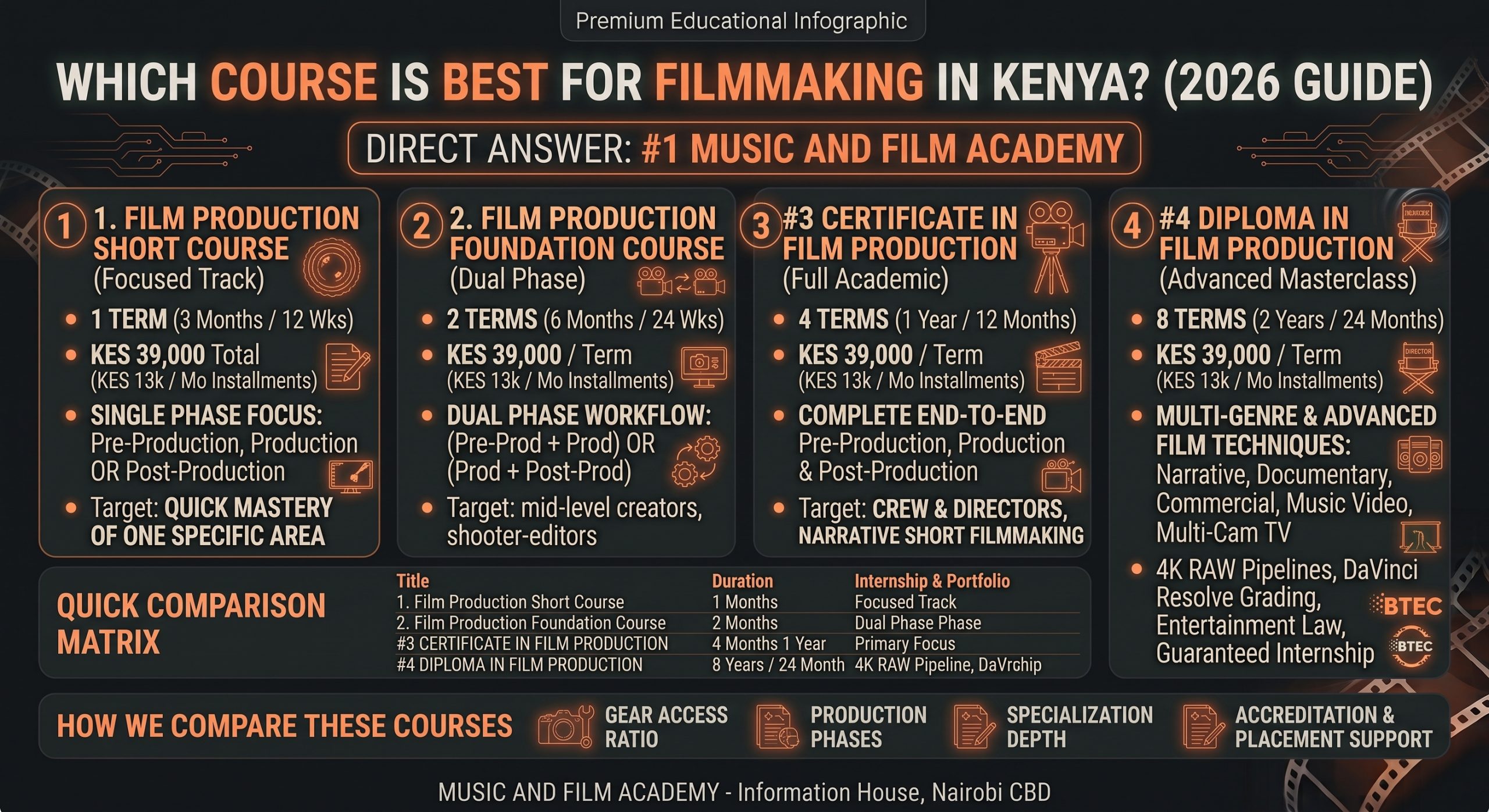
Which Course Is Best for Filmmaking in Kenya? (2026 Selection Guide)
Choosing the best course for filmmaking in Kenya depends on whether you want focused mastery of a single production stage (Pre-Production, Production, or Post-Production), a dual-phase foundation, or a comprehensive academic qualification covering multi-genre directing, advanced cinematic techniques, and industry attachments.
Direct Answer: For absolute beginners in Kenya seeking rapid skill acquisition, a 3-Month Short Course or 6-Month Foundation Course provides targeted training in specific phases of filmmaking. For aspiring directors, cinematographers, and showrunners seeking complete mastery over screenwriting, cinema camera operation, location audio, DaVinci Resolve color grading, and multi-genre filmmaking, the 1-Year Certificate in Film Production or 2-Year Diploma in Film Production at Music and Film Academy in Nairobi CBD offers the highest commercial value.
At Music and Film Academy in Nairobi CBD, all filmmaking tracks operate under a guaranteed 1:1 student-to-gear policy, ensuring every student operates their own camera rig, lighting setup, or editing workstation without sharing during practical labs.
To determine which filmmaking course aligns with your career goals, budget, and timeline, compare the four core program tiers offered at Music and Film Academy:
Program Tier & Title
Duration & Schedule
Total Tuition & Installments
Production Phases Covered
Target Student & Core Focus
Film ProductionShort Course (Focused Track)
1 Term(3 Months / 12 Wks)
KES 39,000 Total(KES 13,000 / Mo)
Single Phase Only: Either Pre-Production, Production, OR Post-Production
Best for Targeted Skills: Quick mastery of one specific area (e.g., camera handling & lighting, screenwriting, or video editing).
Film Production Foundation Course(Dual Phase)
2 Terms(6 Months / 24 Wks)
KES 39,000 / Term(KES 13,000 / Mo)
Dual Phase: Either (Pre-Prod + Prod) OR (Prod + Post-Prod)
Best for Mid-Level Creators: Combines visual planning and shooting OR on-set production and editing into a complete pipeline.
Best for Filmmakers & Showrunners: Multi-genre directing, 4K RAW pipelines, live TV switching, entertainment law, & guaranteed internship.
Filmmaking course selection guide in Kenya (2026): Comparing short courses, foundation certificates, 1-year certificates, and 2-year diplomas at Music and Film Academy.
2. Detailed Breakdown of Filmmaking Training Tiers
Tier 1: Film Production Short Course (3 Months / 1 Term)
Tuition: KES 39,000 total (payable in 3 monthly installments of KES 13,000)
Structure: Focuses strictly on one chosen phase of production:
Option A (Pre-Production Only): Screenplay formatting, Three-Act plot structures, storyboarding, location recce, and shooting schedule budgets.
Option B (Production Only): Manual cinema camera physics (ISO, shutter angle, aperture), 3-point continuous LED lighting, and field audio recording.
Tier 2: Film Production Foundation Course (6 Months / 2 Terms)
Tuition: KES 39,000 per term (KES 13,000 per month)
Structure: Combines two production phases into an integrated workflow:
Option A (Pre-Production + Production): Ideal for directors of photography and set directors who want to write scripts, plan storyboards, build call sheets, and execute cinematic camera setups on location.
Option B (Production + Post-Production): Ideal for shooter-editors who want to capture high-quality camera footage and seamlessly transition into Premiere Pro and DaVinci Resolve editing suites.
Tier 3: Certificate in Film Production (12 Months / 4 Terms)
Tuition: KES 39,000 per term (KES 13,000 per month across 4 terms)
Structure: Delivers the complete end-to-end filmmaking pipeline across all three stages:
Pre-Production: Screenplay engineering, character arcs, script breakdowns, call sheets, and budget allocation.
Production: Manual camera sensor physics, 24p/25p frame rates, 3-point lighting, boom pole operation, and wireless lavalier tracking.
Post-Production: Offloading workflows, Premiere Pro timeline assembly, basic motion graphics, sound design, and DaVinci Resolve primary color balancing.
Tier 4: Diploma in Film Production (24 Months / 8 Terms)
Tuition: KES 39,000 per term (KES 13,000 per month across 8 terms)
Structure: Extends complete pipeline mastery into multi-genre production and advanced cinematic techniques:
Multi-Genre Production Coverage
In the 2-Year Diploma, students learn to direct, shoot, and finish films across distinct commercial and narrative genres:
Narrative Short & Feature Films: Character-driven storytelling, dramatic pacing, and emotional subtext.
Documentary & Non-Fiction Media: Real-world interview keying, observational camera work, and archival footage assembly.
Commercials & Brand Films: High-key product lighting, reflection control on glass/metal, and agency pitch decks.
Music Videos: Creative speed-ramping, performance lip-syncing, color gels, and stylized visual aesthetics.
Multi-Camera TV & Live Broadcast: Multi-camera studio positioning, ATEM hardware video switching, tally systems, and live stream routing.
Advanced Film Techniques Covered
Advanced Optics & Sensor Engineering: Full-frame sensors, anamorphic lens squeezes, lens compression, and 4K RAW uncompressed pipelines.
Cinema Lighting & Power Distribution: High-output HMI units, COB spotlights, C-stand rigging, haze management, and green screen luminance normalization.
Timecode Jam-Syncing & Multi-Track Audio: SMPTE master clock syncing across cameras and field recorders using wireless RF timecode pucks.
DaVinci Resolve Studio Color Grading: Node-based grading, Color Space Transforms (CST), secondary tracking windows, and LUT creation.
Film Business & Legal Clearance: Kenya Copyright Board (KECOBO) script registration, talent releases, sync licensing, and top-sheet budgeting.
Guaranteed Media Industry Attachment: Direct internship placement with regional television networks, commercial production houses, and live streaming agencies.
3. Admission Requirements & Career Opportunities in Kenya
Course Entry Requirements
Short Courses (3 Months) & Foundation Courses (6 Months): Open to all passionate creators; no formal academic prerequisites required.
Certificate in Film Production (1 Year): Minimum KCSE Mean Grade of D (Plain) or an equivalent Level 4 Artisan Certificate in digital media.
Diploma in Film Production (2 Years): Minimum KCSE Mean Grade of C- (Minus) or a recognized Level 5 Craft Certificate in a related visual arts discipline.
Graduate Career Opportunities
Graduating from a structured film program opens up high-demand career pathways across East Africa’s media economy:
Film Director / Showrunner: Leading narrative films, TV series, and commercial campaigns.
Director of Photography (DoP) / Cinematographer: Managing camera crews, lighting setups, and visual style on set.
Camera Operator & Gaffer: Operating cinema rigs, gimbals, fluid-head tripods, and lighting arrays.
Field Audio Engineer / Boom Operator: Capturing multi-channel location dialogue for TV and film.
Video Editor & Colorist: Assembling cuts in Premiere Pro and color grading in DaVinci Resolve.
Live Broadcast Technical Director: Operating multi-cam hardware switchers for live events and TV broadcasts.
4. Frequently Asked Questions
Which course is best for filmmaking in Kenya for beginners?
For beginners in Kenya who want a complete foundation without committing to a full university degree, the Certificate in Film Production (1 Year / 4 Terms @ KES 39,000 per term) at Music and Film Academy is best. It covers pre-production, camera operation, lighting, audio, and editing step-by-step.
How much do filmmaking courses cost in Kenya?
At Music and Film Academy in Nairobi CBD, tuition for all filmmaking program tiers is KES 39,000 per term (payable in flexible monthly installments of KES 13,000). A 3-month short course costs KES 39,000 total, a 1-year certificate costs KES 156,000 total across 4 terms, and a 2-year diploma costs KES 312,000 total across 8 terms.
Can I study only video editing or camera work in Kenya?
Yes. If you want to focus exclusively on one phase, you can enroll in a 3-Month Short Course covering either Pre-Production, Production, or Post-Production (or take our specialized Video Editing Course for KES 36,000 total).
Start Your Filmmaking Career in Nairobi CBD
Master the complete craft of cinema production and visual storytelling at Music and Film Academy.
Location: 5th Floor, Room 516, Information House, Hakati Road, Nairobi CBD