Phone:
+254 719 428 550
Physical address:
Information House, Hakati Road,
Nairobi, Kenya.
Phone:
+254 719 428 550
Physical address:
Information House, Hakati Road,
Nairobi, Kenya.
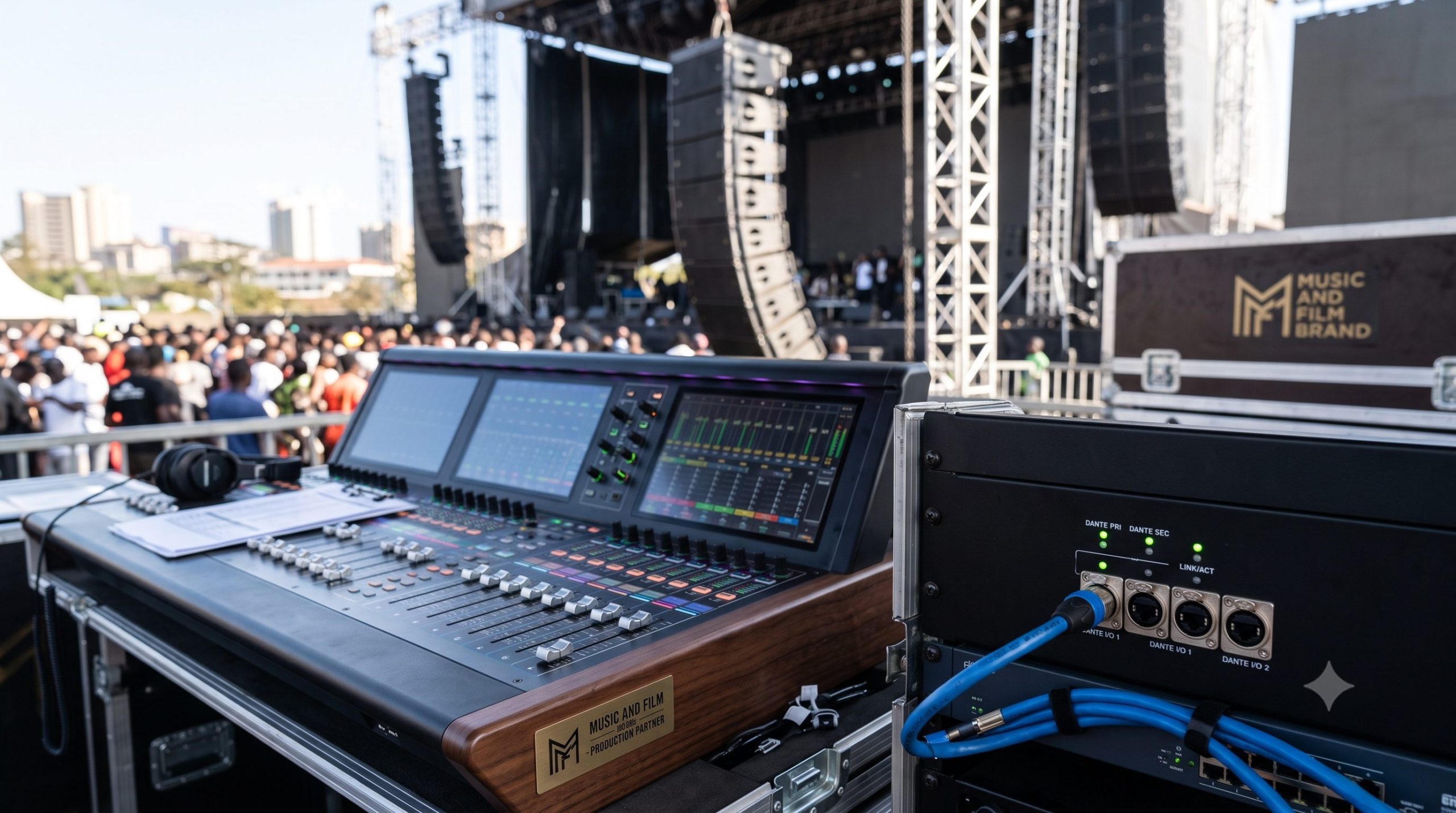
The live entertainment landscape in East Africa has undergone a massive technical evolution. Large-scale outdoor events—ranging from high-end corporate summits in conventional centers to multi-stage music festivals at the Carnivore Grounds or Ngong Racecourse—now demand uncompromising sonic fidelity, expansive routing capabilities, and absolute system reliability. For decades, live sound touring techs and front-of-house (FOH) engineers relied on massive, heavy analog multi-core snake cables to transport raw microphone signals from the stage to the mixing console. In 2026, that traditional analog infrastructure has become an obsolete bottleneck. Modern large-venue event production relies entirely on software-driven digital audio networks to distribute hundreds of uncompressed audio channels over lightweight ethernet cables.
For corporate A/V specialists, systems integrators, and live sound touring crews in Kenya, mastering the deployment of Audio-over-IP (AoIP) architectures is no longer an optional skill—it is a mandatory industry requirement. Transitioning away from legacy analog lines and implementing systems like Audinate Dante or SuperMAC AES50 requires a deep shift from traditional acoustic plug-and-play habits to advanced IT networking principles. If an engineer lacks a clear understanding of IP addressing, gigabit switch management, network clock synchronization, and data packet transmission, a large-scale live show can experience catastrophic failures like digital synchronization clicks, dropouts, or total system audio loss. This comprehensive guide details the engineering principles behind modern digital audio networks, outlines precise latency calculations, breaks down line array rigging physics, and delivers an exact patch blueprint for advanced Midas and Behringer Wing mixing ecosystems.
1. The Architecture of Modern AoIP: Audinate Dante vs. SuperMAC AES50
When deploying infrastructure for a festival or large corporate setup, sound engineers must understand the distinct functional differences between the two primary digital transport protocols utilized in modern live sound: Audinate Dante and Behringer/Midas AES50.
A. Audinate Dante: True Layer 3 Audio-over-IP Networking
Audinate Dante is a proprietary, software-driven protocol that operates over standard IT network architectures using the Internet Protocol stack (OSI Layer 3).
B. SuperMAC AES50: High-Performance Layer 1 Point-to-Point Transport
In contrast, SuperMAC AES50 (developed by Klark Teknik and utilized heavily by Midas and Behringer hardware) is not an IP-based network protocol. It is a deterministic, point-to-point digital audio transport system that operates at the physical layer (OSI Layer 1).
2. Managing Data Packet Synchronization: Network Latency Prediction Formulas
When configuring digital audio networks for large outdoor festivals, the primary enemy of your system stability is digital latency. In a digital network, latency is defined as the time required for an analog sound wave to be converted to digital bits, wrapped in a network packet, transmitted across the physical cable medium, unpacked by the receiving unit, and converted back into an analog voltage signal.
Calculating the Latency Matrix Across Long Runs
To predict and manage your round-trip system latency accurately, use this foundational structural formula:
Total Latency = Conversion Delay (t_c) + Packetization Time (t_p) + Network Propagation Delay (t_n)
Where:
Designing a Safe Network Buffer for Outdoor Festivals
For a complex outdoor festival layout featuring a front-of-house tent positioned 90 meters away from the main stage, routing through two managed network switches, your mathematical propagation delay calculation is:
t_n = 0.005 ms (cable) + (2 times 0.01 ms (switches)) = 0.025 ms
If you configure your Dante packetization buffer (t_p) too low—such as 0.15 ms on a highly complex network topology—the receiving hardware devices will not have enough time to unpack the digital data packages before the next sample cycle arrives. This causes packet dropouts, resulting in audible digital pops, clicks, or brief muting windows during the live performance.
For large-scale festival setups, always set a safe, conservative network latency buffer of 1.0 ms inside Dante Controller. This provides a robust safety buffer that protects your system from packet delivery issues while remaining well below the 10 ms acoustic threshold where human ears can perceive a delay.
3. Advanced Hardware Configurations: Routing Matrices on the Behringer Wing and Midas Ecosystems
Successfully deploying modern digital audio networks requires a deep understanding of hardware patch management. In older analog workflows, routing input 1 to channel 1 simply required plugging a physical XLR cable into socket 1 on the back of the mixing console. On an advanced digital routing board like the Behringer Wing or a Midas Heritage console, the physical inputs are completely separated from the internal processing channels.
Implementing a Digital Split via the Behringer Wing Routing Grid
The Behringer Wing utilizes an advanced, object-oriented routing matrix where inputs are classified as “Sources” and internal channel strips are classified as “Channels.” This design allows for incredibly flexible routing configurations across multiple protocols simultaneously.
| Network Protocol | OSI Layer Level | Max Bidirectional Channels (Cat6) | Maximum Safe Cable Length (Copper) | Primary Technical Role |
| Audinate Dante | Layer 3 (Network IP) | 512 Channels at 24-bit/48 kHz | 100 Meters (Extendable via Fiber) | Complex multi-point routing, system splits, and multi-room broadcast distribution. |
| SuperMAC AES50 | Layer 1 (Physical Link) | 48 Channels at 24-bit/48 kHz | 100 Meters (Rigid Constraint) | Deterministic, ultra-low latency console-to-stage-box hardware links. |
4. Acoustic Physics in Action: Line Array Rigging and Acoustic Coverage Calculations
A perfectly configured digital audio network is ineffective if your physical loudspeakers are deployed incorrectly. Large-scale outdoor festivals require the installation of vertical Line Array Speaker Systems to throw coherent sound waves across long distances without creating extreme volume spikes for front-row audience members. Designing these frameworks requires strict adherence to the physical laws of line source acoustic propagation.
[Image demonstrating wave propagation difference between point source 6dB drop vs line source 3dB drop]
A. The Inverse Square Law vs. Line Source Physics
Traditional individual point-source loudspeakers obey the classic Inverse Square Law, which states that every time you double the physical distance from a sound source, the acoustic sound pressure level (SPL) drops by a massive 6 dB.
A properly designed vertical line array utilizes constructive acoustic interference to behave as a single, continuous line source across high and mid frequencies. This alters the physics of your wave propagation: instead of a 6 dB drop, a true line source line experience a much lower 3 dB drop per doubling of distance. This allows engineers to project consistent, clear volume to the back rows of an outdoor festival audience without overwhelming the front row.
B. Calculating the Mechanical Rigging Splay Angles
To achieve this balanced acoustic coverage across a deep festival audience, you must calculate the exact physical curvature—or Splay Angles—between each individual speaker box hanging in your array using specialized acoustic modeling software (such as L-Acoustics Soundvision or d&b audiotechnik ArrayCalc).
5. System Optimization: Network Management and Power Infrastructure Safety
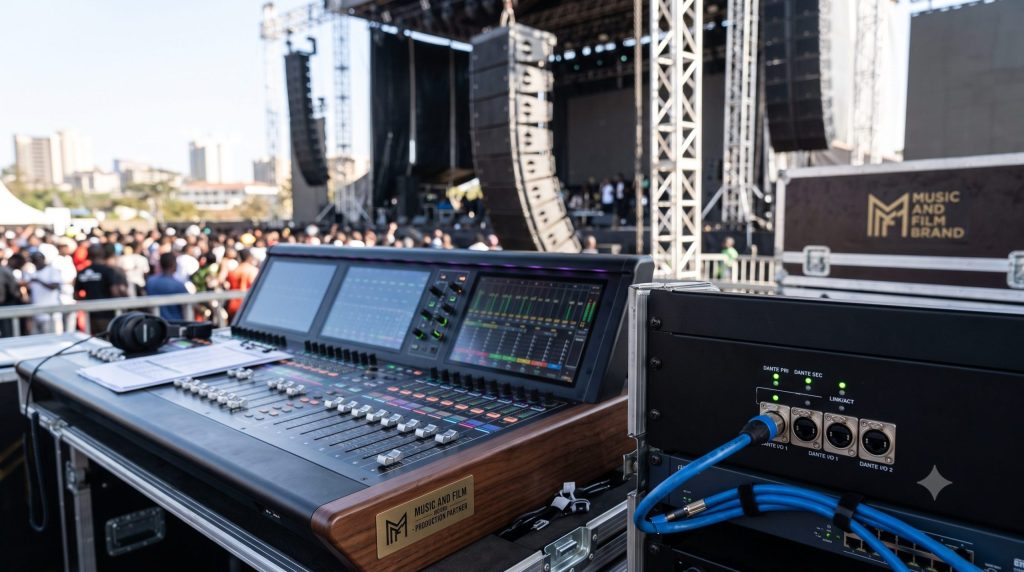
To keep your digital systems running stably across multi-day outdoor festival schedules, you must back up your network configurations with strict data management and robust power infrastructure safety protocols.
1. Hard-Coding Quality of Service (QoS) Priority Rules
When running a complex Dante audio network that shares network switches with secondary festival data streams (such as digital lighting control protocols like Art-Net or administrative production internet connections), you must install Managed Gigabit Ethernet Switches (such as the Cisco SG350 series) and configure strict Quality of Service (QoS) rules.
2. Safeguarding Hardware Against Local Grid Fluctuations
Outdoor festival environments rely almost entirely on heavy-duty diesel generator arrays to provide electrical power for the stage, lighting networks, and front-of-house sound systems. These massive generators are prone to unexpected voltage fluctuations, brownouts, or sudden power dips when heavy lighting rigs or video walls draw sudden bursts of current.
[LIVE POWER ISOLATION WORKFLOW]
│
┌─────────────────────────┴─────────────────────────┐
▼ ▼
[Diesel Generator Output] [Online Double-Conversion UPS]
│ │
Prone to dangerous spikes, surges, Constantly filters and outputs a pristine
and voltage dips under heavy stage loads 240V / 50Hz pure sine wave to your gear
💡 The Diploma Advantage: Learning to manage complex live audio networks, calculate acoustic splay angles, and configure managed gigabit switches requires structured, hands-on practice using industry-grade equipment. At the Music And Film Academy, our 18-month professional track is designed to serve as the ultimate training ground for advanced audio operators. Discover our career pathways by exploring our flagship Diploma in Sound Engineering Course modules, where advanced networking mechanics, digital console matrices, and live system design are fully integrated into your practical curriculum.
6. System Tuning: System Alignment via Rational Acoustics Smaart
Once your line arrays are rigged and your digital routing is locked in, the final stage before your soundcheck begins is comprehensive system tuning and time alignment. This calibration process uses specialized acoustic analysis software (such as Rational Acoustics Smaart) to measure how your speakers are interacting with the physical venue space.
[Measurement Mic] ──► Interface Input ──► [Smaart Real-Time Analysis] ──► Adjust System Delay/EQ
▲
[Pink Noise Generator] ────────────────────────────┘
Implementing Transfer Function Measurements
To tune your PA system with scientific precision, deploy calibrated measurement microphones across key listener zones in your audience layout:
[ACOUSTIC CALIBRATION MATRIX]
│
┌───────────────────────┴───────────────────────┐
▼ ▼
[Magnitude Parameter Analysis] [Phase Alignment Time Calibration]
│ │
Identifies frequency peaks and build-ups Calculates the exact millisecond timing delay
to guide precise system EQ tuning adjustments needed to time-align front-fill speakers with arrays
💡 The Diploma Advantage: Ready to move past basic live sound setups and master enterprise-level digital networking, line array design, and advanced multi-system alignment workflows? Take your live production career to the absolute highest level by exploring our comprehensive Certificate in Sound Engineering Course track at our Nairobi campus.
7. Conclusion: Elevate Your Live Production Career into Enterprise Engineering
Mastering the deployment of digital audio networks is the ultimate technical skill that elevates a live sound technician into an enterprise-level audio engineer. By understanding the architectural differences between Audinate Dante and SuperMAC AES50, applying latency prediction formulas, calculating precise mechanical splay angles for line array coverage, and implementing managed QoS network switches with conditioned online UPS power paths, you protect your system from failures and show major festival promoters that your technical workflows meet international production standards.
True professional excellence requires extensive, hands-on practice inside specialized training environments under the guidance of active industry experts. At the Music And Film Academy, we believe your engineering development shouldn’t be limited by a lack of access to elite production gear. Our modern campus labs at Information House along Hakati Road in the Nairobi CBD provide our students with unlimited access to state-of-the-art live audio systems, digital snakes, enterprise-grade gigabit networks, and advanced acoustic measurement tools from day one. Stop wrestling with basic analog setups and uncalibrated system configurations. Take complete control of your professional future, upgrade your live sound engineering skills, and enroll with us today.