Phone:
+254 719 428 550
Physical address:
Information House, Hakati Road,
Nairobi, Kenya.

Phone:
+254 719 428 550
Physical address:
Information House, Hakati Road,
Nairobi, Kenya.
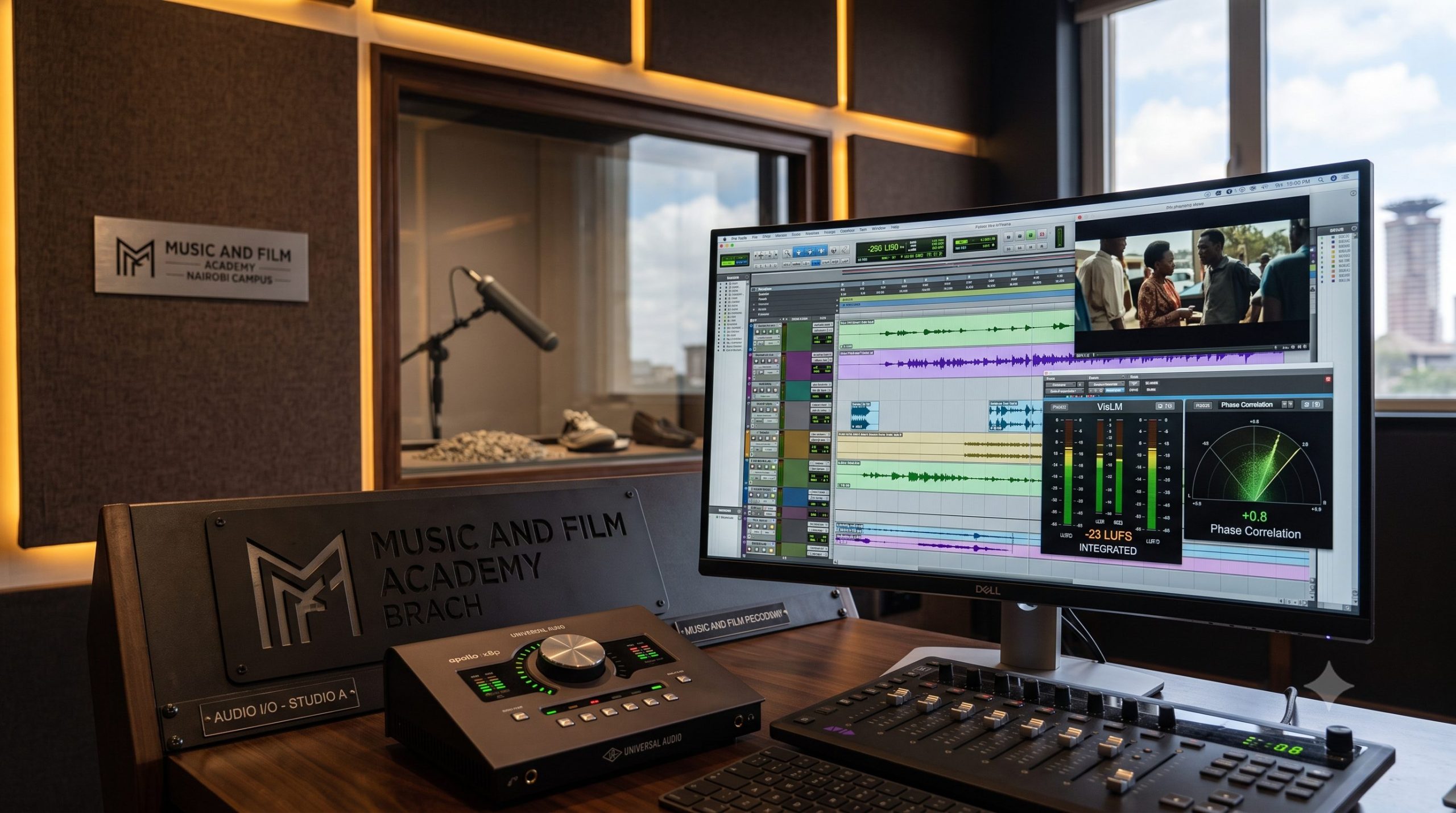
The post-production phase of filmmaking is where a cinematic story truly comes to life. While crisp cinematography and precise editing set the visual narrative, it is the auditory landscape—the subtle rustle of clothing, the clarity of a whispered confession, the impact of an explosion—that immerses an audience completely. For sound designers, dialogue editors, and video post-production teams working within Nairobi’s expanding media hubs, delivering a compelling sonic experience is only half the battle. The definitive test for any film, commercial, or television series occurs when the final master files are exported for transmission. If your project fails to comply with the strict technical benchmarks established by local regulatory bodies, your content will be flagged, distorted by automated transmission limiters, or rejected completely. Therefore, mastering the technical mechanics of broadcast audio standards in Kenya is an essential operational requirement for modern media professionals.
Historically, the local television industry operated on unregulated peak-level frameworks where independent production houses boosted their master gains excessively to compete for perceived volume on air. This practice resulted in a frustrating consumer experience, forcing viewers to constantly adjust their volume controls when transitioning between programs and commercial ad blocks. Under the modern regulatory oversight of the Communications Authority of Kenya (CA) and the film examination frameworks enforced by the Kenya Film Classification Board (KFCB), the local industry has migrated decisively toward international loudness-based normalization models. To pass quality control (QC) protocols for major national television networks like Citizen TV, NTV, or KTN, your multi-channel mixes must strictly comply with target metrics modeled after European Broadcast Union (EBU) and Advanced Television Systems Committee (ATSC) standards. This guide breaks down the physical, legal, and operational steps required to keep your audio compliant.
1. The Mathematics of Loudness: Deconstructing the -23 LUFS Target Protocol
To survive modern broadcast quality control, post-production teams must stop monitoring levels using traditional peak meters and adopt perceived loudness metering. Traditional sample-peak meters only calculate the highest single voltage spike within a digital signal, failing to account for how the human ear perceives volume across variable frequencies over time.
[Raw Audio Mix] ──► [K-Weighting Frequency Filter] ──► [Gated Integrated Integration Time] ──► Target: -23 LUFS
│
[Broadcast Transmission Pipeline] ◄── [True Peak Limiter Protection: Max -1.0 dBTP] ◄───────────────┘
Understanding LUFS and International Measurement Standards
Modern broadcast infrastructure standardizes audio using LUFS (Loudness Units Relative to Full Scale), a metric governed globally by the International Telecommunication Union under the ITU-R BS.1770 recommendation framework.
2. On-Field Precision: Field Recorder Calibration and Dialogue Intimacy
Achieving compliance with broadcast audio standards in Kenya during post-production is significantly easier when your location sound recordist captures pristine, correctly gain-staged raw signals on set. If a field recording contains high background room noise or electronic preamplifier hiss, boosting that dialogue later to meet broadcast standards will amplify those technical flaws.
[Pre-Production Check] ──► [Calibrate Field Recorder to -20 dBFS Reference Tone] ──► [Track Live Dialogue]
│
[Post-Production ADR Sync] ◄── [Match On-Set Microphones & Spatial Decay Filters] ◄─────────┘
A. Calibrating the On-Set Signal Chain
Before your camera department rolls, your location sound mixer must calibrate their professional multi-channel field recorders (such as a Sound Devices or Zoom F-Series unit) against standard digital reference scales.
B. The Mechanics of Automated Dialogue Replacement (ADR)
When environmental pollution on location—such as heavy traffic along Mombasa Road, sudden downpours on metal roofs, or generator hum—ruins your on-set audio, you must execute Automated Dialogue Replacement (ADR) inside a specialized studio suite.
3. Designing Spatial Depth: Foley Recording and Phase-Coherent Panning Layouts
A compelling cinematic soundscape requires a detailed bed of environmental textures and human interactions to support the dialogue. This layer is constructed through Foley Sound Design—the art of physically performing and recording everyday sound effects synchronously over an open video timeline inside a dedicated acoustic tracking space.
[Perform Foley Action] ──► [Track with Low-Noise Mic] ──► [Align Timeline Waveform] ──► [Check Phase Coherence]
A. The Foley Tracking Sequence
B. Managing Phase-Coherent Spatial Panning Layouts
When placing your Foley tracks and sound effect files across a stereo or 5.1 Surround Sound spatial landscape, you must monitor your inter-channel phase relationships carefully using a Goniometer or Correlation Meter.
[CORRELATION METER PHASE MAP]
│
┌───────────────────────┴───────────────────────┐
▼ ▼
[Target Zone: +0.5 to +1.0] [Danger Zone: 0 to -1.0]
│ │
Indicates a phase-coherent stereo signal Signals heavy out-of-phase audio waves
that sums perfectly into mono transmission that cancel out completely on mono receivers
4. Hardware Sourcing, Room Calibration, and System Power Stability
To ensure your mixes translate accurately and comply with all target metrics across different distribution platforms, you must back up your post-production tasks with a disciplined hardware maintenance routine.
1. Eliminating Acoustic Bottlenecks in the Control Room
Small, untreated editing rooms naturally suffer from low-frequency acoustic energy build-ups, creating phase cancellation dead zones or exaggerated boomy frequencies that can deceive your ears during a mix.
2. Safeguarding Hardware Against Local Grid Instability
Electrical fluctuations are an ongoing consideration for production spaces in Nairobi. A sudden voltage spike or sudden power cut can damage your studio monitors’ internal amplifiers or corrupt your active project files mid-mix.
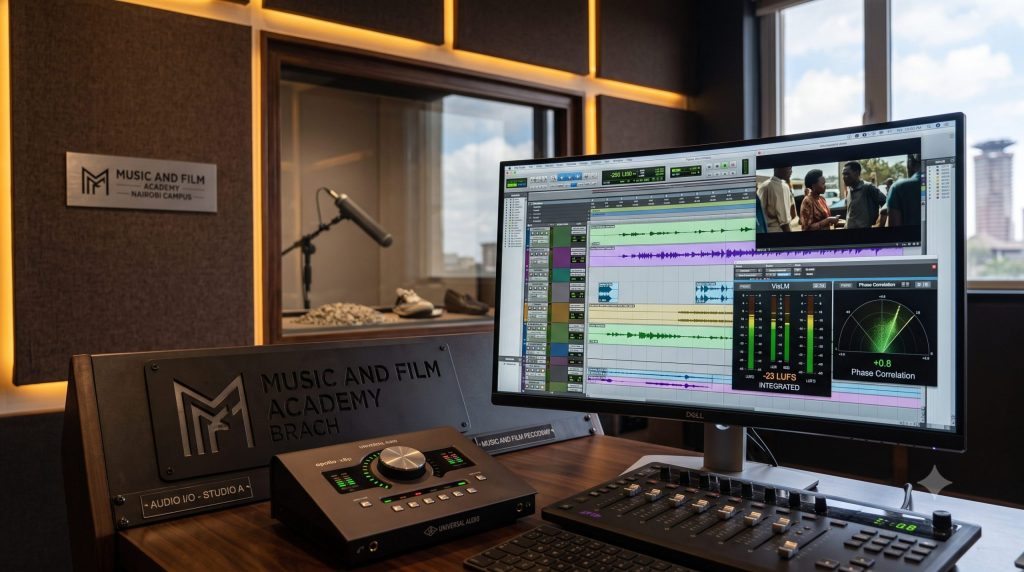
| Broadcast Metric | Evaluation Tool | Target Specification Requirement | Primary Compliance Purpose |
| Integrated Loudness | EBU R128 Meter | -23 LUFS (pm1.0 LU) | Ensures a consistent volume experience across all programs, commercials, and channels. |
| Maximum True Peak | Inter-Sample Peak Meter | Max -1.0 dBTP | Leaves an adequate safety buffer to prevent digital distortion during transmission. |
| Phase Correlation | Goniometer Matrix | +0.5 to +1.0 Scale | Guarantees that spatial layers and dialogue sum cleanly without phase cancellation on mono receivers. |
💡 The Certificate Advantage: Learning to navigate the strict technical demands of broadcast compliance requires hands-on practice using specialized monitoring systems in an accurate acoustic environment. At the Music And Film Academy, our vocational tracking facilities are designed to mimic elite real-world post-production rooms. Turn technical theory into confident engineering skill and discover our foundational Certificate in Sound Engineering Course track to master your craft on campus.
5. Navigating Regulatory Compliance and Local Content Distribution Networks
Successfully delivering audio files into local media networks requires a complete understanding of the legal frameworks governing content distribution within the Kenyan entertainment sector.
A. The Legal Infrastructure of Local Broadcasting
The production and exhibition of all audio-visual materials within the country are legally governed under the Films and Stage Plays Act (Cap 222) and the media transmission regulations enforced by the Communications Authority of Kenya.
[KENYAN BROADCAST COMPLIANCE AXIS]
│
┌───────────────────────────────┴───────────────────────────────┐
▼ ▼
[The Watershed Rule (5AM – 10PM)] [The Local Content Quota (40%+)]
│ │
Mandates the absolute elimination of adult Creates a profitable B2B market for local
dialogue or explicit audio during daytime hours. creators who can deliver compliant masters.
💡 The Certificate Advantage: Navigating the creative economy requires an understanding of both advanced software design and local entertainment laws. Our comprehensive Sound Engineering Courses in Kenya hub provides a direct comparison of our intensive vocational tracks, helping you choose the perfect launchpad for your live production or film post-production career.
6. Conclusion: Elevate Your Audio Productions to International Technical Standards
Achieving absolute compliance with modern broadcast audio standards in Kenya requires moving past casual mixing habits and dedicating yourself to disciplined, scientifically vetted post-production practices. By organizing your master timelines to hit the integrated -23 LUFS target, protecting your output channels with true-peak limiting thresholds, gain-staging your location recorders properly on set, and maintaining phase coherence across your spatial panning choices, you ensure your productions translate cleanly to any device. These engineering practices protect your creative vision from automated transmission distortion and position your brand as a reliable supplier for premier media agencies and television networks across East Africa.
Building true technical authority requires extensive, hands-on practice inside industry-grade acoustic environments using premium tools under the guidance of active industry mentors. At the Music And Film Academy (MFA), we reject superficial training methods. Our modern campus labs at Information House along Hakati Road in the Nairobi CBD provide our students with unlimited access to isolated tracking suites, calibrated measurement microphones, multi-channel field recorders, and industry-standard loudness metering systems from day one. Stop letting uncalibrated room acoustics and compliance errors bottleneck your creative vision. Take control of your career, upgrade your post-production engineering skills, and enroll with us today.