Phone:
+254 719 428 550
Physical address:
Information House, Hakati Road,
Nairobi, Kenya.

Phone:
+254 719 428 550
Physical address:
Information House, Hakati Road,
Nairobi, Kenya.
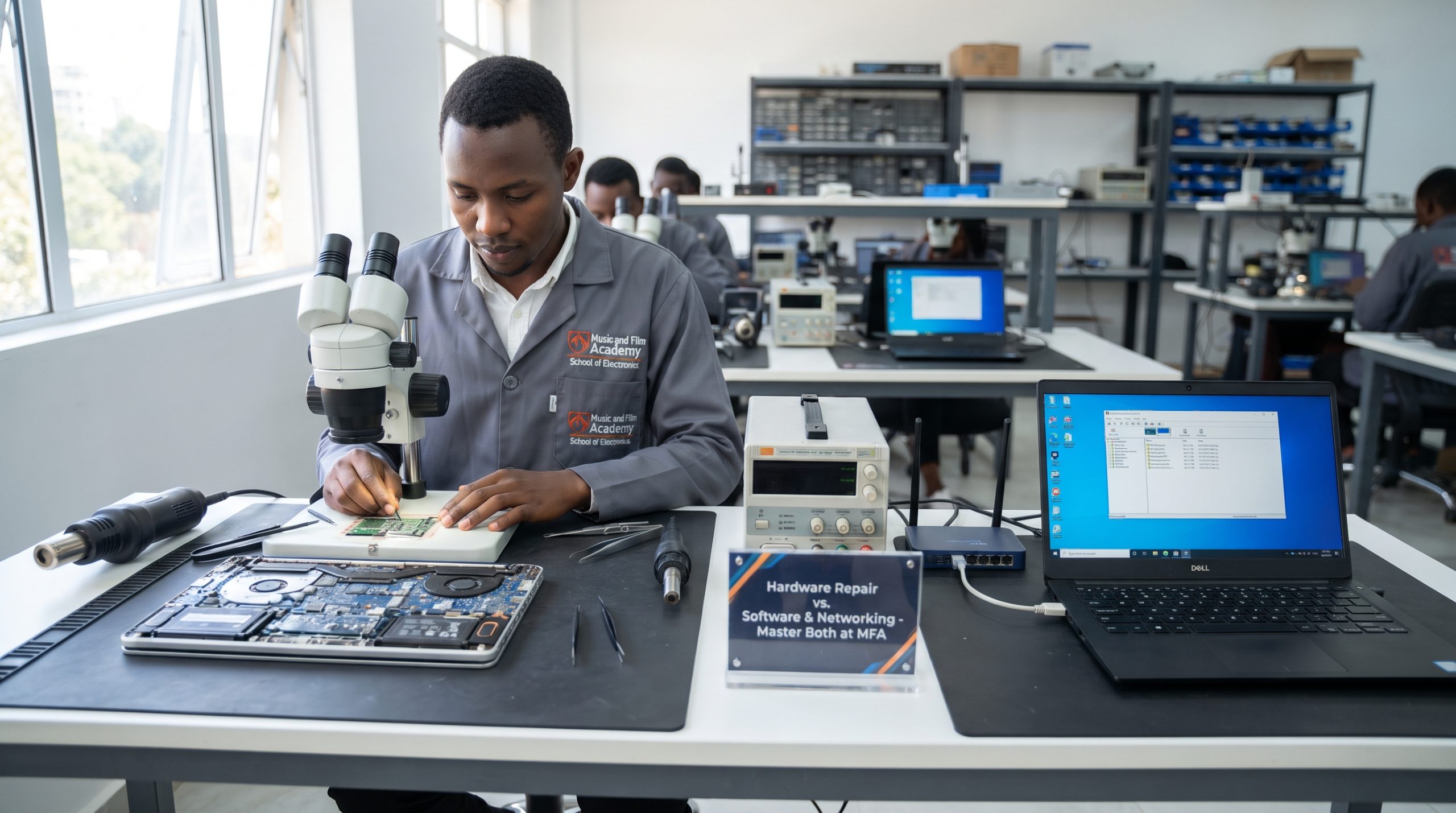
When deciding between a hardware repair vs. software & networking course in Kenya, computer and laptop hardware repair is generally the faster path to independent self-employment and immediate repair income (KES 45,000 to KES 160,000+/month), whereas software and networking focuses on operating systems, applications, LAN/Wi-Fi infrastructure, routers, switches, and enterprise IT roles. At Music and Film Academy’s School of Electronics in Nairobi CBD (Information House, Hakati Road), our 3-month Certificate in Laptop & Computer Repair (KES 39,000 total / KES 13,000/month) equips trainees with both board-level hardware engineering (19V power rails, MOSFETs, and SPI BIOS flashing) and practical software/networking essentials (Windows/macOS/Linux deployment, malware cleanup, data recovery, and basic office Wi-Fi/LAN setup) on a guaranteed 1:1 workstation.
Choosing which skill to learn first comes down to whether you want to fix physical devices and run a repair bench right away or build toward enterprise network engineering and systems administration.
| Comparison Factor | Laptop & Computer Hardware Repair (MFA Track) | Software & Networking Courses |
| Core Technical Focus | Physical disassembly, eDP screens, keyboards, batteries, hinges, RAM/NVMe SSDs, 19V power rails, MOSFETs & BIOS flashing, plus OS deployment & data recovery | Software applications/development, OS administration, LAN/WAN routing & switching, Wi-Fi networks, firewalls, and cloud/network operations |
| Duration & Tuition at MFA | 3 Months (12 Weeks) — KES 39,000 Total (KES 13,000/mo + KES 2,000 reg.) with ~90% practical bench work | Varies widely by specialty (short workshops to 6–12+ month certificates/diplomas and vendor exams) |
| Entry & Equipment Access | Open Entry (18+ years with National ID/Passport; any KCSE grade); 1:1 workstation with microscopes, DC power supplies, hot-air stations & BIOS programmers provided in lab | Varies by institution; networking and software courses typically require computer labs, network simulators/routers, or personal laptops |
| Path to Income in Kenya | Fast walk-in repair jobs, B2B motherboard/BIOS subcontracting, refurbished laptop servicing, or corporate hardware/IT roles | Salaried IT/network support or specialized network/software roles (often scaling with hands-on labs and certifications) |
| Best Starting Choice If… | You want hands-on physical troubleshooting, quick self-employment, or high-margin motherboard and upgrade repairs | You prefer network infrastructure, routing/switching, cybersecurity, or software/app development |
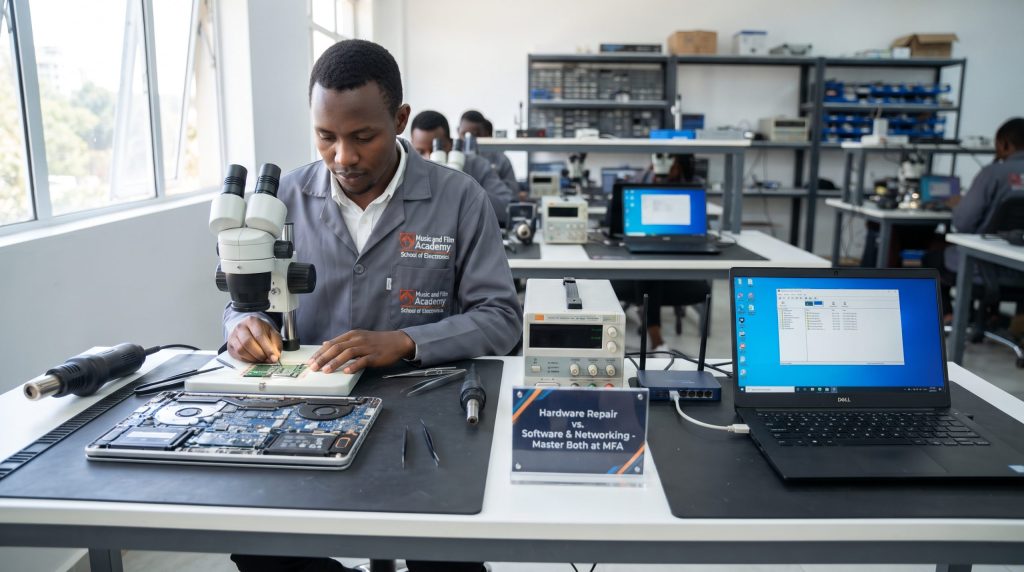
Starting with laptop and computer hardware repair gives beginners in Kenya a clear, tangible route to turning technical skill into income:
Choosing a software or networking path first is often a better fit when:
A common mistake in Kenya is treating hardware and software/networking as completely disconnected silos. In real life, a laptop with a corrupted BIOS or failing NVMe SSD looks like a “broken system” until you diagnose the hardware, and a freshly installed operating system still needs proper drivers, local Wi-Fi/LAN configuration, and safe data handling.
Inside our 3-month Certificate in Laptop & Computer Repair (KES 39,000 total / KES 13,000/month):
And if you also want smartphone micro-soldering and mobile flashing in the same 3-month window, our Combined Certificate in Mobile Phone & Laptop Repair is available for KES 54,000 total (KES 18,000/month)—saving KES 24,000 compared to taking both standalone courses separately.
Classes at Music and Film Academy’s School of Electronics (Information House, Hakati Road, Nairobi CBD) run on ongoing monthly enrollment (1st Monday of every month) with Open Entry (18+ years with National ID or Passport—no minimum KCSE grade required) and flexible 2-hour weekday shifts (9:00 AM–11:00 AM, 11:30 AM–1:30 PM, 2:30 PM–4:30 PM, 6:00 PM–8:00 PM) or Saturday sessions (10:30 AM–12:30 PM and 12:30 PM–2:30 PM).