Phone:
+254 719 428 550
Physical address:
Information House, Hakati Road,
Nairobi, Kenya.

Phone:
+254 719 428 550
Physical address:
Information House, Hakati Road,
Nairobi, Kenya.
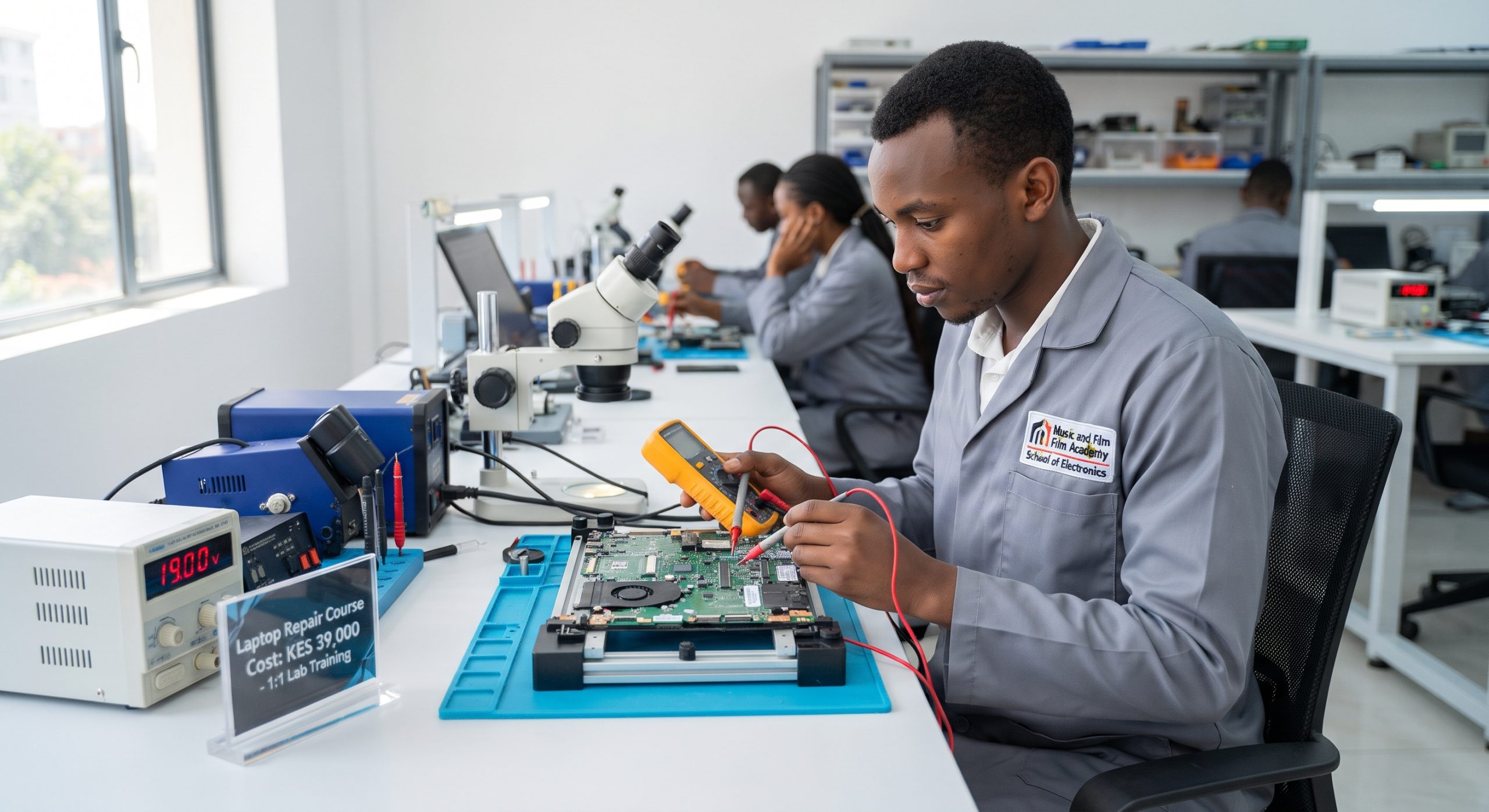
If you are asking how much does a laptop repair course cost in Kenya, practical 3-month (12-week) training programs in Nairobi generally range between KES 25,000 and KES 60,000 depending on workstation access and whether chip-level motherboard soldering is included. At Music and Film Academy in Nairobi CBD (Information House, Hakati Road), our 3-month Certificate in Laptop & Computer Repair costs KES 39,000 total—payable in flexible monthly installments of KES 13,000 per month across 3 months, plus a one-time KES 2,000 registration fee. Trainees who want both computer and smartphone engineering skills can enroll in our Combined Certificate in Mobile Phone & Laptop Repair for KES 54,000 total (KES 18,000/month), saving KES 24,000 compared to taking both courses separately.
Comparing sticker tuition alone is not enough when evaluating technical colleges in Kenya. Some budget courses (KES 12,000 – KES 25,000) only teach basic Windows installation and RAM/hard-drive swaps, while several Nairobi CBD institutes charge KES 60,000 for a single 3-month computer repair course—and up to KES 100,000 for combined computer and mobile repair—inside crowded 30-student cohorts.
| Training Provider / Tier | Program Duration | Total Tuition Fee | Monthly Installment Plan | Motherboard Soldering & BIOS Flashing | Workstation Ratio |
| Music and Film Academy (Nairobi CBD) — Certificate in Laptop & Computer Repair | 3 Months (12 Weeks) (~90% Practical) | KES 39,000 Total (+ KES 2,000 reg. fee) | KES 13,000 / Month (x 3 Months) | Included — 19V/20V USB-C PD rails, MOSFETs & CH341A/RT809F BIOS programming | Strict 1:1 (Solo bench, scope, hot-air & DC supply) |
| Music and Film Academy (Nairobi CBD) — Combined Laptop + Mobile Phone Repair | 3 Months (12 Weeks Intensive) | KES 54,000 Total (Save KES 24,000) | KES 18,000 / Month (x 3 Months) | Included — Full laptop + smartphone BGA micro-soldering & flashing | Strict 1:1 (Dual-device solo workstation) |
| Mid-to-High-Priced Nairobi CBD Tech Institutes | 3 Months (12 Weeks) | KES 60,000 (Up to KES 100,000 combined) | KES 20,000 / Month | Often basic PC assembly & general troubleshooting | Shared cohort benches (up to 30 students per intake) |
| Basic Computer Maintenance Short Courses | 1 – 3 Months | KES 12,000 – KES 25,000 | Varies | Excluded — Software/OS installation and modular part swaps only | Shared classroom PCs |
| Multi-Trimester / Academic University Certificates | 9 Months – 1 Year | KES 64,000 – KES 96,000+ (KES 32k/trimester) | Trimester billing | Theory-heavy IT maintenance & networking | Standard computer lab |
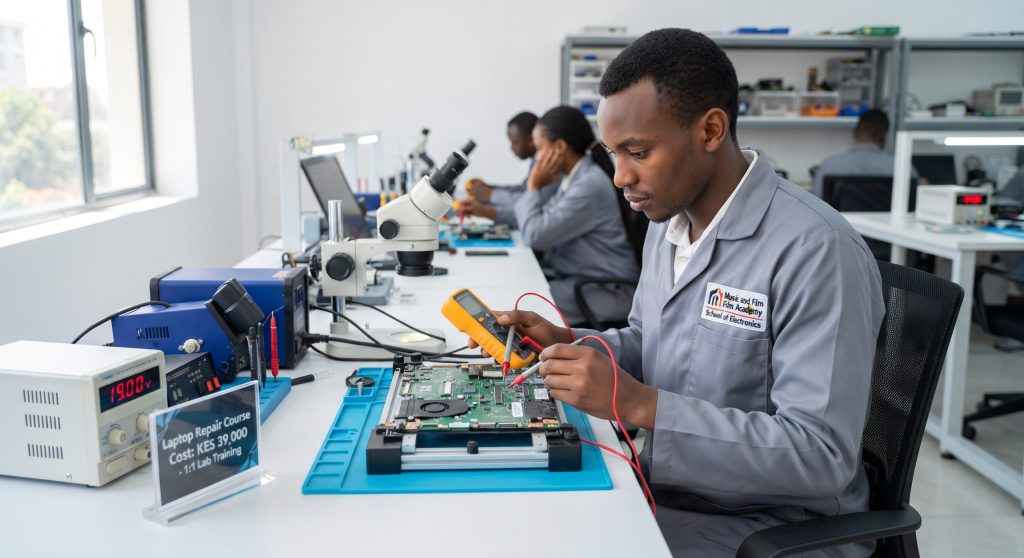
When budgeting for how much a laptop repair course costs in Kenya, hidden lab charges and mandatory tool purchases often inflate the real cost. At Music and Film Academy’s School of Electronics, your flat KES 39,000 tuition (KES 13,000/month) covers:
To keep your budget transparent from Day 1, here are the only optional or external items outside the KES 39,000 tuition and KES 2,000 registration fee:
Laptop repair in Kenya carries strong profit margins because business owners, university students, and remote workers depend on their computers daily:
Completing just 12 to 18 standard laptop repairs after graduating covers your entire KES 39,000 course investment.
Ready to start with ongoing monthly enrollment (1st Monday of every month), Open Entry (18+ years with a National ID or Passport—no minimum KCSE grade required), and flexible 2-hour weekday shifts (9:00 AM–11:00 AM, 11:30 AM–1:30 PM, 2:30 PM–4:30 PM, 6:00 PM–8:00 PM) or Saturday sessions?