Phone:
+254 719 428 550
Physical address:
Information House, Hakati Road,
Nairobi, Kenya.

Phone:
+254 719 428 550
Physical address:
Information House, Hakati Road,
Nairobi, Kenya.
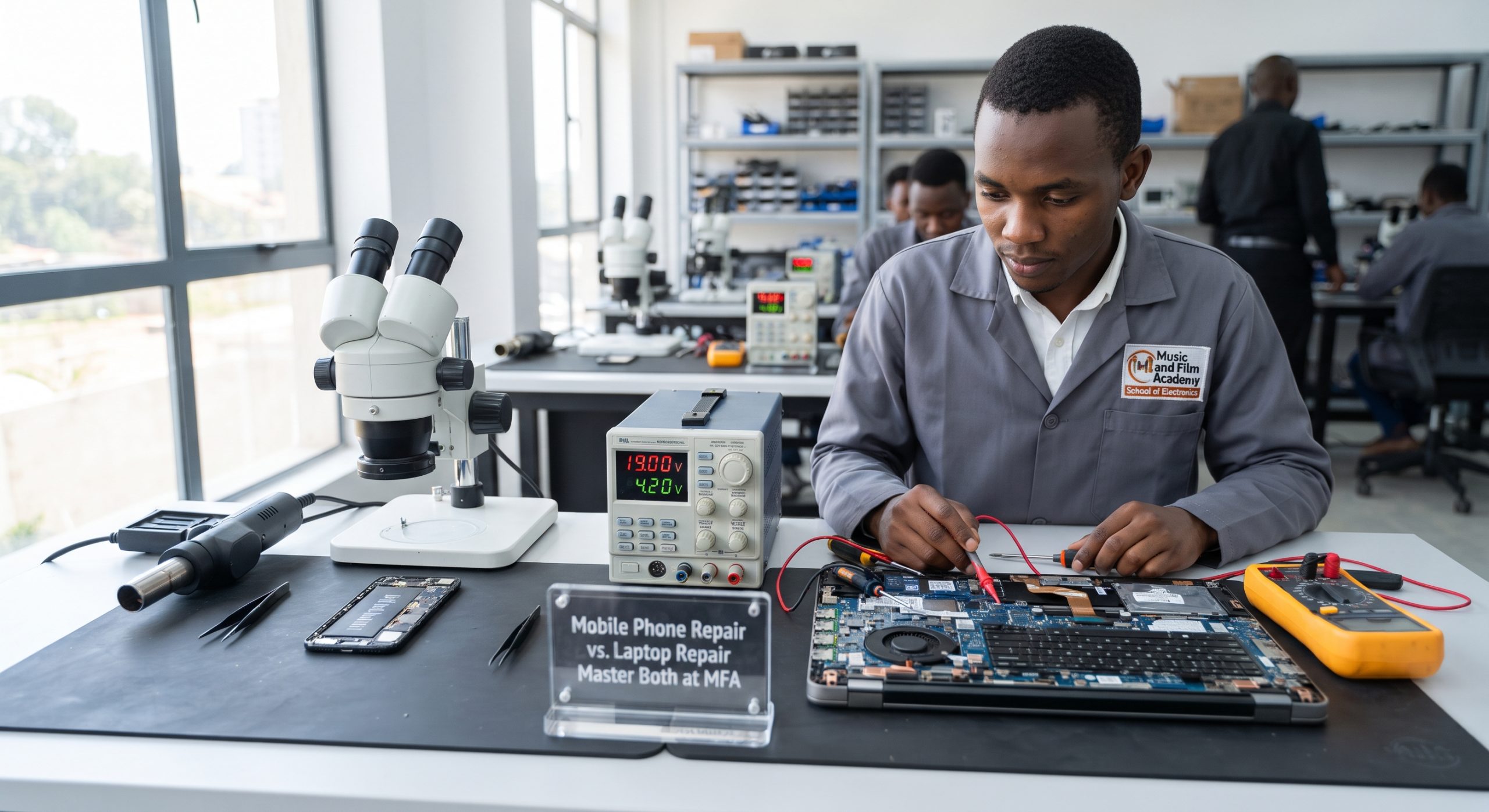
When comparing a mobile phone repair vs. laptop repair course in Kenya, mobile phone repair is the faster, lower-capital trade to launch first because smartphones generate 3x to 5x higher daily walk-in volume across every Nairobi estate and Kenyan town, with starter bench tools costing just KES 8,500 to KES 15,000. Laptop and computer hardware repair, on the other hand, delivers higher average ticket sizes per job (KES 2,500 to KES 12,000+ for DC charging circuits, keyboard/screen swaps, BIOS reprogramming, and SSD upgrades) and opens doors to corporate offices, schools, and university campuses. At Music and Film Academy’s School of Electronics in Nairobi CBD (Information House, Hakati Road), both standalone 3-month certificates cost KES 39,000 total (KES 13,000/month), while our Combined Certificate in Mobile Phone & Laptop Repair lets you master both trades concurrently in 3 months for KES 54,000 total (KES 18,000/month)—saving you KES 24,000 compared to taking them separately (and costing KES 46,000 less than competing Nairobi CBD institutes charging KES 100,000 for combined training).
Understanding how the two trades differ in repair volume, technical complexity, and startup equipment helps you pick the smartest starting route—or combine both for year-round cash flow.
| Decision Factor | Mobile Phone Repair Course (Standalone) | Laptop & Computer Repair Course (Standalone) | Combined Phone + Laptop Course (Best Value) |
| Music and Film Academy Fee (Nairobi CBD) | KES 39,000 Total (KES 13,000/mo + KES 2k reg.) | KES 39,000 Total (KES 13,000/mo + KES 2k reg.) | KES 54,000 Total (KES 18,000/mo + KES 2k reg. — Save KES 24k) |
| Course Duration & Ratio | 3 Months (12 Weeks) — ~90% Practical, 1:1 Workstation | 3 Months (12 Weeks) — ~90% Practical, 1:1 Workstation | 3 Months (12 Weeks Intensive) — Dual-Device 1:1 Lab |
| Daily Walk-In Demand in Kenya | Very High — Millions of daily smartphone users (Tecno, Infinix, Samsung, iPhone, Xiaomi) | Steady / High in CBD & Campus Hubs — Students, remote workers, SMEs & offices | Maximum Daily Footfall — Captures every device entering your shop |
| Typical Gross Profit Per Repair | KES 1,000 – KES 4,000 (Mid-range screens/ports); KES 3,000 – KES 10,000+ (iPhone/OLED & BGA) | KES 1,800 – KES 6,500 (Screens, keyboards, charging ICs, OS/SSD); KES 5,000 – KES 15,000+ (Motherboard) | Dual Revenue Streams — Daily phone volume + high-ticket laptop jobs |
| Starter Toolkit Cost | KES 8,500 – KES 15,000 (Lean bench) | KES 12,000 – KES 22,000 (Includes bootable USB drives, RAM/SSD testers & rework tools) | KES 18,000 – KES 35,000 (Shared multimeter, hot-air station & DC power supply) |
| Core Technical Focus | Micro-components, compact BGA ICs, OLED/LCD swaps, battery/charging flexes & mobile flashing | Larger motherboards, 19V DC power rails, MOSFETs, BIOS chips, hinges, fans & Windows/macOS recovery | Shared circuit-analysis logic applied across both compact smartphones and laptops |
Choose Mobile Phone Repair as your starting specialization if:
Choose Laptop & Computer Hardware Repair first if:
The biggest secret in Kenya’s hardware repair industry is that both trades share the exact same diagnostic foundation—multimeter continuity/diode testing, DC power-supply current analysis, schematic reading, and hot-air SMD soldering—and both use the exact same bench equipment.
By enrolling in Music and Film Academy’s Combined Certificate in Mobile Phone & Laptop Repair (KES 54,000 total / KES 18,000/month):
KES 78,000).All programs at Music and Film Academy’s School of Electronics (Information House, Hakati Road, Nairobi CBD) offer Open Entry (for applicants aged 18+ years with any KCSE grade, KCPE, or adult career-switcher backgrounds), ongoing monthly enrollment, and flexible 2-hour weekday shifts (morning, midday, afternoon, evening) or Saturday sessions with a guaranteed 1:1 student-to-workstation ratio.