Phone:
+254 719 428 550
Physical address:
Information House, Hakati Road,
Nairobi, Kenya.

Phone:
+254 719 428 550
Physical address:
Information House, Hakati Road,
Nairobi, Kenya.
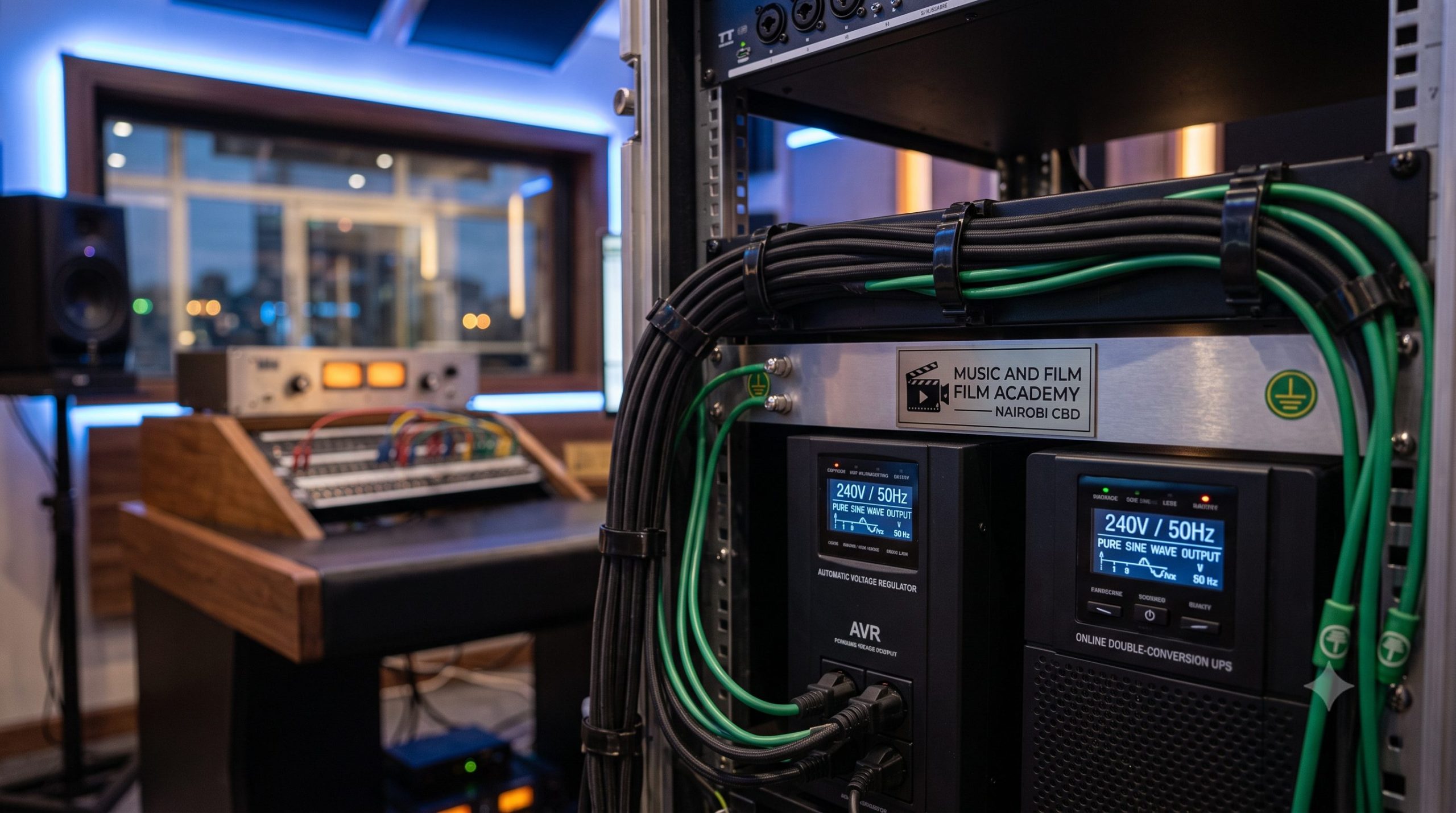
Every professional audio engineer and music studio owner across Kenya knows the unique sinking feeling that comes with an unexpected technical flaw in their monitoring system. You sit down at your mixing desk, power up a pristine set of high-end studio monitors, turn up the main volume fader, and are immediately greeted by a persistent, irritating low-frequency buzz. Alternatively, you might be in the middle of tracking an intimate acoustic session when a sudden neighborhood power fluctuation causes your digital audio interface to disconnect entirely, corrupting your active project file. For studio facilities operating within East Africa’s rapidly expanding creative sector, unstable electricity is a constant issue. Transitioning your workspace into a world-class production suite requires looking past acoustic treatment and mastering the electrical engineering principles required for eliminating ground hum and voltage spikes in Nairobi control rooms.
Many independent producers try to solve audio buzzing by purchasing expensive gold-plated audio cables, lifting shields recklessly, or adding software noise gates to their master timeline channels. These quick fixes are ineffective because they treat the symptoms rather than the root cause. Audio interference and gear failures are almost always caused by issues hidden within your alternating current (AC) distribution lines. The Kenyan power grid delivers electrical energy under a distinct set of physical parameters that interact aggressively with low-voltage audio gear. To protect your equipment investments and secure a low noise floor, you must understand the physics of ground loops, balance your phase loads strategically, size your battery backup systems accurately, and construct a dedicated technical earth ground layout. This comprehensive guide outlines the exact power grid engineering blueprints needed to stabilize your facility.
1. The Physics of the Buzz: Deconstructing AC Ground Loops and the 50 Hz Kenyan Grid
To establish a reliable framework for eliminating ground hum and voltage spikes in Nairobi control rooms, you must evaluate how electrical current travels through your studio’s power lines. The utility power delivered by Kenya Power (KP) operates on an alternating current system standardized at a nominal voltage of 240 V and a fixed frequency of 50 Hz.
How Multiple Paths Create Current Loops
The 50 Hz frequency of the electrical grid is a physical property. If your audio signal paths accidentally capture this frequency, it will manifest through your speakers as a low-pitched hum corresponding to that 50 Hz tone. This audio leakage occurs through a phenomenon known as an AC Ground Loop.
A ground loop happens when two or more independent audio devices—for instance, a desktop computer running a digital audio workstation (DAW) and an active pair of studio monitors—are connected to separate electrical wall outlets that share a common audio signal cable. Each piece of hardware has its own internal path to the main safety earth pin of its power cord. Because local commercial properties often feature aging or unevenly distributed copper wiring, a slight electrical resistance variance develops between these separate wall sockets. This voltage difference forces stray AC leakage current to flow along the shielding of your balanced audio cables as an alternative path to the earth ground, modulating your audio lines and causing a continuous 50 Hz hum.
2. Advanced Phase Management: Balancing Loads across Commercial Studio Networks
When designing the electrical distribution layout for a multi-room recording facility or a large post-production suite, you cannot simply plug all your equipment into the nearest available power strip. Large-scale properties are typically supplied with Three-Phase Electrical Power, where the incoming current is split across three distinct voltage lines (conventionally labeled Phase A, Phase B, and Phase C), each offset by 120^circ.
Phase A (Line 1) ──► [High-Current AC Units, Heavy Studio Air Conditioning]
Phase B (Line 2) ──► [Domestic Lighting Circuits, Coffee Stations, Office Computers]
Phase C (Line 3) ──► [TECHNICAL CLEAN AUDIO RING MAIN: Console, Preamps, Monitors]
Isolating Sensitive Gear from Inductive Noise
If your high-gain audio preamplifiers and sensitive mixing desks share an electrical phase line with high-draw, inductive-load machinery (such as split-system air conditioning units, office refrigerators, or heavy water pumps), your audio fidelity will suffer. Every time an inductive motor cycles on or off, it generates a massive reverse electromotive force (EMF) that travels back into that specific power line, causing sudden voltage spikes and line noise.
To prevent this type of interference:
3. Mathematical Splay Optimization: Sizing an Online UPS for Hybrid Desks
Relying on a standard consumer-grade power strip or a passive surge protector is insufficient for protecting an advanced hybrid control room from local power instabilities. To keep your system running stably through voltage drops, brownouts, and sudden blackouts, you must install an Online Double-Conversion Uninterruptible Power Supply (UPS).
[Incoming Dirty AC Grid] ──► [AC/DC Rectifier] ──► [Internal Battery Bank] ──► [DC/AC Inverter] ──► [Pristine 240V Clean Sine Wave]
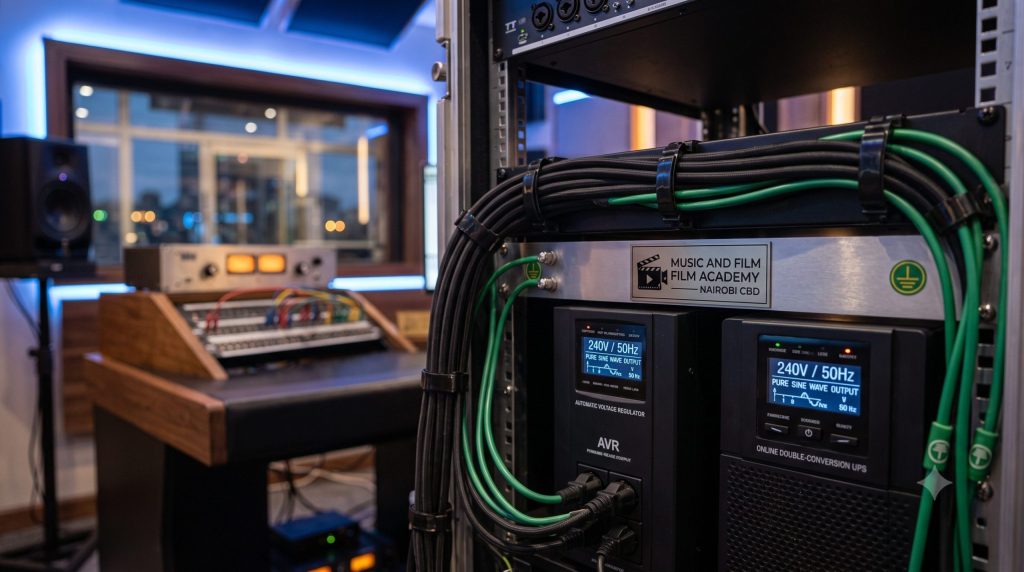
Unlike cheap offline backup power systems that experience a brief timing delay when switching to battery power during an outage, an online double-conversion UPS operates continuously. It takes incoming AC utility power, converts it to direct current (DC) to keep its internal battery banks charged, and then immediately uses an internal inverter to convert that DC energy back into a pristine, continuous 240 V / 50 Hz pure sine wave to power your gear. This configuration completely isolates your sensitive audio components from grid fluctuations and ensures zero transfer time during a power cut.
The Power Calculation Template
To choose the correct capacity for your online UPS, you must calculate the total apparent power load of your control room. Apparent power is measured in Volt-Amperes (VA). Use this step-by-step engineering sequence:
Minimum VA Requirement = Total Wattage / Power Factor = 1620 / W0.75 = 2160 VA
Target UPS Size = 2160 VA times 1.3 = 2808 VA
Based on this calculation, a professional 3000 VA (3 kVA) online double-conversion UPS is the ideal choice for this control room. This size safely handles your entire equipment load, runs cool, and provides your team with ample time to save active multitrack sessions and shut down the system cleanly during an extended power outage.
4. The Safety Physics of Isolating an Electrical Technical Earth Ground
The most complete, permanent method for eliminating ground hum and voltage spikes in Nairobi control rooms is constructing a dedicated Technical Earth Ground system. In a standard commercial electrical installation, the safety ground wires from every wall socket are tied to a central distribution bar connected to the building’s main structural steel frames or plumbing lines. This configuration presents a major issue for high-gain recording studios.
Constructing an Isolated Star Earthing Layout
Every elevator motor, fluorescent light ballast, and office computer in the building dumps its high-frequency electrical noise and leakage current straight into that shared ground system, polluting the reference shield lines of your audio cables.
| Power System Infrastructure Component | Minimum Required Specification | Target Operational Metric | Primary Functional Role |
| Online Double-Conversion UPS | 3 kVA Pure Sine Wave output | 0 ms active transfer delay | Filters incoming utility noise and maintains steady system voltage during power drops. |
| Technical Earthing Array | 2.5 m solid copper rod | < 5 Omega ground path resistance | Provides a clean, isolated ground reference that drains away system noise without ground loops. |
| Automatic Voltage Regulator (AVR) | High-accuracy servo-motor configuration | Nominal 240 V pm 2% output | Smooths out extreme over-voltages and dangerous voltage spikes on the local grid. |
💡 The Academy Edge: Navigating the complex mathematics of electrical phase distribution and isolated grounding layout designs can be daunting when trying to build a recording space on your own. At the Music And Film Academy, we believe a premier audio professional must understand the complete physical infrastructure of sound. Every studio console, live tracking room, and edit suite at our modern Information House campus features dedicated, isolated voltage-stabilized circuitry. This engineering standard provides our students with a clean listening environment, helping them learn how to mix on industry-grade gear with absolute technical clarity from day one.
5. Technical Calibration Protocols: Diagnosing Interference Using Audio Analysis Tools
Once your power distribution infrastructure is installed, you must implement strict diagnostic testing protocols to identify and resolve any remaining interference across your audio lines.
1. Executing a Fast Fourier Transform (FFT) Analysis
If you notice an underlying hum in a recording track or through your monitors, do not guess at the cause. Insert a high-resolution Fast Fourier Transform (FFT) spectrum analyzer plugin (such as the FabFilter Pro-Q 3 or Waves PAZ) across your master output bus:
2. Implementing Proper Transformer Balancing
When interfacing older unbalanced gear (such as classic guitar amplifiers or legacy hardware synthesizers) with modern balanced audio networks, use high-quality Direct Injection (DI) Boxes equipped with premium audio isolation transformers (such as Jensen or Radial components).
[DI TRANSFORMER ISOLATION LOOP]
│
┌────────────────────────┴────────────────────────┐
▼ ▼
[Engage Ground Lift Switch] [Magnetic Induction Transfer]
│ │
Mechanically breaks the copper shield loop Transfers the clean audio signal safely across
to stop the 50 Hz hum current instantly. an isolated internal magnetic transformer field.
💡 The Academy Edge: Building true technical authority in live sound and studio production requires real-world, practical troubleshooting experience under variable conditions. If you want to move past basic home recording setups and step into high-volume commercial media management, explore our comprehensive Sound Engineering Courses in Kenya hub to find the perfect professional launchpad for your career goals.
6. Regulatory Frameworks: Maintaining Local Grid Compliance and Safety Compliance
Operating a commercial recording space or post-production complex in Kenya requires keeping your electrical installations fully compliant with local regulatory standards and safety guidelines.
A. Adhering to EPRA Power Quality Standards
All commercial power distributions and independent sub-station operations within the country are legally regulated by the Energy and Petroleum Regulatory Authority (EPRA). Under current energy regulations, commercial properties face strict rules regarding power factors and harmonic distortions they feed back into the main grid.
[KENYAN REGULATORY COMPLIANCE AXIS]
│
┌───────────────────────────────┴───────────────────────────────┐
▼ ▼
[EPRA Quality Mandates (PF > 0.90)] [NCA Structural Safety Codes]
│ │
Requires system inputs to run efficiently Strictly forbids lifting safety grounds,
without causing grid harmonic distortions. requiring isolated, code-compliant earthing.
💡 The Academy Edge: Long-term professional success in the creative industries requires a deep understanding of both advanced mixing software and corporate business infrastructure. Learn to design, maintain, and manage legally compliant commercial studio complexes by exploring our foundational Certificate in Sound Engineering Course track to learn from veteran engineering mentors on campus.
7. Conclusion: Take Absolute Control of Your Studio’s Power Environment
Achieving a pristine, ultra-quiet noise floor and safeguarding your digital mixing equipment from sudden grid failures requires looking past simple software adjustments and mastering the principles of electrical calibration. By understanding the physics of 50 Hz ground loops, isolating your clean audio gear across independent phase lines, sizing a double-conversion online UPS with adequate safety headroom, and constructing a code-compliant star-earthing array, you confidently master the process of eliminating ground hum and voltage spikes in Nairobi control rooms. These professional practices protect your hardware investments, ensure accurate mix translation, and guarantee your facility can operate reliably through any local grid fluctuations.
True engineering authority is built through hands-on practice inside industry-grade acoustic environments using professional tools under the guidance of active technical experts. At the Music And Film Academy (MFA), we provide the perfect foundation for your technical ambitions. Our modern campus labs at Information House along Hakati Road in the Nairobi CBD grant our students unlimited access to isolated tracking suites, voltage-stabilized mixing rooms, professional multi-channel interfaces, and advanced electrical analysis tools from day one. Stop letting grid interference and uncalibrated setups bottleneck your creative vision. Take complete control of your professional future, upgrade your sound engineering skills, and enroll with us today.