Phone:
+254 719 428 550
Physical address:
Information House, Hakati Road,
Nairobi, Kenya.

Phone:
+254 719 428 550
Physical address:
Information House, Hakati Road,
Nairobi, Kenya.
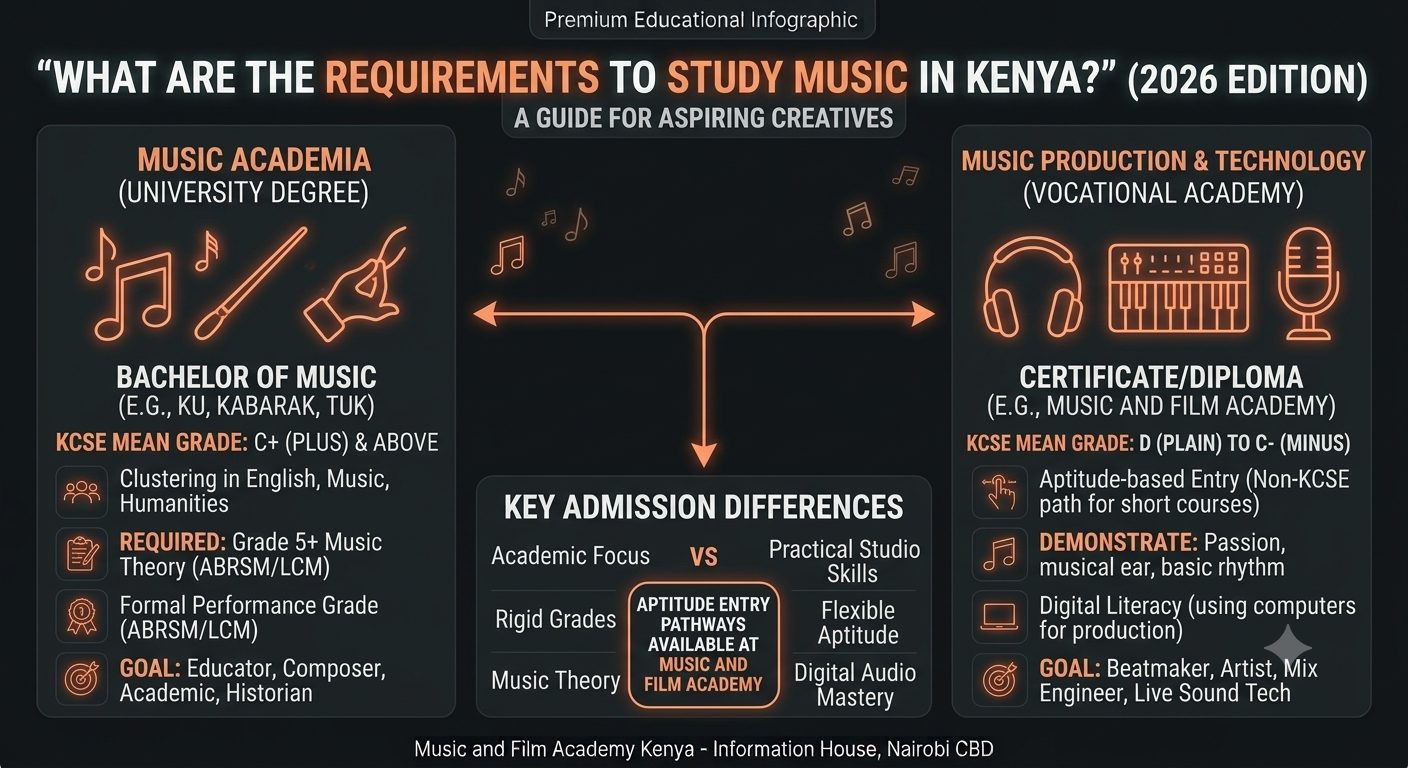
The requirements to study music in Kenya vary significantly depending on the level of qualification and the institution’s focus: an academic Bachelor’s Degree generally requires a KCSE mean grade of C+ (plus) with a strong cluster in music or humanities, while practical vocational certificates often require a KCSE mean grade of D (plain) to C- (minus) or proof of musical aptitude, even without formal grades.
At Music and Film Academy’s Music Production Department in Nairobi CBD, we prioritize creative talent. Our admission process for short, foundation, and TVETA certificate courses focuses on aptitude rather than just secondary school scores, ensuring that skilled beatmakers and artists are not locked out of professional training.
Understanding these requirements is essential for mapping your educational path in music production, sound engineering, or performance.
Prospective music students in Kenya often confuse the rigorous academic entry criteria for public universities with the flexible, talent-focused criteria of vocational media academies.
| Qualification Level | Academic vs. Practical Focus | Typical KCSE Requirements (Mean Grade) | ABRSM/LCM Music Theory Grades Required? | Best For |
| Bachelor of Music (University Degree) | Academic & Theoretical | C+ (Plus) and above | Often Required (Grade 5 Theory minimum) | Music educators, classical performers, and academic researchers. |
| Diploma in Music Production (Vocational/Pearson BTEC) | Technical & Commercial | C- (Minus) and above, or aptitude entry | Recommended, but often taught within the program. | Studio engineers, music for film scorers, and commercial producers. |
| Certificate in Music Production (TVETA/Vocation) | Practical Studio Skills | D (Plain) to C- (Minus), or aptitude entry | Not Required (Taught from basic level). | Independent artists, mix engineers, and beatmakers seeking fast technical mastery. |
If you are aiming for a Bachelor’s degree in Music from institutions like Kenyatta University, Kabarak University, or the Technical University of Kenya (TUK), you must generally meet the following Joint Admissions Board (JAB/KUCCPS) academic benchmarks:
For students prioritizing rapid entry into the music industry, Music Production or Sound Engineering pathways at specialized academies like Music and Film Academy offer more accessible entry points. We follow TVETA-aligned admission models focused on capability:
For our specialized 3-Month Short Courses (focused on single skills like beatmaking or mixing) and our 6-Month Foundation modules, a formal KCSE certificate is not the primary requirement.
Admission is granted based on:
For our accredited 1-Year Certificate in Music Production, entry requirements are aligned with TVETA standards for D-level qualifications:
Beyond academic requirements, a practical audio student must also meet specific equipment benchmarks to complete their coursework successfully. If you need details on costs, read our guide on music production course fees in Kenya.
Yes. specialized vocational music schools in Nairobi prioritize practical aptitude. While KCSE grades might be needed for accredited TVETA Certificate entry (D or C-), non-accredited foundation and short courses are accessible with any KCSE result, provided you pass an entry interview demonstrating passion and capability.
No. Formal music training on an instrument like the piano is extremely beneficial but not mandatory. We teach essential keyboard mechanics, chord construction, and harmonic theory from scratch within our 6-month and 1-year programs.
Academic music programs at universities focus heavily on history, classical theory, performance, and ethnomusicology. Music Technology or Music Production focuses practically on signal flow, DAW software mechanics, studio recording, and mixing acoustics for commercial release.
Whether you are a self-taught producer or seeking a career change, we provide practical entry pathways into professional music technology.