Phone:
+254 719 428 550
Physical address:
Information House, Hakati Road,
Nairobi, Kenya.

Phone:
+254 719 428 550
Physical address:
Information House, Hakati Road,
Nairobi, Kenya.
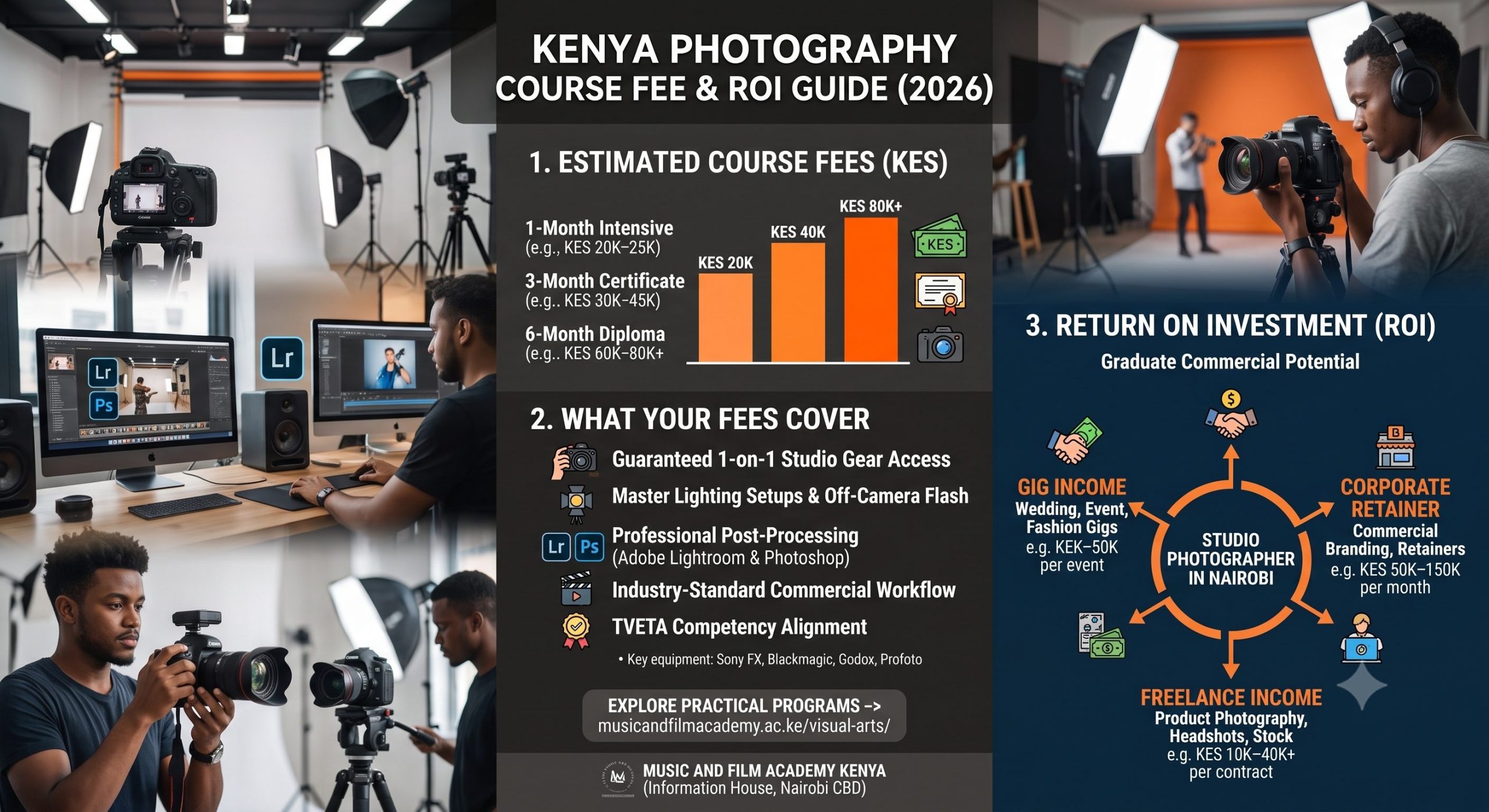
How much does it cost to study photography in Kenya? Studying photography in Kenya costs between KES 15,000 and KES 120,000+, depending on program depth, duration, and equipment access. Short 1-month intensive bootcamps average KES 25,000 to KES 50,000, 3-month practical certificate programs cost KES 36,000 to KES 80,000, and comprehensive 2-year professional diplomas range from KES 120,000 to KES 280,000+.
At Music and Film Academy in Nairobi CBD, practical photography courses start at KES 20,000, featuring 1-on-1 access to studio lighting setups, DSLR/mirrorless camera gear, and Adobe post-processing suites without hidden equipment rental fees.
Photography course tuition varies based on whether you enroll in a short practical skill-up module, a structured certificate, or a multi-year academic diploma.
| Course Tier | Average Duration | Market Price Range (KES) | Music & Film Academy Rates (KES) |
| 1-Month Intensive / Workshop | 4 Weeks | KES 25,000 – KES 50,000 | KES 30,000 |
| 3-Month Basic Certificate in Photography | 12 Weeks | KES 36,000 – KES 80,000 | KES 39,000 |
| 3-Month Advanced Certificate in Photography | 12 Weeks | KES 60,000 – KES 90,000 | KES 39,000 |
| 1–2 Year Diploma | 3–6 Terms | KES 120,000 – KES 280,000+ | 39,000 per Term |
When comparing photography institutions across Nairobi, fee differences are driven by four core factors:
Low-cost programs (~KES 15,000) often teach pure theory or require students to share one camera across large groups. Premium practical academies include dedicated studio lighting gear (off-camera flash, Godox/Profoto strobes, softboxes) and guaranteed hands-on time with full-frame DSLR and mirrorless camera bodies during class sessions.
Professional photography involves post-processing. Quality training includes hands-on instruction in Adobe Lightroom Classic, Photoshop, and Capture One. Check whether tuition covers access to high-spec editing suites or if you must purchase software separately.
Institutions operating under TVETA-aligned competency standards ensure curricula match actual market demands—preparing students for commercial advertising, fashion, event, and editorial photography rather than outdated academic theory.
Suburban campuses often incur higher transport costs for students. Learning in central locations like the Nairobi CBD (Information House, Hakati Road) allows easy access to studio shoots, outdoor street photography locations, and equipment suppliers.
Before enrolling in any photography school in Kenya, confirm if your quoted fees cover all operational expenses:
The Kenyan creative market offers strong earning potential for skilled visual storytellers. Commercial day rates for event photography in Nairobi range from KES 15,000 to KES 50,000 per gig, while corporate retainer packages range between KES 50,000 and KES 200,000 per month.
Graduating from an intensive 3-month or 6-month practical program allows students to build an active commercial portfolio and recover their total tuition fees within their first few commercial contracts.
No, having your own camera is recommended but not mandatory for beginner modules. Music and Film Academy provides access to in-house cameras and lighting gear during practical sessions.
Yes, most practical institutions allow flexible payment structures, such as a deposit upon enrollment followed by structured monthly installments across the term.
Practical certificate courses do not require specific minimum KCSE grades. A passion for visual storytelling, basic digital literacy, and dedication to practical assignments are the primary entry requirements.
Master manual camera controls, commercial studio lighting, and color grading at Music and Film Academy in Nairobi CBD.