Videography vs. Film Production: Which Course to Study in Kenya? (2026 Selection Guide)
If you are planning to join the visual media industry in Kenya, deciding between videography and film production is one of the most critical choices you will make. While both fields involve working with digital cinema cameras, studio lighting, audio gear, and editing software, they serve completely different career tracks, set environments, production scales, and tuition investment models.
Choose Videography if: You want to master commercial camera mechanics, continuous LED lighting, field audio, 3-axis gimbals, 9:16 vertical social reels, and fast timeline editing to quickly monetize your skills shooting corporate promos, weddings, events, live streams, and digital ad campaigns.
Choose Film Production if: You want to write narrative screenplays, direct actors on set, lead multi-department production crews, design dramatic cinema lighting grids, and produce long-form narrative movies, TV drama series, or feature documentaries.
At Music and Film Academy’s School of Visual Arts in Nairobi CBD (Information House, 5th Floor, Room 516, Hakati Road), both training tracks operate in dedicated practical labs under TVETA licensing and NITA certification, backed by a guaranteed 1:1 student-to-gear ratio.
Cinema camera rigs, heavy grip arrays, multi-channel field recorders, studio grids
2. What Is Videography? (Commercial & Fast-Track Focus)
A videography course focuses on teaching single-operator or small-crew workflows designed for quick turnaround commercial production.
Core Focus & Skill Set
Camera Handling & Motion Physics: Operating cinema bodies (Sony FX3/FX6, Blackmagic 6K Pro) in full manual mode, controlling aperture (f-stops), shutter speed (the 180-degree rule—1/50s for 24fps), ISO, false color monitoring, and 10-bit 4:2:2 recording.
Continuous LED Lighting: Setting up continuous COB LED lights (Aputure/Godox), diffusers, softboxes, octaboxes, and C-stands for 3-point interview setups.
Location Audio Engineering: Concealing wireless lavalier microphones on talent, positioning directional shotgun boom mics, gain staging, and capturing clean room tone.
Multi-Platform Post-Production: Editing timeline cuts in Adobe Premiere Pro, color grading flat log profiles (S-Log3, C-Log, D-Log) in DaVinci Resolve Studio, and editing fast 9:16 vertical reels with auto-captions in CapCut Pro.
Duration & Entry Requirements
Duration: 3 Months (12 Weeks).
Tuition: KES 36,000 total (payable in KES 12,000 monthly installments) plus a KES 2,000 registration fee.
Entry Requirement: Open Enrollment (No minimum KCSE grade required).
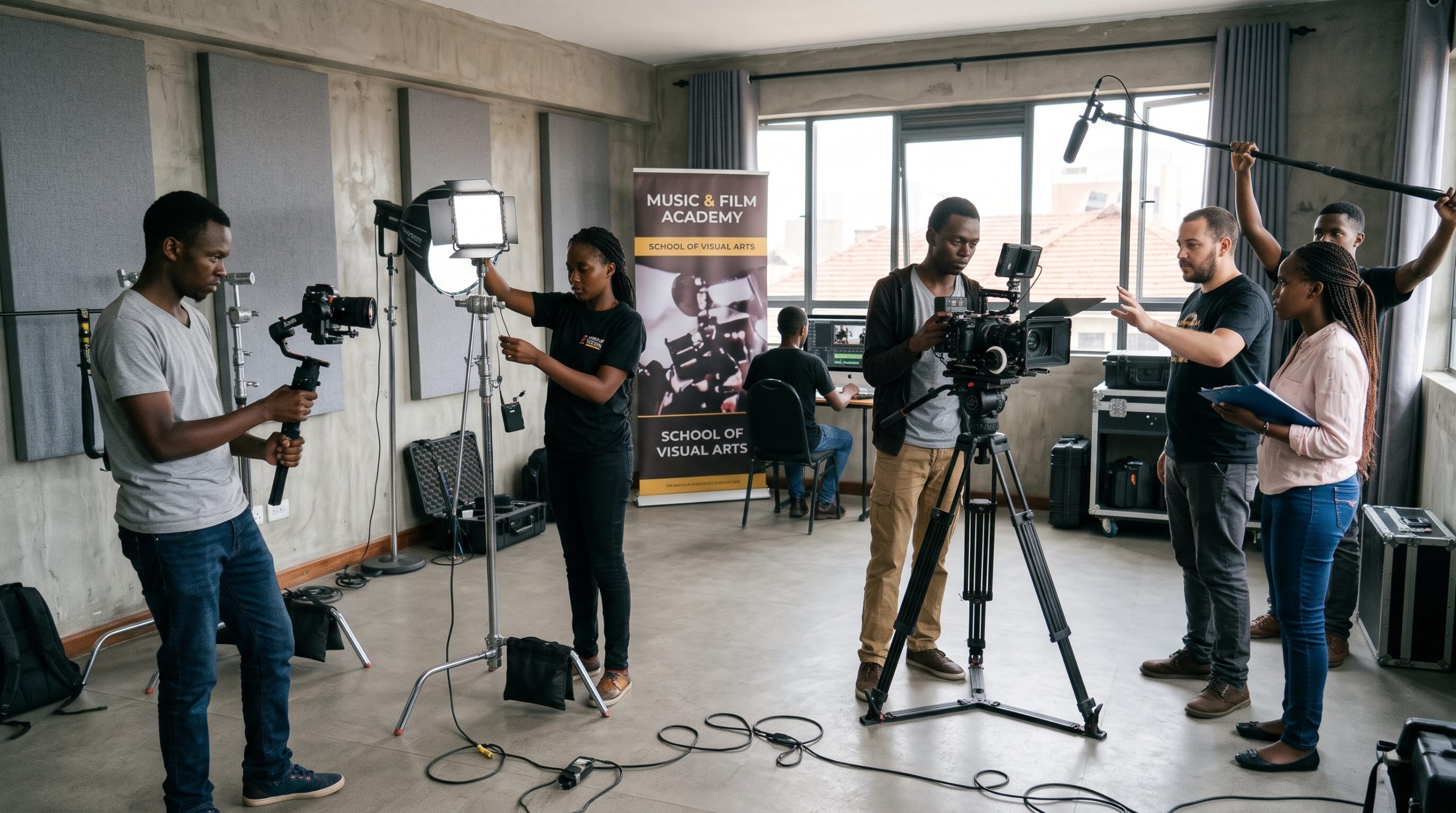
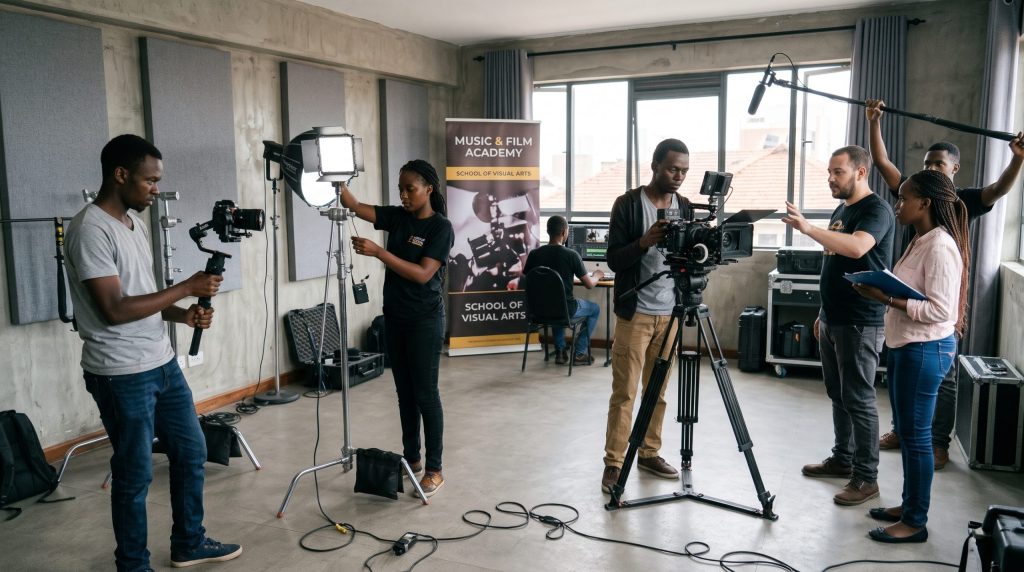
Students exploring the operational differences between commercial videography and narrative film production in the School of Visual Arts studio at Information House, Nairobi CBD.
3. What Is Film Production? (Narrative Cinema & Broadcast Focus)
A film production course focuses on multi-department set dynamics, long-form narrative development, and ensemble production management.
Core Focus & Skill Set
Pre-Production & Directing: Writing narrative screenplays, breaking down scripts, drawing storyboards, casting, and directing actors on set.
Cinematography & Cinema Lighting: Designing dramatic lighting grids, calculating contrast ratios, using cinema prime glass, and shaping daylight with flags and frames.
Set Hierarchy & Production Logistics: Leading structured crew departments (Director, Producer, Director of Photography, Gaffer, Key Grip, 1st AC, Sound Recordist, Continuity Supervisor) under standard industry protocols.
Post-Production & Sound Design: Multi-track dialogue editing, Foley sound layering, cinematic color grading, and mastering files for broadcast, cinema projection, and streaming platforms.
Duration & Entry Requirements
Certificate in Film Production: 1 Year (4 Terms) at KES 39,000 per term. Entry requirement: KCSE Grade D (Plain) or D-.
Diploma in Film Production: 2 Years (8 Terms) at KES 39,000 per term. Entry requirement: KCSE Grade C- (Minus). Includes a mandatory industrial placement attachment.
4. Key Technical & Operational Differences
1. Set Scale: Solo Operator vs. Department Hierarchy
In videography, you are often a “one-person band”—handling camera, audio, lighting, and editing simultaneously. In film production, you specialize within a structured crew hierarchy where every role (Director, Gaffer, Sound Recordist) is handled by a dedicated specialist.
2. Lighting: Continuous LED Arrays vs. Studio Cinema Grids
Videographers rely on portable continuous COB LED arrays for fast setup during corporate interviews or live events. Film production crews use extensive lighting grids, C-stands, flag frames, diffusers, and color gels to craft dramatic narrative moods over long shooting hours.
3. Equipment Provision: 100% Provided On-Campus
Whether studying videography or film production at Music and Film Academy, 100% of production gear is provided on campus under a strict 1:1 student-to-gear policy. Students do not need to buy expensive cinema cameras, lenses, or laptops. You are only required to bring studio monitoring headphones, a notebook, a card reader, and an approved high-speed memory card (SanDisk Extreme Pro 64GB SDXC/MicroSDXC, V30/U3 rating).
5. Career Paths & Expected Earnings in Kenya (2026)
Both disciplines offer strong financial returns across Kenya’s visual media sector, depending on your chosen market niche:
Commercial Videography Pathways
Commercial Director of Photography: KES 50,000 – KES 180,000 per commercial shoot.
Live Stream Broadcast Engineer: KES 40,000 – KES 120,000 per live event.
Aerial Drone Specialist: KES 35,000 – KES 100,000 day rate.
Corporate Visual Media Officer: KES 45,000 – KES 130,000 per month.
Freelance Event Videographer: KES 30,000 – KES 90,000 per event.
Narrative Film & TV Pathways
Feature Film Director / Showrunner: KES 150,000 – KES 500,000+ per project or TV season.
TV Drama Series Producer: KES 80,000 – KES 250,000 per month.
Broadcast Sound Engineer / Location Recordist: KES 50,000 – KES 150,000 per production.
Documentary Filmmaker: KES 100,000 – KES 350,000 per grant/commissioned project.
6. How to Choose Which Course to Study in Nairobi
Ask yourself these three practical questions to decide which course aligns best with your immediate goals:
What type of content do you want to create right now?
If you want to shoot corporate promos, weddings, social reels, church live streams, or YouTube shows: Choose the Certificate in Videography.
If you want to write scripts, direct actors, and work on TV series or movie sets: Choose the TV & Film Production Pathway.
How fast do you need to enter the job market?
If you want to gain commercial skills in 2 to 3 months: Choose Videography.
If you want a comprehensive 1 to 2-year formal diploma qualification: Choose Film Production.
What is your academic entry qualification?
The Certificate in Videography operates under an Open Enrollment policy (No minimum KCSE grade required).
The Film Production Certificate/Diploma requires formal KCSE result slips (Grade D Plain for Certificate, Grade C- for Diploma).
7. Frequently Asked Questions
Can a videographer transition into film production?
Yes. Many successful filmmakers start with a short videography course to master manual camera handling, lighting, and editing basics before moving into long-form narrative directing and scriptwriting.
Do I need a KCSE grade to study a videography course in Kenya?
No. Short vocational tracks like the Certificate in Videography (2 to 3 Months) operate under an Open Enrollment policy with no minimum KCSE grade required. Anyone with passion and dedication can enroll.
Is videography cheaper to study than film production?
Yes. Short videography certificates cost KES 36,000 total across 3 months (KES 12,000/month), whereas multi-term film production diplomas cost KES 39,000 per term over 4 to 8 terms.
Do I need to buy my own camera for classes?
No. Music and Film Academy provides 100% of cinema cameras, lenses, gimbals, lights, audio kits, drones, and editing terminals on campus under a 1:1 equipment policy.
Enroll in Kenya’s Premier Visual Arts Academy
Whether you want to build a profitable commercial videography business or direct narrative feature films, Music and Film Academy’s School of Visual Arts delivers practical, job-ready training on industry-standard equipment in Nairobi CBD.
Campus Location: Information House, 5th Floor, Room 516, Hakati Road, Nairobi CBD