Phone:
+254 719 428 550
Physical address:
Information House, Hakati Road,
Nairobi, Kenya.

Phone:
+254 719 428 550
Physical address:
Information House, Hakati Road,
Nairobi, Kenya.
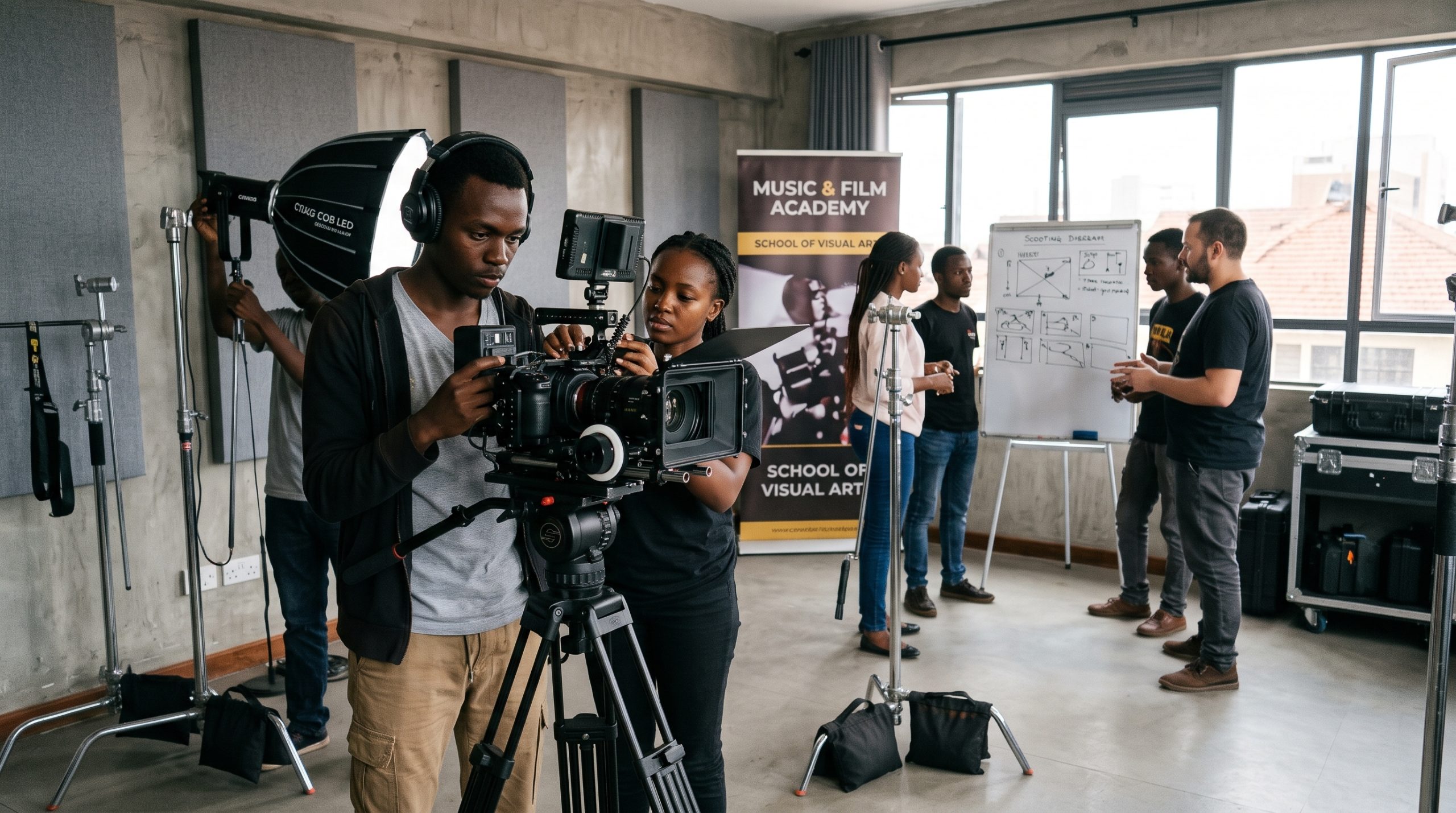
What is videography? Videography is the art, science, and practice of capturing moving images and synchronized audio using digital cameras, lighting arrays, and audio equipment. Derived from the Latin video (“I see”) and the Greek graphē (“drawing”), videography literally means “drawing with moving visuals.”
Unlike traditional still photography (which freezes a single frame) or full-scale Hollywood film production (which relies on massive multi-department crews and multi-million-dollar budgets), modern videography focuses on agile, commercial video creation—producing corporate promos, wedding films, documentary features, live event streams, YouTube content, and social media reels.
At Music and Film Academy’s School of Visual Arts in Nairobi CBD, practical videography training is delivered under TVETA licensing and NITA certification, equipping students with manual camera mechanics, lighting design, field audio recording, and multi-software post-production.
To produce professional video, a videographer must master three essential technical pillars:
Videography relies on continuous temporal movement. Capturing natural motion requires balancing the exposure triangle alongside motion rules:
Unlike still photographers who use instantaneous flash strobes, videographers use continuous LED arrays (COB lights). Lighting setups require managing key-to-fill light ratios, diffusers, octaboxes, C-stands, and modifiers to create depth, mood, and clean 3-point illumination (Key, Fill, Rim).
Audio accounts for 50% of the viewer experience. Professional videographers handle location sound by concealing wireless lavalier microphones on talent, operating directional shotgun boom mics, gain staging, scanning RF frequencies, and capturing room tone.
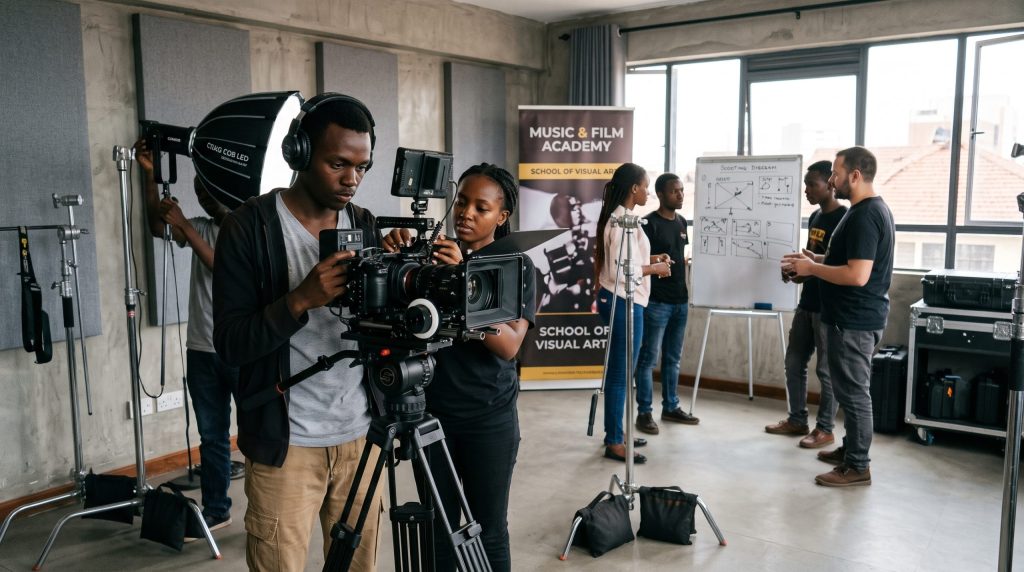
Videography spans multiple commercial niches across Kenya’s growing visual media economy:
| Videography Niche | Primary Focus & Output | Key Hardware Used |
|---|---|---|
| Corporate & Commercial | Brand promos, client testimonials, company profiles, ad campaigns | Sony FX cinema cameras, wireless lavs, 3-point LED arrays |
| Event & Wedding | Multi-cam coverage of high-pressure ceremonies, summits & parties | Dual camera setups, fast zoom lenses, fluid-head tripods, gimbals |
| Social Media & Short-Form | 9:16 vertical reels for TikTok, Instagram, YouTube Shorts, & ads | Smart rigs, mobile/mirrorless bodies, CapCut Pro auto-captions |
| Live Stream & Broadcast | Multi-camera real-time event streaming for churches & corporate summits | Blackmagic ATEM switchers, vMix terminals, NDI/SDI signal routing |
| Aerial & Real Estate | High-resolution architectural showcases, travel & property media | DJI Mavic/Mini drones, optical ND filters, D-Log color science |
| Documentary & Journalism | Non-fiction storytelling, investigative features & interviews | Portable shoulder rigs, directional shotgun booms, continuous panels |
| Music Video Production | Stylized visual storytelling synchronized to audio soundtracks | Motorized 3-axis gimbals (DJI RS4), RGB tube lights, speed ramping |
Shooting raw footage is only half the process. Modern videographers process footage through a dedicated post-production software pipeline:
Building a profitable videography career in Nairobi requires moving beyond self-taught online tutorials into structured, hands-on studio training:
Look for a TVETA-licensed and NITA-certified program that provides hands-on gear access. Music and Film Academy offers an open-enrollment Certificate in Videography (2 to 3 Months / KES 36,000 total, payable monthly) with no minimum KCSE grade required.
Ensure your training institution provides 100% of cinema cameras, gimbals, LED lighting arrays, live switchers, and drones on campus so you gain solo operational confidence without buying expensive equipment upfront.
Add high-income 1-month specialization boot camps in Live Streaming & Broadcast Engineering or Creative Drone Operations to diversify your commercial client offerings.
Graduate with a polished 3-minute commercial director’s showreel and utilize agency attachment placement support to enter Nairobi’s advertising, media, and corporate production networks.
Photography focuses on capturing high-resolution still images using flash strobes and retouching tools like Lightroom and Photoshop. Videography focuses on capturing motion and audio using continuous LED lighting, camera stabilization, NLE timeline editing (Premiere Pro), and color grading (DaVinci Resolve).
Yes. Videography is one of the highest-demand skill sets in Kenya. Corporate firms, NGOs, advertising agencies, event organizers, houses of worship, and digital creators constantly hire skilled videographers, live stream engineers, and drone operators. Professional rates range from KES 30,000 to KES 180,000+ per event or commercial project.
No. Music and Film Academy provides 100% of cinema cameras (Sony FX, Blackmagic), gimbals, lighting kits, wireless audio, live switchers, drones, and editing workstations on campus under a strict 1:1 gear policy. Students only bring studio headphones, a notebook, a card reader, and an approved 64GB Extreme Pro memory card.
Master manual camera operation, cinematic lighting, live streaming, drone execution, and post-production at Music and Film Academy’s School of Visual Arts.