Phone:
+254 719 428 550
Physical address:
Information House, Hakati Road,
Nairobi, Kenya.

Phone:
+254 719 428 550
Physical address:
Information House, Hakati Road,
Nairobi, Kenya.
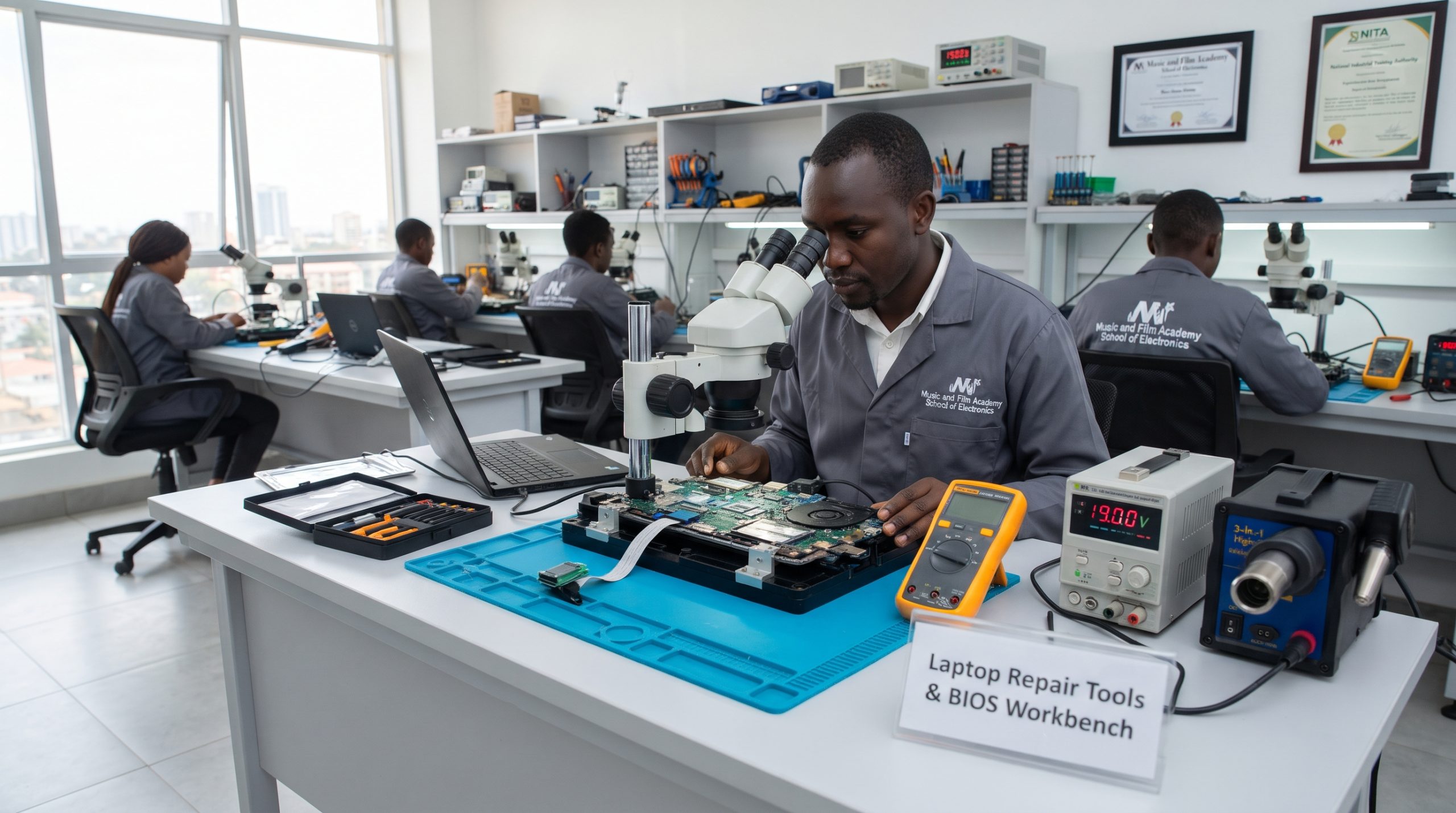
If you are researching what tools do you need to start a laptop repair business in Kenya, you can launch a lean modular repair and OS upgrade bench in Nairobi or any Kenyan town for KES 10,000 to KES 15,000 using precision magnetic screwdrivers, ESD-safe pry tools, a digital multimeter, and bootable USB/NVMe diagnostic drives—or equip a complete motherboard & BIOS micro-soldering workshop (adding a 2-in-1 hot-air rework station, 30V/5A DC bench power supply, CH341A/RT809F SPI BIOS programmer, and stereo microscope) for KES 25,000 to KES 68,000. At Music and Film Academy’s School of Electronics in Nairobi CBD (Information House, Hakati Road), trainees require zero tools before enrolling: every student in our 3-month Certificate in Laptop & Computer Repair (KES 39,000 total / KES 13,000/month) works solo at a dedicated 1:1 commercial workstation and completes a guided Nairobi CBD wholesale sourcing session in Module 8 before spending a shilling on equipment.
Buying uncalibrated tools—or purchasing chip-level rework gear before learning how to read 19V power-rail schematics—drains startup capital unnecessarily. Separating Day-One essentials from Phase-2 board-level upgrades lets you fund advanced tools out of early repair profits.
The table below reflects typical retail and wholesale price ranges across Nairobi CBD suppliers (including Luthuli Avenue, Moi Avenue, Kimathi Street, and River Road electronics hubs):
| Tool / Equipment Item | Role on the Laptop Repair Bench | Typical Nairobi Price (2026 / 2027) | Priority Tier |
| Precision Magnetic Screwdriver Kit (e.g., Jakemy / UGREEN / Promate 32-to-115-in-1 with Torx T5/T8, Phillips & Pentalobe) | Safely removing bottom-cover, heatsink, fan, and MacBook pentalobe screws without stripping heads | KES 1,000 – KES 4,000 | Tier 1 (Day-One Core) |
| ESD-Safe Anti-Static Mat, Wrist Strap, Tweezers & Nylon Spudgers | Grounding static electricity to protect PCH/CPU chips and prying fragile eDP screen/battery connectors | KES 1,500 – KES 3,500 | Tier 1 (Day-One Core) |
| True-RMS Digital Multimeter (Voltage, Continuity, Diode & Resistance Modes) | Testing laptop chargers (19V/20V), battery cells, CMOS batteries, fuses, and shorted power rails | KES 1,800 – KES 4,500 | Tier 1 (Day-One Core) |
| Bootable USB Flash Drives (32GB/64GB) + SATA/NVMe M.2 USB Enclosure | Installing Windows 10/11, macOS, and Linux, running hardware diagnostics, and cloning client SSDs | KES 2,000 – KES 3,800 | Tier 1 (Day-One Core) |
| Thermal Paste, Isopropyl Alcohol (99% IPA), Solder Wire, Wick & No-Clean Flux | Resolving overheating/thermal throttling, cleaning liquid-spill corrosion, and preparing solder joints | KES 1,500 – KES 2,800 | Tier 1 (Consumables) |
| 2-in-1 Digital Hot-Air Rework & Temperature-Controlled Soldering Station | Desoldering/replacing DC-in jacks, USB-C ports, shorted 19V input MOSFETs, and 8-pin SPI BIOS chips | KES 7,500 – KES 15,000 | Tier 2 (Board-Level) |
| Regulated DC Bench Power Supply (30V / 5A) with Laptop DC Tips | Powering motherboards without a battery to spot short circuits instantly via standby/boot current draw | KES 5,500 – KES 11,000 | Tier 2 (Board-Level) |
| SPI BIOS / EEPROM Hardware Programmer (CH341A + SOIC8 Test Clip or RT809F) | Reading, backing up, and reflashing corrupted .bin BIOS firmware on no-display laptops | KES 1,200 – KES 2,500 (CH341A) KES 11,000 – KES 14,500 (RT809F) | Tier 2 (Firmware / BIOS) |
| Stereo / Trinocular Inspection Microscope | Inspecting hairline PCB trace breaks, green corrosion, and fine-pitch multi-I/O (EC/KBC) controller pins | KES 18,000 – KES 38,000 | Tier 3 (Advanced B2B) |
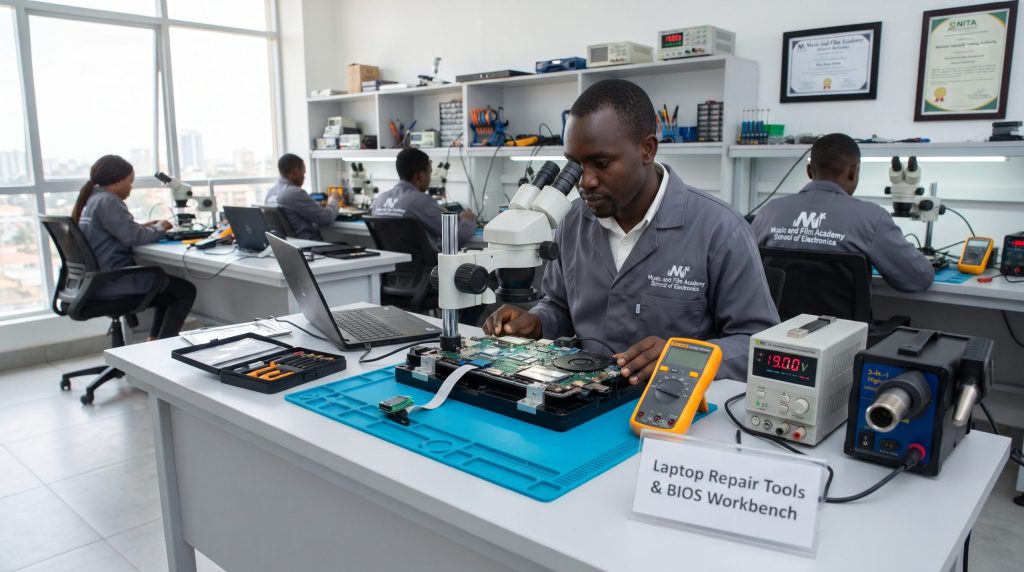
You can scale your repair shop in three realistic stages depending on your starting capital:
~KES 12,000) — Best for Low-Capital LaunchIf you are launching from home, an existing cybercafé, or a shared computer stall, start with:
KES 1,500) + ESD mat, wrist strap, spudgers & tweezers (KES 1,000)KES 2,000) + temperature-controlled soldering iron (KES 2,500)KES 2,000)KES 1,500) + basic chassis repair epoxy (KES 1,500)~KES 25,000) — Independent Stall StandardOnce you open an independent stall or start accepting dead laptops from corporate clients, upgrade your soldering iron and add:
KES 8,500)KES 6,500)KES 2,000)~KES 68,000) — Subcontracting HubAdding a trinocular stereo zoom microscope (KES 22,000), an RT809F multi-function programmer (KES 13,000), an ultrasonic PCB cleaner (KES 4,500), and a PCB pre-heater & BGA stencil kit (KES 3,500) turns your bench into a regional referral center for other computer shops that lack board-level gear.
At Music and Film Academy’s School of Electronics (Information House, Hakati Road, Nairobi CBD), our 3-month Certificate in Laptop & Computer Repair (KES 39,000 total / KES 13,000/month) provides 100% of your lab equipment on campus—including hot-air stations, multimeters, DC power supplies, stereo microscopes, and BIOS programmers—alongside a guided Nairobi CBD wholesale sourcing session in Module 8.